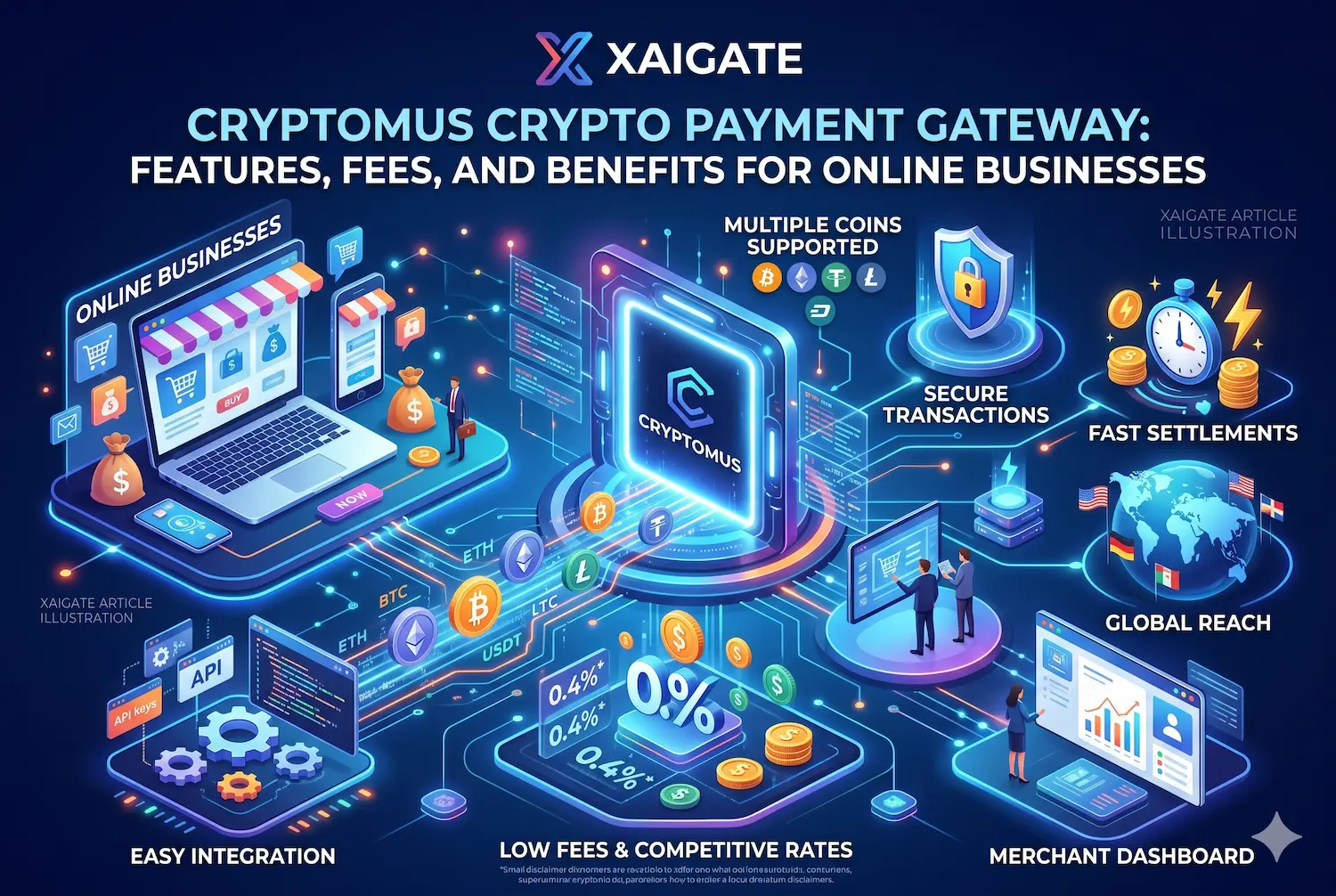
Adding crypto payments to a business can feel like opening a new checkout lane in a crowded store. The opportunity is obvious, but the wrong setup creates friction, delays, and extra cost. That is why many merchants searching for a Cryptomus crypto payment gateway are not just looking for another processor. They want a tool that is simple to integrate, affordable to run, and practical for real operations. For online businesses that want faster global payments, lower chargeback exposure, and more flexible settlement options, Cryptomus has become a name worth evaluating. Explore the details with XAIGATE in the article below.
What Is Cryptomus Crypto Payment Gateway and How Does It Work?
At its core, Cryptomus is a crypto payment gateway built for businesses that want to accept digital assets online. It promotes features such as global coverage, instant transactions, zero chargebacks, volatility protection, transaction status management, and mass payouts. For merchants, that combination matters because crypto acceptance is rarely only about adding one more payment button. It is about running a cleaner payment flow with fewer reversals and broader customer reach.
Overview of Cryptomus crypto payment gateway for merchants
Cryptomus is positioned for merchants that want to accept crypto on websites, ecommerce stores, and digital service platforms. Its ecosystem includes hosted payment flows, API access, and integrations for common CMS and store platforms. Official materials also highlight support for more than 20 CMS options, which makes it easier for non-enterprise merchants to get started without a heavy custom build.
How crypto payment processing works in real-world transactions
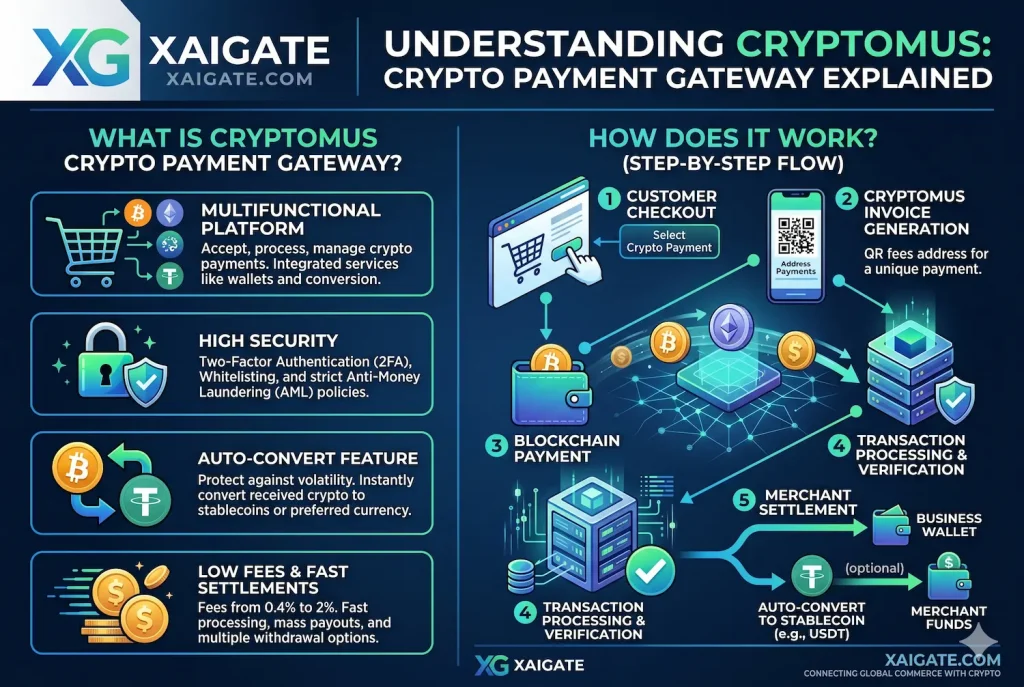
In a normal transaction, a customer selects crypto at checkout, receives a payment invoice or wallet destination, completes the transfer on-chain, and the merchant receives confirmation through the gateway. The business then tracks payment status, records the order, and either keeps the crypto or converts it according to its treasury preferences. Cryptomus emphasizes instant transactions and status management, which are important for businesses that need a more predictable checkout experience and cleaner reconciliation.
Key use cases: ecommerce, SaaS, and digital services
The strongest fit is usually with businesses that already sell online and serve cross-border buyers. Ecommerce brands, SaaS companies, hosting services, agencies, freelancers, and digital product sellers often care most about speed, payment flexibility, and reduced chargeback risk. Cryptomus also markets recurring-payment support and mass payouts, which can be useful for subscription services, affiliate systems, and partner disbursements.
See more: How to Reduce Crypto Payment Gateway Fees
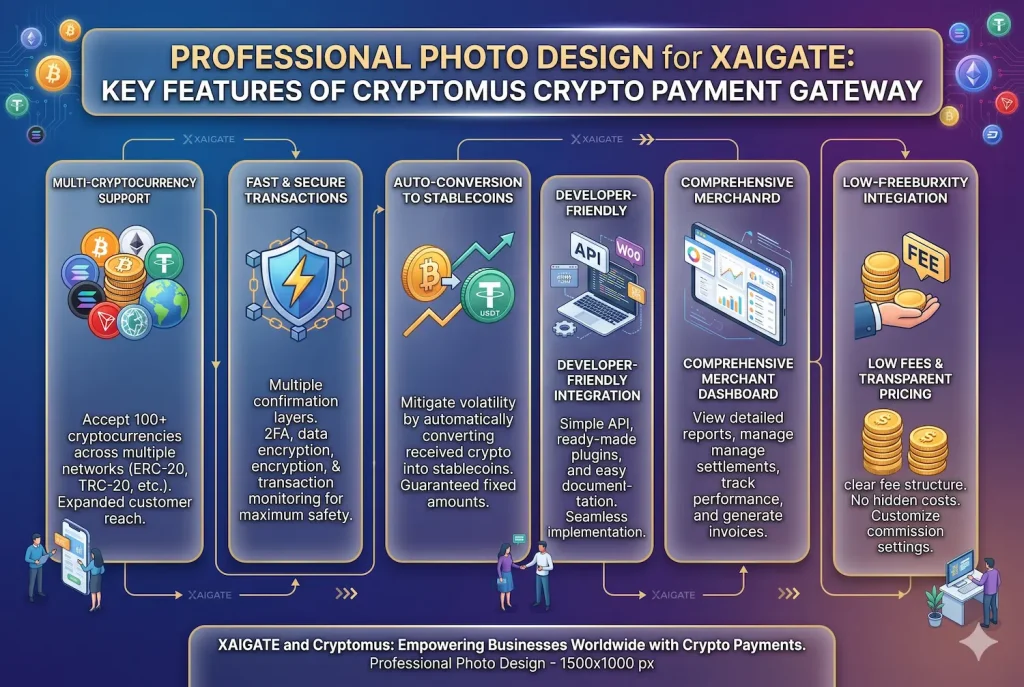
Key Features of Cryptomus Crypto Payment Gateway
For decision-makers, features only matter when they improve cost control, operational flow, or buyer conversion. Cryptomus stands out less as a theoretical crypto tool and more as a merchant operations product. Its feature set is designed to answer the questions businesses ask before integration: how much will this cost, how fast can we deploy it, and how much risk does it remove?
Low transaction fees and cost efficiency for businesses
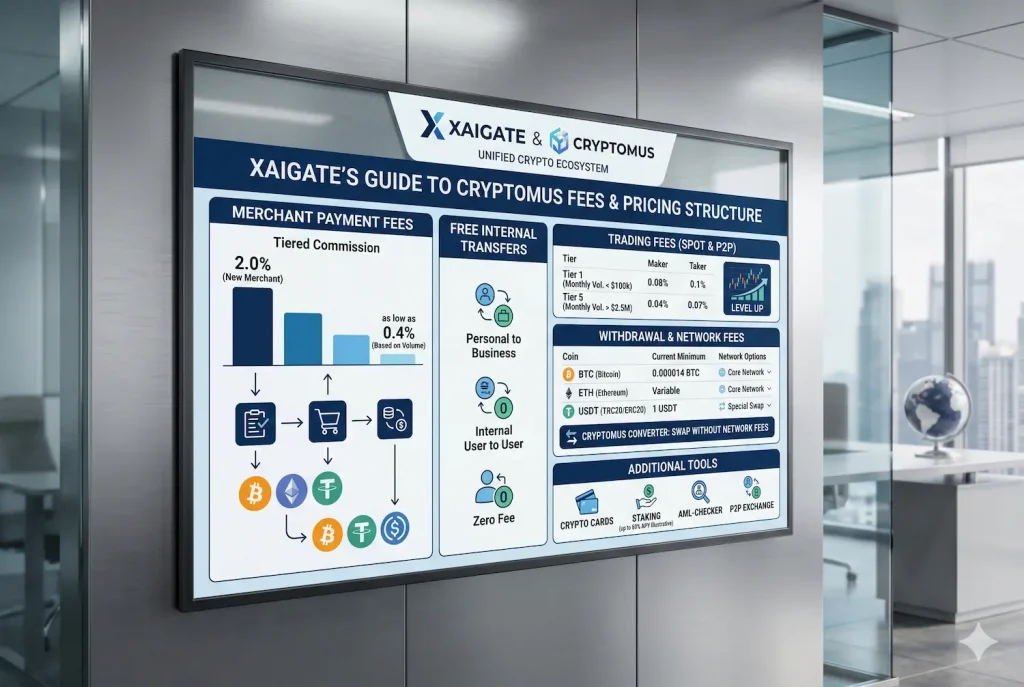
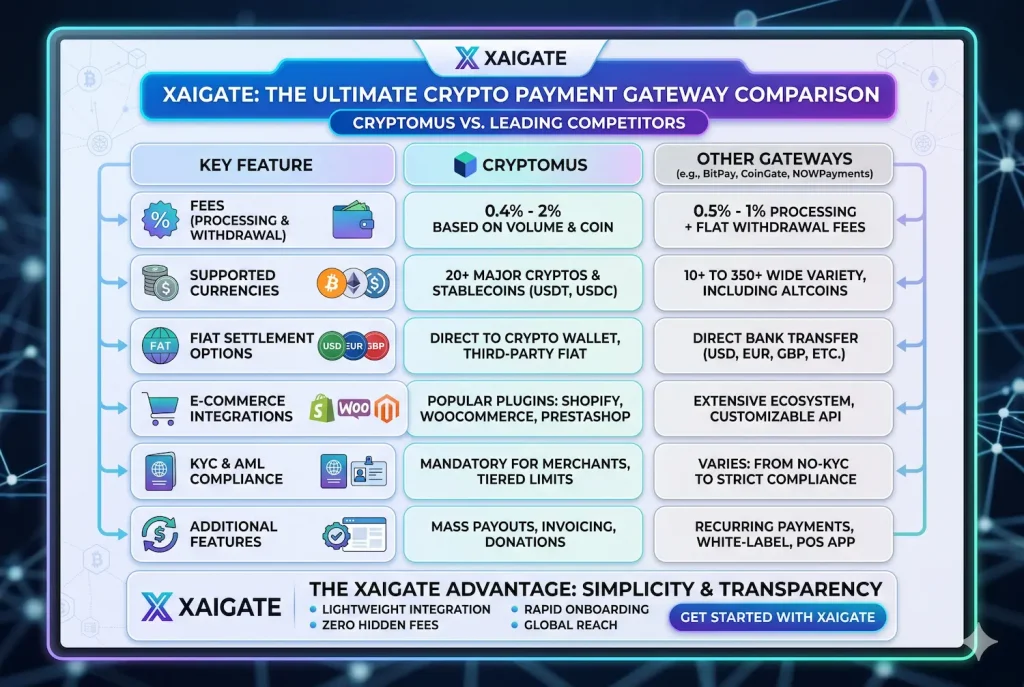
One reason the Cryptomus crypto payment gateway gets attention is pricing. According to Cryptomus fee information, new users may see a 2% commission per transaction, while negotiated pricing can go as low as 0.4%. That range means merchants need to look closely at their expected volume and commercial terms rather than assume one universal rate. Even so, the lower end is highly competitive compared with many established payment options.
Wide cryptocurrency support and stablecoin payments
For merchants, broad coin acceptance is not just a technical feature. It directly affects conversion. The more payment options customers see, especially major assets and stablecoins, the easier it becomes to reduce cart abandonment from crypto-native buyers. Cryptomus also highlights automatic conversion into stablecoins through volatility protection, which is useful for businesses that want crypto acceptance without taking full market exposure onto their balance sheet.
API, plugins, and easy integration for ecommerce platforms
Integration speed is one of the biggest buying triggers in this category. Cryptomus promotes API access and support for ecommerce plugins and CMS systems, including WooCommerce, PrestaShop, WHMCS, OpenCart, and more. For a business owner, that matters because the real cost of a gateway is not only the transaction fee. It is also the implementation burden, maintenance time, and operational complexity after launch.
Security, privacy, and zero chargeback advantage
Traditional card payments carry a built-in reversal risk. Crypto gateways appeal to many merchants because blockchain payments are structurally different. Cryptomus explicitly promotes zero chargebacks, which can be attractive for digital goods, global sales, and categories that often face dispute pressure. It also references security measures such as AML controls and two-factor authentication in its broader materials.
Cryptomus Fees and Pricing Structure
Before choosing any gateway, merchants should compare pricing in context rather than in isolation. A platform with a low headline fee can still create friction through conversion costs, network costs, or limited settlement options. The better question is whether the total commercial model supports your average order value, gross margin, and international payment mix.
Transaction fees and hidden cost considerations
Cryptomus states that incoming payment fees can start from 0.4%, while standard new-user pricing can be 2% per transaction. That suggests pricing flexibility based on account conditions or negotiated arrangements. Merchants should still verify exactly how rates apply to their account, whether conversion settings change economics, and how blockchain network costs are handled in practice.
Comparison with other crypto payment gateways
The fee picture becomes clearer when placed next to alternatives. NOWPayments lists 0.5% for payments without exchange and 1% for multicurrency payments. CoinGate lists a 1% merchant processing fee. BitPay uses a tiered model ranging from 1% to 2% plus a fixed 25-cent fee per transaction, depending on monthly volume. In that landscape, Cryptomus can be very competitive at the low end, but less attractive if a merchant remains on higher default pricing.
| Gateway | Stated Merchant Fee | Notes |
| Cryptomus | 2% for new users, up to 0.4% on negotiated terms | Flexible pricing model |
| NOWPayments | 0.5% without exchange, 1% with exchange | Strong altcoin coverage |
| CoinGate | 1% | Simple flat merchant fee |
| BitPay | 1%–2% + $0.25 per transaction | Volume-based pricing |
Cost optimization for growing merchants
The smartest way to evaluate Cryptomus is to model your own payment mix. A merchant with international buyers, high card-processing pain, or strong stablecoin demand may find the gateway cost-effective even before reaching the lowest pricing tier. A low-margin store with small ticket sizes, however, should test how gateway fees interact with network costs and settlement choices.
Benefits of Using Cryptomus Crypto Payment Gateway for Businesses
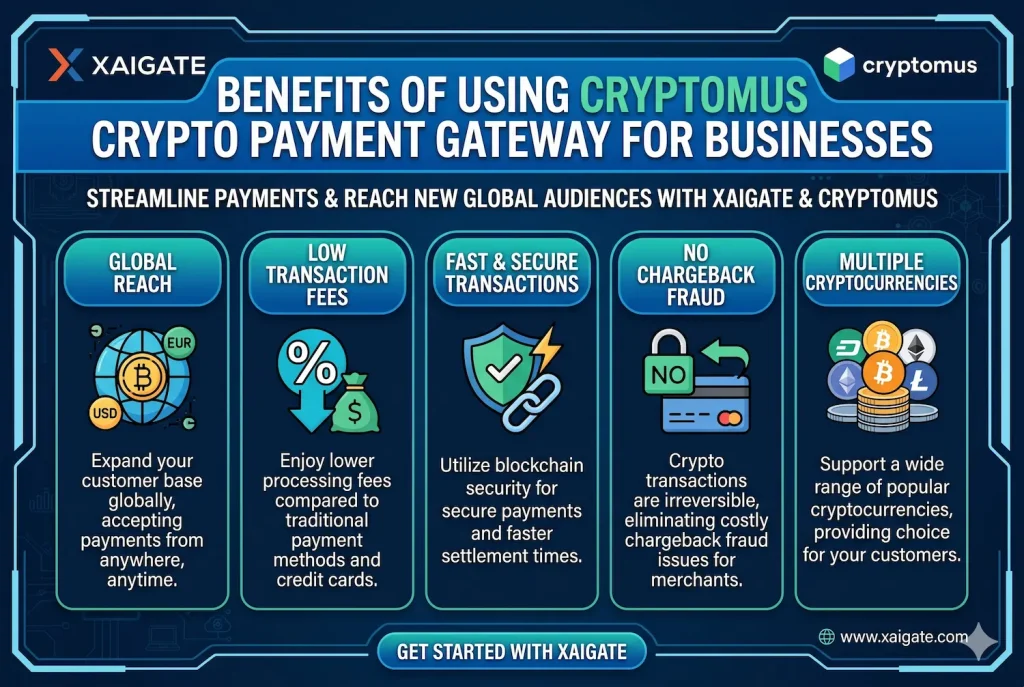
A gateway should not be judged only by features on a landing page. It should be judged by what it improves in the business. For many merchants, the real value of crypto acceptance appears in speed, buyer reach, settlement flexibility, and payment resilience.
Faster transactions and broader global payment access
Cryptomus markets instant transactions and global coverage, both of which align with what online-first businesses need. Crypto payments can be particularly attractive when customers are international, underbanked, or simply more willing to pay in digital assets than through card rails. For merchants entering global markets, that flexibility can expand addressable demand.
Reduced volatility risk with stablecoin conversion
One common objection to crypto acceptance is price fluctuation. Cryptomus addresses that directly through volatility protection and automatic conversion into stablecoins. For businesses, this changes the conversation from speculative asset exposure to controlled payment intake. That makes crypto more usable as a revenue channel rather than just an experimental option.
Better checkout experience for crypto-native customers
A checkout flow that matches customer preference usually converts better than one that forces a traditional method. If your audience already uses BTC, ETH, or stablecoins, adding crypto checkout reduces friction. It can also strengthen brand relevance in sectors where digital assets are already part of the buying culture.
See more: Fiat to Crypto Payment Gateway 2026 – Secure, Fast & Compliant Business Solutions
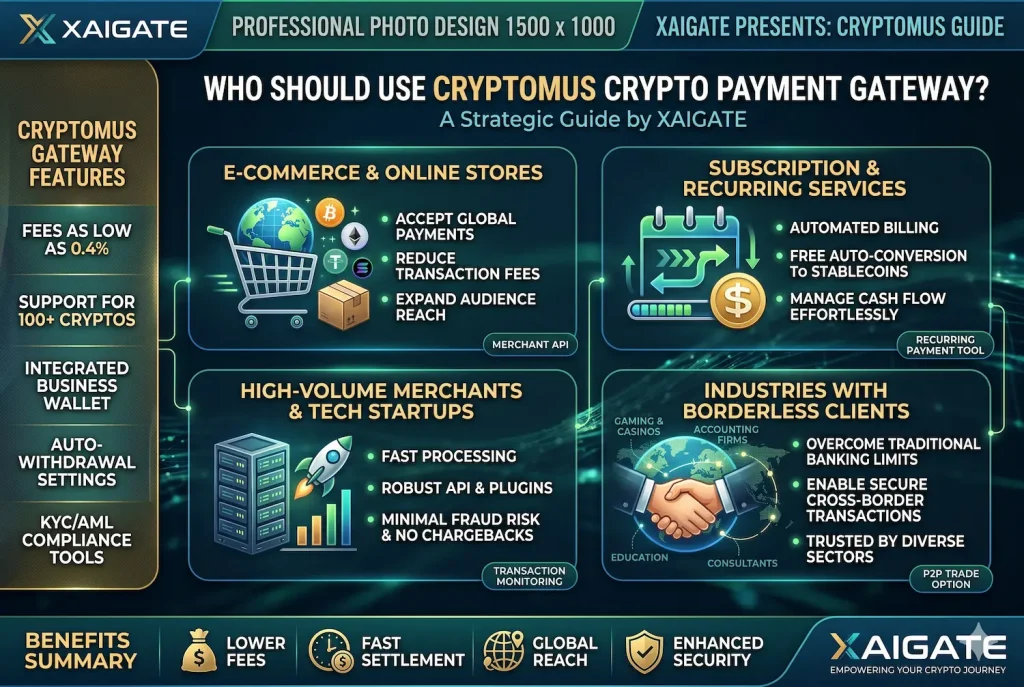
Who Should Use Cryptomus Crypto Payment Gateway?
Not every company needs a crypto processor, but several business models can benefit quickly.
- Ecommerce stores with global traffic: Brands selling across borders often need more flexible payment acceptance and fewer issues tied to regional card coverage.
- SaaS and subscription businesses: If your customers are digital-first and geographically distributed, crypto can add another predictable payment route.
- Digital services and freelancers: Agencies, consultants, and creators may value faster settlement and easier international billing.
- Higher-risk or dispute-sensitive categories: Businesses that suffer from card reversals may find zero-chargeback payment rails especially useful.
Cryptomus vs Other Crypto Payment Gateways
A smart merchant rarely asks whether Cryptomus is good in absolute terms. The real question is where it fits against alternatives.
- Cryptomus vs NOWPayments: NOWPayments is attractive for merchants wanting straightforward 0.5% to 1% pricing and broad crypto support. Cryptomus may appeal more when negotiated pricing, volatility tools, or specific operational features align better with the business.
- Cryptomus vs CoinGate: CoinGate offers a simple 1% merchant fee and a more regulation-forward positioning. Cryptomus can look stronger for merchants prioritizing lower potential pricing and broader merchant workflow features.
- Cryptomus vs BitPay: BitPay remains a strong enterprise-recognized option, but its tiered fee structure plus fixed transaction charge may be less appealing to smaller merchants. Cryptomus may be a better fit where flexibility and lower negotiated rates matter more than legacy brand recognition.
Conclusion
The Cryptomus crypto payment gateway is a practical option for businesses that want to accept crypto without turning payments into a complicated infrastructure project. Its appeal comes from a strong merchant value proposition: potentially competitive fees, integration flexibility, stablecoin-oriented risk control, mass payout support, and zero-chargeback positioning. The best fit is usually an online business with international buyers, digital delivery, or a real need for alternative checkout methods. If your goal is to expand payment choice while keeping operations lean, Cryptomus deserves a serious place on your shortlist.
For daily updates, subscribe to XAIGATE’s blog!
We may also be found on GitHub, and X (@mxaigate)!
FAQs – Cryptomus Crypto Payment Gateway
1. What is Cryptomus crypto payment gateway?
It helps businesses accept cryptocurrency payments online.
2. Who should use Cryptomus?
Ecommerce, SaaS, agencies, freelancers, and digital services.
3. Does Cryptomus support stablecoins?
Yes, it supports stablecoins and volatility protection.
4. What are Cryptomus fees?
Fees may range from 0.4% to 2% per transaction.
5. Does Cryptomus support plugins?
Yes, it supports ecommerce plugins and CMS integrations.
6. Can Cryptomus support API integration?
Yes, merchants can use APIs for custom payment flows.
7. Does Cryptomus reduce chargebacks?
Yes, it promotes zero-chargeback crypto payments.
8. Can Cryptomus support recurring payments?
Yes, recurring payments are useful for subscriptions.
9. Does Cryptomus support mass payouts?
Yes, mass payouts help affiliates, partners, and teams.
10. What should merchants compare first?
Compare fees, coins, plugins, settlement, payouts, and support.