Selling online used to mean choosing between reach and friction. You could expand into new markets, but each extra market added more payment fees, more settlement delays, and more failed transactions. In 2026, that tradeoff is harder to accept. Ecommerce businesses need faster cash flow, wider customer access, and lower payment overhead at the same time. That is why the ecommerce businesses crypto payment gateway conversation is moving from curiosity to strategy. A well-built crypto gateway is no longer just a trend feature. It is becoming a practical tool for stores that want to grow globally without making checkout more complex. Explore the details with XAIGATE in the article below.
What Is a Crypto Payment Gateway for Ecommerce Businesses?
A crypto payment gateway helps an online store accept digital assets at checkout, then route settlement based on the merchant’s preferred setup. For ecommerce teams, the value is not just the ability to accept crypto. It is the ability to turn blockchain payments into an operationally usable payment flow.
How crypto payment gateways work in online stores
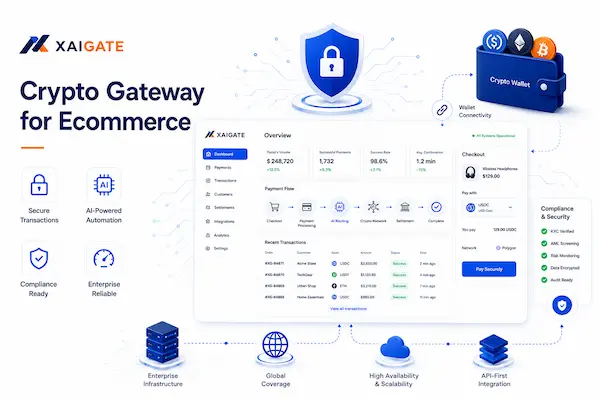
In a standard ecommerce flow, the customer chooses crypto at checkout, receives a wallet address or payment request, sends the payment, and waits for blockchain confirmation. After confirmation, the gateway notifies the store and triggers fulfillment or order confirmation. Depending on the provider, settlement can remain in crypto or convert into fiat or stablecoins for easier treasury handling. Stripe’s guidance on crypto payments describes this model around confirmation, irreversibility, and settlement infrastructure.
- Checkout request: The gateway creates a payment request tied to the order amount and currency.
- Blockchain confirmation: The payment is verified on-chain before the order is marked as paid.
- Merchant settlement: Funds can be held in crypto, converted into stablecoins, or routed into fiat depending on the gateway model.
Difference between traditional and crypto payment processing
Traditional online payments rely on banks, card networks, acquirers, and dispute systems. Crypto payment gateways reduce the number of intermediaries in the payment path. That matters because card-based systems often include chargeback exposure, cross-border costs, and longer settlement windows, while confirmed crypto transactions are generally irreversible. Stripe and Coinbase both position crypto payments around lower fees, global reach, and no chargebacks for merchants.
Types of crypto gateways: custodial vs non-custodial
Some gateways are custodial, meaning the provider controls wallet infrastructure and often simplifies merchant operations. Others are non-custodial, which gives the merchant more control over funds and wallet ownership. The right model depends on risk appetite, internal finance processes, and the level of control the business wants over settlement and custody. For many ecommerce brands, the decision is less about ideology and more about speed, simplicity, and compliance readiness.
See more: Top Crypto Payment Gateways 2026: Best Options for Global Merchants
Key Benefits of Crypto Payment Gateways for Ecommerce Businesses
The real reason to consider crypto payments is not novelty. It is performance. Ecommerce operators care about cost, checkout efficiency, and market expansion. A good gateway directly affects all three.
Lower transaction fees and no chargebacks
Card disputes create direct losses, admin work, and revenue uncertainty. Stripe notes that chargebacks can trigger additional fees for merchants, while confirmed crypto payments are irreversible and do not follow the same chargeback logic. That changes the economics of online selling, especially for stores handling international or high-risk transactions.
- Lower processing overhead: Crypto rails can reduce reliance on costly traditional payment layers.
- No chargeback exposure on confirmed transactions: This helps protect margin and reduces operational workload.
- Better revenue predictability: Finance teams can forecast net receipts more accurately when dispute risk drops.
Borderless payments for global ecommerce expansion
Cross-border growth is attractive until payments become the bottleneck. Stablecoin and crypto infrastructure is now being framed by major payments players as a way to lower costs, reduce FX friction, and improve access to funds across markets. For ecommerce brands selling internationally, this creates a more flexible route to accept payments from customers who prefer digital assets or face local banking limitations.
Faster settlements and improved cash flow
Slow settlement can trap working capital. Stripe’s recent stablecoin and crypto resources emphasize faster access to funds and shorter settlement cycles compared with many legacy cross-border methods. For an ecommerce business, that can improve inventory planning, supplier payments, and marketing spend efficiency. Faster settlement is not just a finance benefit. It supports growth execution.
Access to new crypto-native customers
WooCommerce and major crypto payment providers consistently position crypto acceptance as a way to reach new customer segments and support international growth. That matters because some buyers actively prefer paying in crypto, while others use stablecoins as a practical alternative to unstable local currencies or limited card access. Adding crypto does not replace traditional checkout. It expands the store’s payment coverage.
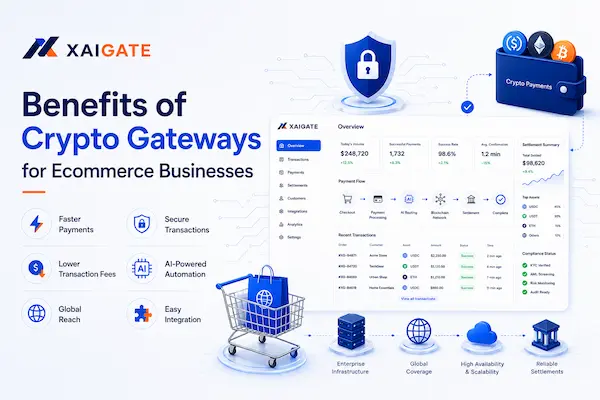
Challenges Ecommerce Businesses Must Consider When Accepting Crypto
The upside is real, but strong implementation matters. Ecommerce businesses should assess risk and process design before adding a new payment rail.
- Price volatility and risk management: Volatile assets can distort margins if the business holds them too long. Stablecoins and auto-conversion features help reduce this issue by keeping value closer to fiat expectations.
- Regulatory and compliance concerns: Crypto payment rules vary by region, and compliance requirements can affect onboarding, reporting, and settlement options. This is one reason businesses should choose a gateway with strong compliance processes and clear merchant support.
- Integration complexity with ecommerce platforms: The more custom the store setup, the more important clean plugins, APIs, and documentation become. Ecommerce teams should not adopt a gateway that creates checkout friction or excessive developer dependency. Shopify maintains a wide ecosystem of integrated gateways, while WooCommerce also supports crypto payment extensions.
- Customer adoption and UX friction: Not every buyer wants to use crypto. The crypto option should sit alongside standard methods, not disrupt them. The goal is better payment flexibility, not forcing a new behavior on all customers.
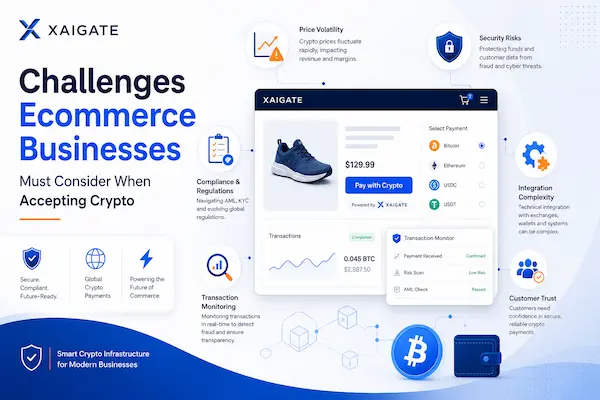
Must-Have Features in a Crypto Payment Gateway for Ecommerce
A crypto gateway only works for ecommerce if it fits daily operations. Decision-makers should evaluate features through the lens of conversion, finance control, and platform compatibility.
Multi-currency support including stablecoins
Wide asset support increases flexibility, but stablecoin support is especially important. Stablecoins give merchants the efficiency of crypto rails with more predictable value. That is why business-focused payment content in 2026 increasingly emphasizes stablecoins for cross-border commerce and treasury use.
Seamless integration with ecommerce platforms
A strong gateway should support platforms such as Shopify, WooCommerce, and custom ecommerce stacks through plugins or developer-ready APIs. Integration should be fast, stable, and well documented. Shopify’s payment gateway ecosystem and WooCommerce’s crypto extensions show how central integration has become for merchant adoption.
Automatic conversion to fiat or stablecoins
Auto-conversion protects cash flow and reduces exposure to volatile price swings. For many ecommerce businesses, this is not an optional feature. It is the setting that makes crypto acceptance manageable for accounting and treasury teams.
Security, compliance, and settlement visibility
Merchants need transaction tracking, settlement reporting, wallet security, and clear compliance workflows. The gateway should make order reconciliation easier, not harder. Payment visibility is one of the main reasons businesses choose managed infrastructure over handling direct wallet payments alone.
See more: Top commercial benefits of crypto payment gateways
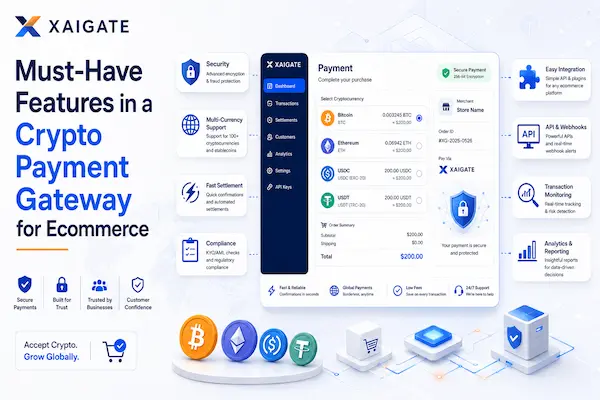
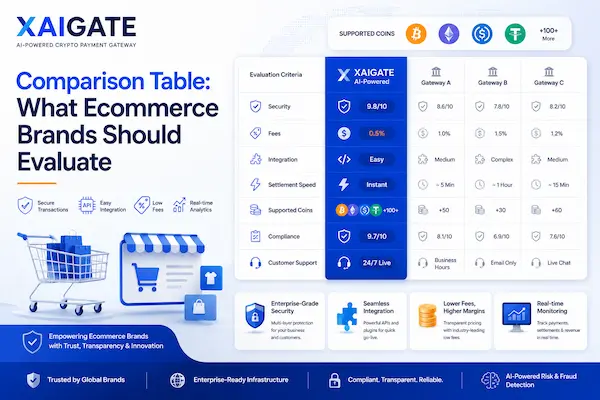
Comparison Table: What Ecommerce Brands Should Evaluate
Before choosing a provider, ecommerce teams should compare capabilities through an operations lens.
| Evaluation area | Why it matters for ecommerce | What to look for |
| Supported assets | Expands payment flexibility | Major coins + strong stablecoin coverage |
| Settlement options | Protects cash flow and margin | Crypto, stablecoin, or fiat settlement |
| Platform integration | Reduces launch time | Shopify, WooCommerce, API support |
| Transaction costs | Affects profitability | Transparent fees and conversion costs |
| Chargeback exposure | Protects revenue | Irreversible confirmed payments |
| Compliance support | Reduces legal and onboarding friction | KYC, merchant vetting, reporting support |
| Checkout UX | Impacts conversion rate | Fast, clear, mobile-friendly payment flow |
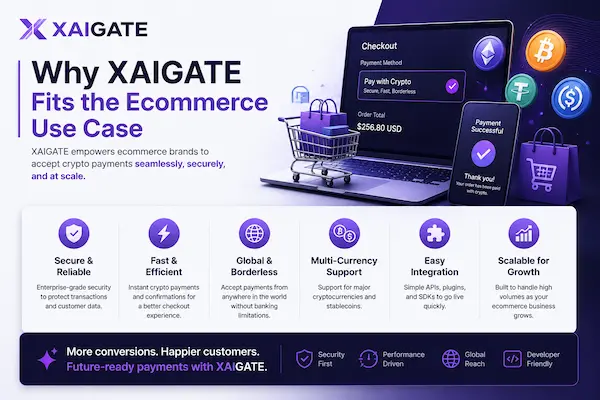
Why XAIGATE Fits the Ecommerce Use Case
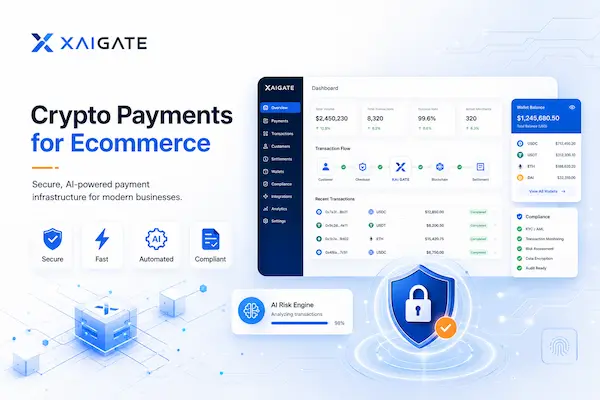
For ecommerce brands, the ideal gateway is not the one with the most technical complexity. It is the one that helps the business accept crypto payments without adding payment chaos. XAIGATE can position itself around the needs that matter most to merchants: flexible integration, efficient settlement, broad digital asset support, and a checkout flow built for online conversion.
That positioning is strong because ecommerce businesses do not need abstract blockchain language. They need a gateway that helps them sell globally, reduce payment friction, and keep finance operations under control. In that context, the ecommerce businesses crypto payment gateway decision becomes less about experimentation and more about infrastructure.
Conclusion
In 2026, the answer is increasingly yes. Ecommerce businesses need payment systems that support international growth, improve cash flow, and lower avoidable payment costs. Crypto gateways are gaining attention because they address those goals in a practical way: lower fee pressure, no chargebacks on confirmed payments, faster settlement, and broader customer reach.
For merchants that want to compete across borders without turning checkout into a bottleneck, a crypto gateway is no longer a niche add-on. It is a serious commerce tool. The right solution should make crypto payments easier to manage, easier to integrate, and easier to scale. That is exactly why the ecommerce businesses crypto payment gateway topic deserves a place in every serious ecommerce growth strategy.
Start with XAIGATE today and explore a faster, more scalable way to accept crypto payments for your ecommerce business.
For daily updates, subscribe to XAIGATE’s blog!
We may also be found on GitHub, and X (@mxaigate)!
FAQs – Ecommerce Businesses Crypto Payment Gateway
1. What is an ecommerce businesses crypto payment gateway?
It lets online businesses accept crypto payments at checkout.
2. Why should ecommerce businesses accept crypto?
Crypto helps reduce payment friction and reach global buyers.
3. Can ecommerce stores accept stablecoins?
Yes, stablecoins help reduce crypto price volatility.
4. Can crypto payments reduce chargebacks?
Yes, confirmed crypto payments are generally irreversible.
5. Do crypto gateways support faster settlement?
Yes, they can improve cash flow with faster settlement.
6. Can crypto gateways integrate with ecommerce platforms?
Yes, many support plugins, APIs, and hosted checkout.
7. What platforms should merchants check?
Shopify, WooCommerce, Magento, OpenCart, and custom stores.
8. Is compliance still important?
Yes, merchants should review KYC, reporting, and local rules.
9. Is XAIGATE suitable for ecommerce businesses?
Yes, it supports crypto checkout, settlement, and integration tools.
10. What should ecommerce merchants check first?
Check fees, coins, settlement, plugins, compliance, and checkout UX.