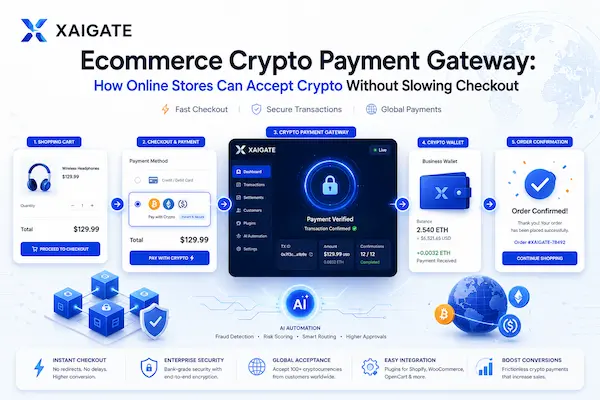
Adding a new payment method often feels like renovating a busy store during business hours. Every change promises growth, yet every extra step can also weaken checkout speed, buyer trust, and conversion. That is why an ecommerce crypto payment gateway matters. It is not just a crypto feature for trend-driven brands. It is a practical payment layer that helps online stores accept digital assets without rebuilding the entire checkout experience. For merchants that want broader payment choice, smoother cross-border selling, and a modern checkout stack, the right gateway can turn crypto from a technical burden into a scalable revenue channel. Explore the details with XAIGATE in the article below.
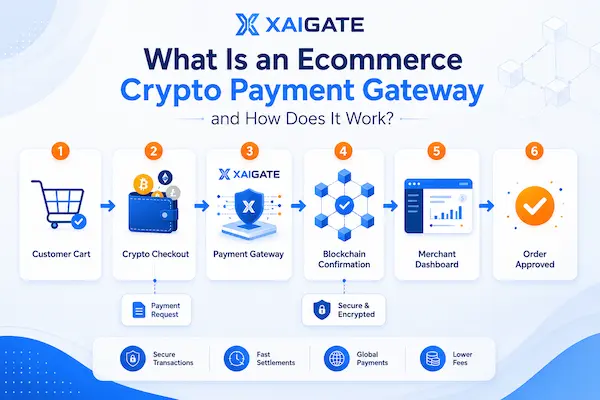
What Is an Ecommerce Crypto Payment Gateway and How Does It Work?
An ecommerce crypto gateway sits between your online store and the blockchain payment flow. Its job is to make crypto payments usable for normal commerce operations, not just for wallet-savvy users.
The role of a crypto payment gateway in online checkout
An ecommerce crypto payment gateway helps merchants accept digital assets through a structured checkout process. Instead of asking your team to manually monitor wallets, confirm transactions, and reconcile orders, the gateway automates those steps inside a merchant-ready flow. It creates payment requests, tracks confirmations, and feeds payment status back into the store so orders can move through fulfillment with less friction.
For ecommerce teams, this matters because the checkout must stay clear and predictable. The customer needs a simple way to pay. The merchant needs reliable payment data. The gateway connects those two needs in one payment layer.
How the payment flow works from cart to settlement
The flow is usually straightforward. A shopper adds products to the cart, chooses crypto at checkout, and receives a payment request with the right amount and destination details. After the blockchain transaction is detected and confirmed, the gateway updates payment status so the store can process the order. Some providers also support settlement options that let merchants receive crypto or convert value through supported business workflows. BitPay, for example, positions its service around crypto checkout with fiat settlement options, while NOWPayments highlights API-based payments, invoices, subscriptions, and fiat withdrawal capabilities for businesses.
Crypto gateway vs traditional payment gateway for ecommerce
A traditional gateway is built around card networks and bank-based rails. A crypto gateway is built around blockchain-based payment acceptance. The business question, however, is similar in both cases: can the merchant accept payment quickly, track transaction status clearly, and move orders forward without confusing the buyer?
The difference is that crypto gateways can help ecommerce brands serve customers who prefer digital assets, especially in cross-border contexts where payment choice affects conversion. They also introduce new operational choices around wallet handling, supported coins, settlement preferences, refunds, and compliance workflow. That means merchants should evaluate crypto gateways as part of their broader checkout infrastructure, not as an isolated add-on.
Why Ecommerce Businesses Are Adding Crypto Payment Gateway Options
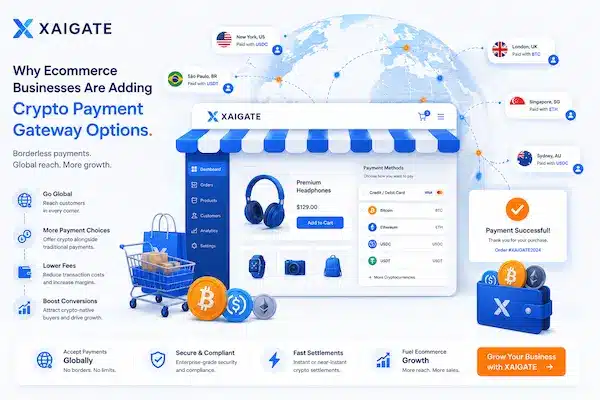
More ecommerce brands are looking at crypto payments because the value is practical. The strongest use case is not hype. It is payment flexibility that supports new customers and new markets.
Reaching global customers with borderless payments
Online stores often lose demand when shoppers cannot use their preferred payment method. Crypto can reduce that barrier for some international buyers, especially in digital commerce, cross-border retail, and crypto-native customer segments. That is one reason providers such as CoinGate frame their ecommerce offer around online stores, plugins, and payment APIs built for business adoption.
For a merchant, the opportunity is clear. Broader payment access can mean broader revenue reach. An ecommerce crypto gateway becomes useful when it helps you serve buyers beyond your default banking and card footprint.
See more: Why Use a Crypto Payment Gateway: Key Advantages You Should Know
Offering more payment choice without complicating the store
Adding payment methods only helps when checkout stays simple. If crypto introduces extra friction, unclear instructions, or trust issues, it will not support growth. Strong gateways solve this by presenting crypto as another structured payment option rather than a separate technical journey.
That is why hosted checkout pages, ready-made plugins, and merchant dashboards matter so much. They reduce implementation complexity on the business side and keep the front-end buying experience easier to understand.
Supporting growth in crypto-native customer segments
Some customer groups actively prefer to pay in Bitcoin, stablecoins, or other digital assets. This is especially relevant for digital products, online services, SaaS, global commerce, and brands targeting tech-forward audiences. For those segments, offering crypto is less about novelty and more about matching customer payment behavior.
The best approach is not to replace existing methods. It is to add a controlled alternative that fits naturally into the checkout mix.
Key Features to Look for in an Ecommerce Crypto Payment Gateway
Choosing the right provider depends less on branding and more on operational fit. Merchants should compare the features that directly affect speed, scalability, and day-to-day usability.
Ecommerce plugins for Shopify, WooCommerce, Magento, and beyond
For many stores, plugin availability is the fastest path to launch. Providers such as BitPay, CoinGate, and NOWPayments all emphasize ecommerce integrations, plugins, or extensions for common store setups. CoinGate highlights ready-made ecommerce plugins and extensions, while BitPay documentation points merchants to plugin-based setup with major ecommerce hosts. NOWPayments also promotes plugins for platforms such as WooCommerce, Magento 2, OpenCart, WHMCS, Ecwid, PrestaShop, Shopify, and Shopware.
If your business runs on a mainstream platform, plugin support should be one of the first filters in your shortlist.
API, hosted checkout, and no-code integration options
Not every ecommerce business uses the same architecture. Some need a no-code setup. Others need hosted checkout to move fast. Larger teams may need API control to align payment flows with custom order logic, notifications, or account systems.
BitPay documents direct API implementation, code libraries, and ecommerce use cases. CoinGate presents both APIs and plugin-based options. NOWPayments positions its API, widgets, invoices, subscriptions, and business tools as part of a flexible integration stack.
A good rule is simple: choose the lightest integration model that still supports your operational needs.
Multi-coin support, settlement flexibility, and business scalability
Supported assets influence customer reach. Broader coin coverage can help merchants serve more buyers, especially in international or crypto-heavy markets. NOWPayments states support for 350+ cryptocurrencies and promotes tools for widgets, invoices, subscriptions, and payment buttons. BitPay also emphasizes support for major assets and a business flow designed to reduce the burden of holding or managing crypto directly.
Scalability also depends on what happens after payment. Can your team reconcile orders efficiently? Can you support refunds? Can finance manage settlement without manual patchwork? Those questions matter just as much as front-end acceptance.
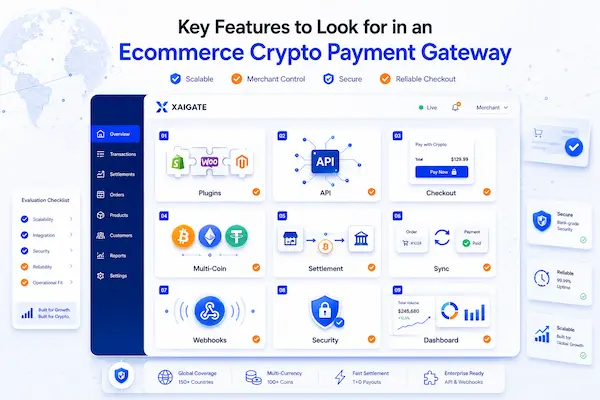
Quick comparison of what merchants should evaluate
| Evaluation area | Why it matters for ecommerce | What to check |
| Platform compatibility | Affects launch speed and maintenance cost | Shopify, WooCommerce, Magento, custom API |
| Integration model | Determines technical workload | Plugin, hosted checkout, widget, API |
| Supported coins | Expands usable payment choice | Major coins, stablecoins, altcoins |
| Settlement workflow | Shapes finance operations | Crypto receipt, payout flow, fiat options |
| Order status sync | Protects fulfillment accuracy | Webhooks, invoice status, merchant dashboard |
| Checkout UX | Impacts conversion | Clear instructions, fast payment flow, trust signals |
See more: Why Businesses Should Use Crypto Payment Gateway: A Complete Guide for Companies
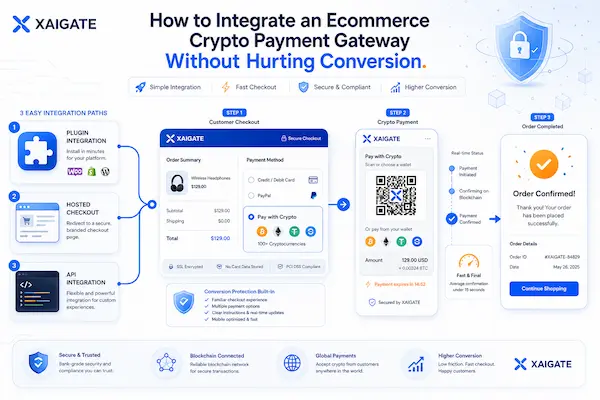
How to Integrate an Ecommerce Crypto Payment Gateway Without Hurting Conversion
Integration should support conversion, not test it. The goal is to add a payment option while protecting the speed and clarity of checkout.
Choosing the right integration path for your store setup
If your store runs on a supported platform, start with a plugin or extension. That usually offers the shortest path to launch. If your team needs more control over order mapping, notifications, or customer experience, API-based integration may be better. Hosted checkout can be the middle ground when you want faster deployment without building every payment screen in-house.
The right choice depends on your tech stack, not on what sounds most advanced.
Keeping the checkout experience simple and trustworthy
Crypto checkout must feel guided. The customer should know what to do, how much to pay, and what happens next. Confusing wallet instructions, poor timing feedback, or unclear payment confirmation can damage trust quickly.
A strong ecommerce implementation uses plain payment instructions, visible status updates, and a seamless handoff back to the store after payment. The user should feel that crypto is simply another checkout method, not a separate system.
Operational considerations before going live
Before launch, merchants should test the entire payment lifecycle. That includes successful payments, expired payment requests, partial payments, order status changes, refund policies, and customer support handoffs. BitPay documentation also highlights webhook notifications for invoice and refund status, which shows how important back-end event handling is for reliable commerce operations.
The smoother your internal process, the smoother the buyer experience will feel.
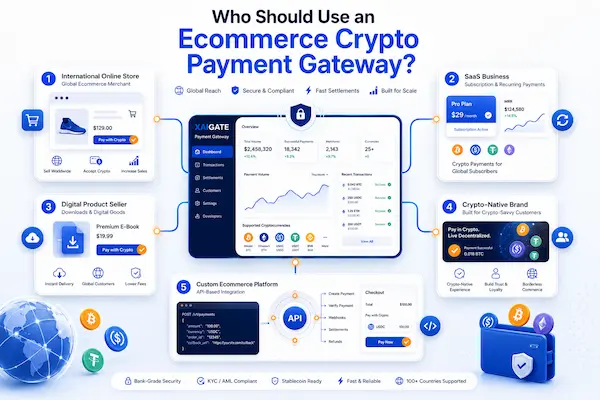
Who Should Use an Ecommerce Crypto Payment Gateway?
Not every store needs crypto immediately, but several business models can benefit sooner than others.
Online stores selling internationally are strong candidates because payment flexibility can support cross-border demand. Digital product sellers and SaaS businesses are also a natural fit because they often serve global buyers and work with fast-moving online checkout flows. Merchants targeting crypto-aware audiences may see additional upside because payment preference itself can influence whether a transaction starts or ends.
Brands with lean tech teams should prioritize plugin-first gateways. Brands with custom architecture should prioritize APIs, webhook support, and clean payment status logic.
Conclusion
The right ecommerce crypto payment gateway does more than let customers pay with digital assets. It helps online stores expand payment choice, support global buyers, and keep checkout efficient. That is the real business value.
Merchants should evaluate gateways based on integration fit, checkout simplicity, settlement workflow, and operational clarity. When those elements align, crypto becomes a usable part of ecommerce growth rather than a technical distraction.
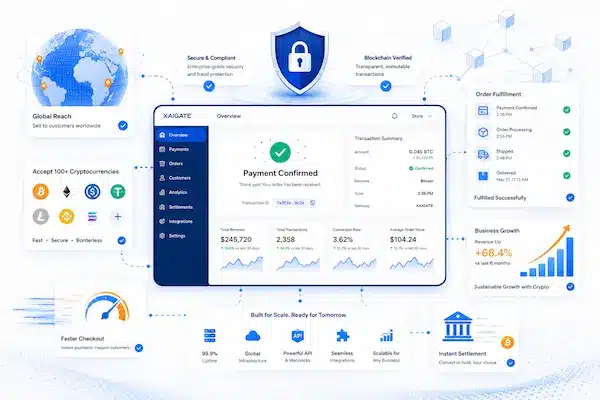
If your store is exploring crypto payments, choose a solution built for commerce execution, not just transaction processing. XAIGATE can turn that next step into a cleaner, faster, and more scalable move for your online business.
For daily updates, subscribe to XAIGATE’s blog!
We may also be found on GitHub, and X (@mxaigate)!
FAQs – Ecommerce Crypto Payment Gateway
1. What is an ecommerce crypto payment gateway?
It lets online stores accept crypto payments at checkout.
2. How does crypto checkout work?
Customers choose crypto, pay a request, and the store receives status updates.
3. Why should online stores accept crypto?
Crypto can support global buyers and new payment preferences.
4. Can crypto checkout hurt conversion?
Yes, if instructions, timing, or confirmation steps are unclear.
5. What integration option is easiest?
Plugins are usually easiest for mainstream ecommerce platforms.
6. When should stores use API integration?
Use APIs for custom checkout, order logic, and advanced workflows.
7. Why are webhooks important?
They update order status after payment confirmation.
8. Can stores accept stablecoins?
Yes, stablecoins can reduce volatility for ecommerce payments.
9. Are crypto refunds possible?
Yes, but stores need a clear refund workflow.
10. What should merchants check first?
Check plugins, coins, fees, settlement, UX, and support.