Adding crypto payments to your business can feel like installing a new door in a building that is already busy, profitable, and carefully secured. The opportunity is clear, but one poor decision can create friction for customers, finance teams, and compliance workflows. That is why learning how to set up a crypto payment gateway matters far beyond simple technical integration. When the setup is done correctly, your business can accept digital assets smoothly, reduce cross-border payment friction, and create a checkout experience that supports modern customer expectations without disrupting existing operations. Explore the details with XAIGATE in the article below.
Contents
- 1 What Is a Crypto Payment Gateway and How Does It Work?
- 2 What You Need Before You Set Up a Crypto Payment Gateway
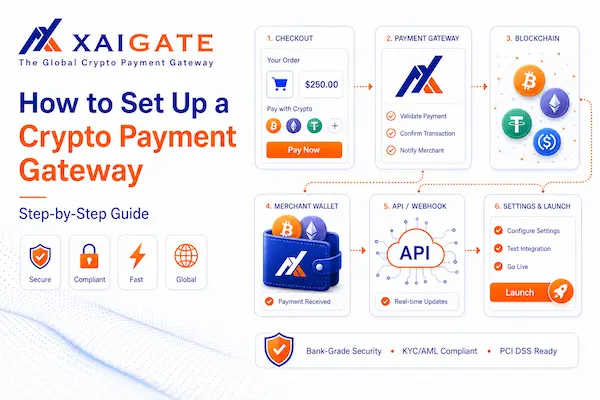
- 3 How to Set Up a Crypto Payment Gateway Step by Step
- 4 Security, Compliance, and Risk Controls You Should Not Skip
- 5 Common Mistakes When Setting Up a Crypto Payment Gateway
- 6 FAQs – How to Set Up a Crypto Payment Gateway
- 7 Conclusion
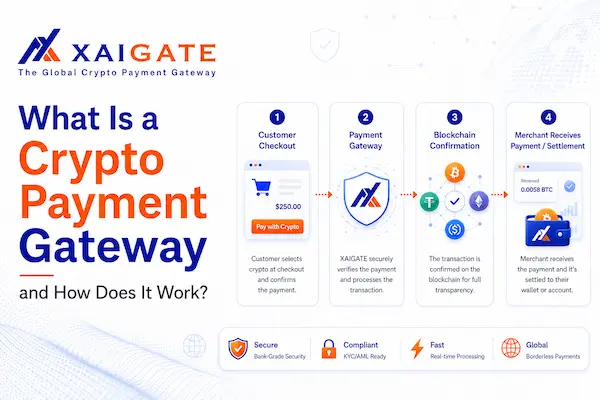
What Is a Crypto Payment Gateway and How Does It Work?
Before you move into configuration, you need a clear view of how a crypto gateway fits into your checkout, settlement, and transaction monitoring process.
What a crypto payment gateway does in the checkout flow
A crypto payment gateway acts as the transaction layer between your customer, your website or app, and the blockchain network used for payment. Instead of asking your team to manually verify incoming transfers, the gateway automates invoice creation, wallet routing, payment detection, and confirmation tracking. This makes crypto payment processing more reliable and easier to manage at scale.
To understand the role clearly, focus on the core actions below:
- Creates a payment request: The gateway generates a checkout invoice with the correct amount, supported coin, wallet destination, and time limit for payment.
- Monitors blockchain activity: It watches the selected network and detects whether the customer has sent the funds correctly and on time.
- Updates order status automatically: Once confirmation conditions are met, it marks the order as paid, pending, or failed inside your system.
Key components you need before setup
A successful setup depends on more than adding a payment button to your site. You need a small but complete operational stack that supports payment acceptance, transaction tracking, and merchant reconciliation. This is where many businesses underestimate the real work behind how to integrate a crypto payment gateway into production workflows.
Your basic setup should include the following elements:
- Merchant account: This gives you access to the dashboard, API credentials, reporting tools, and settlement settings.
- Wallet or payout destination: You need a secure location for receiving crypto or converted funds after each completed payment.
- Integration method: This could be a plugin, hosted checkout page, or direct crypto payment gateway API connection.
- Webhook events: These push transaction updates into your order system so finance and operations can respond accurately.
Crypto gateway vs traditional payment gateway
A traditional payment gateway processes card or bank payments through centralized financial rails, while a crypto gateway handles blockchain-based transactions with different risks and settlement logic. The biggest differences involve chargebacks, confirmation timing, custody choices, and exchange-rate exposure. These distinctions matter when designing merchant crypto payments for real business use.
The comparison usually comes down to these operational differences:
- Chargeback model: Card payments can be reversed, while blockchain payments are generally irreversible after confirmation.
- Settlement structure: Traditional processors settle through banks, while crypto gateways can settle in coins, stablecoins, or converted fiat.
- Transaction visibility: Blockchain transactions are transparent and traceable, but confirmation speed depends on network activity and fee conditions.
See more: Why Use a Crypto Payment Gateway: Key Advantages You Should Know
What You Need Before You Set Up a Crypto Payment Gateway
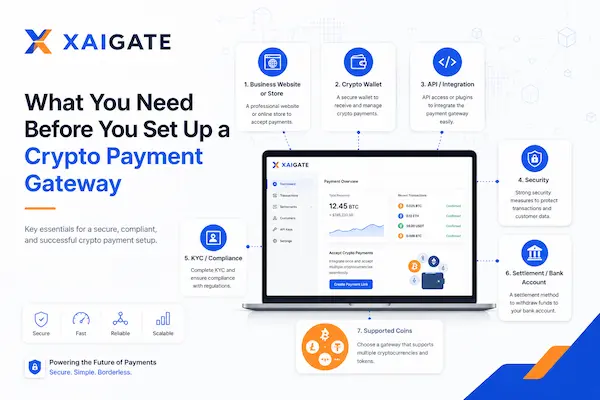
Good setup starts before any technical integration begins. You need business rules first, because your payment architecture should serve revenue, operations, and risk control together.
Define your business goals and payment use cases
The right gateway setup depends on what you want crypto payments to achieve. Some businesses want a new checkout option for international buyers, while others need faster B2B settlement or lower friction for digital products. If you skip this planning stage, you may choose the wrong provider, the wrong coins, or the wrong user flow for your market.
Start by defining the most relevant use cases:
- Ecommerce checkout: Useful when you want to accept crypto payments for business through a product page, cart, or mobile app.
- Invoices and B2B billing: Practical for service providers that need faster settlement and easier cross-border collection.
- Subscriptions or recurring flows: Important for SaaS models, although these often require more specialized logic and wallet behavior.
Choose which cryptocurrencies and networks to support
You do not need to accept every available asset on day one. A focused launch is often more efficient because it simplifies customer choice, treasury management, and internal reporting. Many merchants begin with major assets and stablecoins, then expand later when demand becomes clearer and operations become more mature.
Use these selection criteria to guide the rollout:
- Customer demand: Prioritize coins your audience already uses rather than building around market hype.
- Network cost and speed: Some blockchains are faster and cheaper, which improves conversion during checkout.
- Treasury stability: Stablecoins are often the easiest path when you want predictable value and smoother accounting.
Decide how you want to receive settlements
Settlement strategy is one of the most important decisions in how to set up a crypto payment gateway. It affects accounting, treasury exposure, liquidity, and operational risk. Some merchants want to hold crypto for strategic reasons, while others prefer stablecoin or fiat conversion to avoid volatility and simplify cash-flow planning.
Your main settlement options usually include:
- Receive the original coin: Best for businesses comfortable managing digital assets and price fluctuations.
- Convert into stablecoins: A balanced option that preserves blockchain settlement while reducing exposure to major volatility.
- Convert into fiat: Useful for companies that need conventional accounting and bank-based expense management.
How to Set Up a Crypto Payment Gateway Step by Step
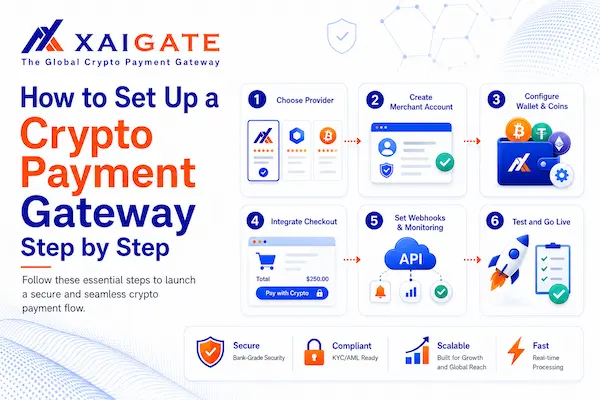
This is the core setup path. Each step should be treated as both a technical action and a business control decision.
Step 1 – Choose the right crypto payment gateway provider
Provider selection shapes your entire payment experience, from user interface and dashboard quality to supported coins, payout flexibility, and compliance readiness. The best option is not always the one with the lowest fee. It is the one that fits your transaction model, customer geography, and technical resources without adding unnecessary complexity.
When reviewing providers, compare these areas carefully:
- Integration options: Check whether the platform supports plugins, hosted pages, or API-based crypto payment gateway integration.
- Settlement features: Review whether you can receive coins directly, convert automatically, or route funds by currency.
- Operational visibility: Strong dashboards, logs, notifications, and reconciliation tools reduce manual work after launch.
Step 2 – Create your merchant account and complete verification
After selecting a provider, create your merchant account and configure the business profile with complete and accurate information. This stage often includes verification steps, internal approvals, and access control assignments for different team members. A clean crypto merchant account setup reduces delays later when payouts, compliance checks, or support cases appear.
At this stage, your checklist should include:
- Business information: Add legal entity details, operating region, website, and transaction use case.
- Team permissions: Give finance, operations, and technical users the right level of access from the beginning.
- Verification readiness: Prepare the company documents needed for KYC or KYB reviews if your provider requires them.
Step 3 – Configure wallets, payout settings, and accepted currencies
Once the account is active, connect your wallet or payout destination and define the exact assets you want to accept. This is where treasury policy meets technical execution. Your wallet setup should support security, clear fund movement, and easy auditability rather than simple convenience alone.
Build this stage around three configuration priorities:
- Wallet structure: Use secure wallet management with clear ownership, controlled access, and role separation.
- Accepted assets: Start with a focused list of coins and networks that match your market and internal capability.
- Payout logic: Decide whether your merchant balance settles as crypto, stablecoins, or converted funds.
Step 4 – Integrate the gateway into your website or app
Integration can be simple or highly customized depending on your platform. Ecommerce stores often use plugins, while SaaS products and custom platforms usually prefer direct API implementation. The best integration is the one that preserves a clean checkout experience while making transaction states easy to monitor inside your internal systems.
The most common integration paths are:
- Plugin-based setup: Ideal for platforms like Shopify or WooCommerce where speed and simplicity matter most.
- Hosted checkout page: Good for businesses that want fast deployment without deep development work.
- Direct API integration: Best for custom products that need branded flows, advanced logic, or flexible backend control.
See more: Why Businesses Should Use Crypto Payment Gateway: A Complete Guide for Companies
Step 5 – Set up webhooks, order status, and transaction monitoring
A payment is not truly integrated until your order system responds correctly to every transaction state. Webhooks connect blockchain payment events to order processing, customer notifications, and finance reconciliation. Without this layer, even a functioning checkout can create expensive operational confusion.
Your monitoring workflow should cover the following areas:
- Status mapping: Define how pending, paid, expired, underpaid, and failed invoices behave inside your system.
- Internal alerts: Notify the right teams when a payment is delayed, mismatched, or completed.
- Audit logging: Keep a structured record of invoice creation, confirmations, and settlement actions for support and accounting.
Step 6 – Test the payment flow before going live
Testing protects your revenue and your brand reputation. You need to verify the full payment journey, not just the happy path. That includes wrong amounts, expired invoices, slow confirmations, and webhook timing issues. Strong testing makes crypto payment gateway testing a launch requirement rather than a technical formality.
Before launch, validate these scenarios:
- Successful payments: Confirm that completed transactions update orders and trigger the correct customer messages.
- Exception cases: Test underpayments, overpayments, expired invoices, and delayed confirmations.
- Settlement visibility: Check whether balances, reports, and payout records match the expected transaction data.
Security, Compliance, and Risk Controls You Should Not Skip
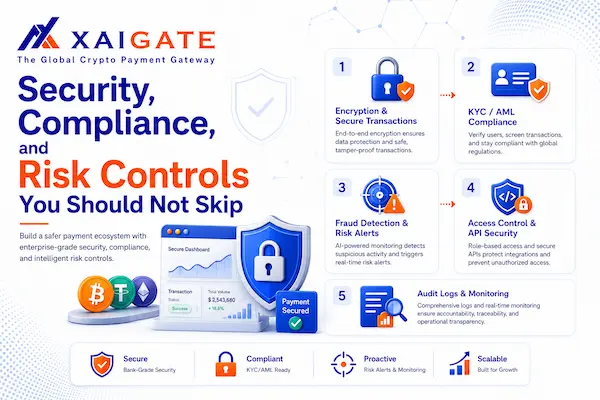
A payment system can only support growth when security and governance are built into the setup from the beginning, not added after problems appear.
- Protect API keys and admin access: Use strong authentication, limited permissions, and secure storage to reduce internal and external risk.
- Manage volatility and refunds carefully: Stablecoins, invoice expiry windows, and clear refund policies help control pricing confusion and customer disputes.
- Review compliance requirements early: Your gateway strategy should align with accounting rules, transaction reporting, and market-specific compliance obligations.
Common Mistakes When Setting Up a Crypto Payment Gateway
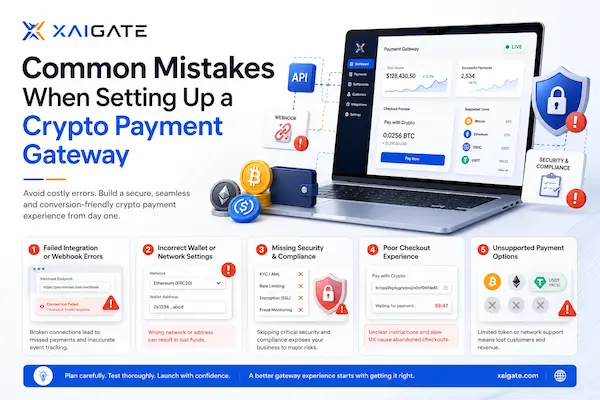
Many failed launches do not come from bad technology. They come from rushed decisions, weak testing, and unclear internal ownership across finance, operations, and technical teams.
- Choosing only by price: Low fees do not matter if the provider creates friction in settlement, reporting, or support.
- Launching too many assets at once: A narrow list is easier to manage, explain, and reconcile in the early stage.
- Ignoring post-payment operations: Refund handling, reconciliation, and customer support need defined workflows before launch.
FAQs – How to Set Up a Crypto Payment Gateway
1. How do you set up a crypto payment gateway?
Choose a provider, create an account, configure wallets, integrate checkout, and test.
2. What do businesses need before setup?
A merchant account, payout wallet, supported coins, and integration method.
3. Do merchants need verification?
Yes, some providers require KYC or KYB verification.
4. Which coins should merchants accept first?
Start with major coins and stablecoins customers actually use.
5. Why does settlement matter?
Settlement affects accounting, cash flow, and volatility risk.
6. Can merchants use plugins?
Yes, plugins work well for ecommerce platforms.
7. When should businesses use API integration?
Use APIs for custom checkout, SaaS, or advanced payment flows.
8. Why are webhooks important?
Webhooks update order status after blockchain payment events.
9. Should merchants test before launch?
Yes, test paid, pending, failed, expired, and underpaid orders.
10. What should merchants secure first?
Protect API keys, admin access, wallets, and settlement settings.
Conclusion
Learning how to set up a crypto payment gateway is not only about connecting a blockchain payment option to your website. It is about building a payment flow that fits your business model, protects revenue, and supports future scale. When you choose the right provider, define your settlement logic, secure your wallet and admin environment, and test the full lifecycle carefully, crypto payments become a practical business tool rather than a risky experiment.
Talk to XAIGATE today to build a crypto payment gateway setup that is secure, scalable, and ready for real business growth.
For daily updates, subscribe to XAIGATE’s blog!
We may also be found on GitHub, and X (@mxaigate)!