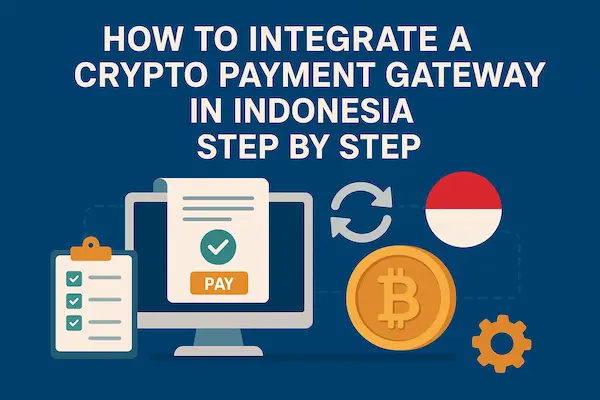
Indonesia is one of the most active digital markets in Southeast Asia. Ecommerce keeps growing, online services sell across borders and more customers already hold crypto or stablecoins. At some point many founders and CTOs start asking the same question: how do we actually integrate a crypto payment gateway in Indonesia without breaking our IDR pricing, our reports or our relationship with the bank. This guide walks through that journey step by step so your team knows what to expect before you touch any code.
Contents
- 1 1. What It Really Means to Integrate a Crypto Payment Gateway in Indonesia
- 2 2. Regulatory context for crypto payments in Indonesia
- 3 3. Define your business model before you integrate a crypto payment gateway in Indonesia
- 4 4. Reference architecture to integrate a crypto payment gateway in Indonesia
- 5 5. Step by step: how to integrate a crypto payment gateway in Indonesia
- 6 6. Payment flows for common Indonesian use cases
- 7 7. IDR pricing, FX and treasury for crypto payments in Indonesia
- 8 8. Risk, AML and compliance for crypto payments in Indonesia
- 9 9. Integration patterns by size and sector in Indonesia
- 10 10. Performance, scalability and reliability for crypto payments in Indonesia
- 11 11. Build vs buy: direct integration vs using a crypto payment gateway in Indonesia
- 12 12. 2025-2026 outlook for crypto payment gateways in Indonesia
- 13 FAQs: how to integrate a crypto payment gateway in Indonesia
- 14 Conclusion: Is It Time To Integrate a Crypto Payment Gateway in Indonesia?
1. What It Really Means to Integrate a Crypto Payment Gateway in Indonesia
In simple terms, to integrate a crypto payment gateway in Indonesia you still quote all prices in IDR, but you let some customers pay in crypto or stablecoins. The gateway creates a payment session, shows how much the customer should send, watches the blockchain for confirmations and then settles back to IDR or a stablecoin, while your systems only see a normal paid order or invoice.
1. High level view for busy founders and CTOs
From your side, a crypto payment gateway is just another rail next to cards, bank transfers and e wallets. The checkout or invoice page offers a “pay with crypto” button, the gateway handles addresses and confirmations, and your app reacts to clear statuses like pending, paid or expired. You do not have to run nodes or read raw transaction data to integrate a crypto payment gateway in Indonesia in a safe way.
2. Core building blocks in an Indonesia focused crypto rail
Most setups reuse the same pieces: an API or plugin to create and fetch payments, a hosted page or widget that shows the crypto option, webhooks for status updates, and a ledger and FX module on the gateway side that track amounts in crypto and IDR. A simple dashboard lets support and finance search, export and review payments without touching blockchain tools.
3. When integrating a crypto payment gateway in Indonesia makes sense
It usually makes sense to integrate a crypto payment gateway in Indonesia when you already have cross border buyers, see FX and card fees hurting margins or serve Web3 native users who ask to pay in digital assets. If most of your sales are local, tickets are small and IDR rails are still unstable, it is better to fix those first and add a small crypto pilot later for the segments where it clearly helps.

2. Regulatory context for crypto payments in Indonesia
When you integrate a crypto payment gateway in Indonesia, you are still working inside rules that keep rupiah as the only legal tender. Crypto is allowed, but treated closer to a digital commodity than money, so your setup has to respect that line.
1. How regulators in Indonesia see crypto
Three actors matter most: Bank Indonesia, OJK and Bappebti. Bank Indonesia insists that IDR is the only means of payment. Bappebti supervises crypto trading as a commodity on licensed platforms. OJK looks at how financial institutions manage risk around these assets. In short, the state accepts crypto exists, but does not treat it like rupiah.
2. What merchants can and cannot do with crypto payments
You can let customers pay with crypto or stablecoins through a gateway, but your prices and contracts should still be in IDR. Avoid marketing crypto as local currency or pushing users to bypass normal banking channels. On every screen and invoice, IDR remains the reference, while crypto is clearly framed as an optional method for certain customers.
3. Compliance boundaries when you integrate a crypto payment gateway in Indonesia
Most licences sit with the provider, but you still own your customer and transaction risk. Decide which countries and segments you serve, how you react to risk flags and who inside the company can approve or block higher risk payments. A short internal policy that covers IDR pricing, settlement options, screening rules
3. Define your business model before you integrate a crypto payment gateway in Indonesia
Before you integrate a crypto payment gateway in Indonesia, you need to be clear who you serve, why you want this rail and how much risk you are prepared to carry. A few decisions on paper early will save you from messy debates later when real money starts to move.
1. Know who you are serving
Start with your main customer groups and use cases. Are you selling ecommerce to local buyers, digital services to clients abroad, travel and experiences in Bali, or B2B projects for overseas companies. Cross border, high value or Web3 native customers are usually the first to use crypto, while purely domestic, low ticket segments may never touch it. The clearer your target, the easier it is to design flows, limits and messaging.
2. Decide who actually holds the crypto
Next, decide whether you want to hold any crypto at all. In most cases the gateway or its partners hold the assets and you just receive IDR or sometimes stablecoins, which keeps things simpler for treasury and accounting. If you choose to keep some value on chain, you will need stronger policies for keys, custody, valuation and tax. Write down which model you are choosing and why, so finance and founders stay aligned.
3. Choose a short list of coins and stablecoins
Finally, pick a short, focused list of assets you are willing to accept. Start with two or three that your customers already use, such as one major stablecoin and one or two large cap coins, instead of turning on every token the gateway offers. Fewer assets mean easier pricing, simpler reporting and less noise for your support team when something goes wrong. You can always add more later once the first flows are stable.
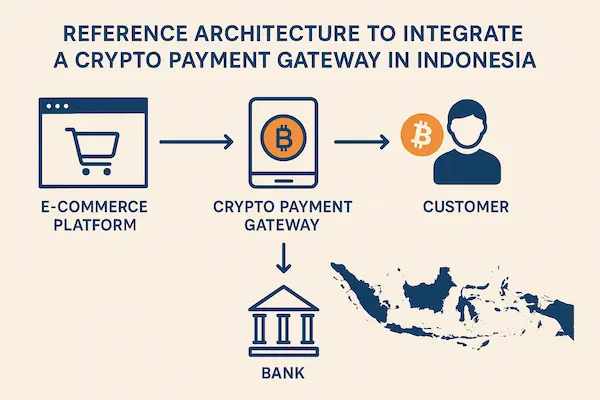
4. Reference architecture to integrate a crypto payment gateway in Indonesia
Once you decide to integrate a crypto payment gateway in Indonesia, it helps to picture how the pieces fit together. The stack is usually made of a few clear layers: what customers see, what your app talks to and what the gateway runs behind the scenes to keep money, rates and logs in order.
Table: Architecture view when you integrate a crypto payment gateway in Indonesia
| Layer | What it does | Who uses it | Key risks |
|---|---|---|---|
| Frontend & UX | Shows crypto option, hosted / embedded checkout, IDR pricing | Product, frontend developers | Confusing copy, wrong IDR / crypto display |
| API & webhooks | Create payments, receive status updates, handle callbacks | Backend, integration engineers | Timeouts, webhook failures, missing retries |
| On-chain engine | Track blockchain tx, confirmations, map tx to orders | Gateway infra team | Node issues, chain congestion, reorgs |
| Ledger & FX module | Store amounts, rates, fees, settlements in IDR and crypto | Finance, accounting | Mispricing, FX mismatch, broken balances |
| Dashboard & logs | Search, reports, manual review, refunds and payouts | Ops, support, compliance | Incomplete logs, hard-to-audit decisions |
1. External components: APIs, checkout and plugins
On the edge, your app talks to the gateway through an API or plugin and shows a hosted page or embedded widget for “pay with crypto”. The frontend handles IDR prices, simple messages and a clean handoff to the gateway, while the backend creates payment sessions, stores ids and listens for status updates. This is the only part most of your team will see day to day.
2. On chain and off chain engines
Behind that interface, the gateway runs services that watch the blockchain, match incoming transactions to payment sessions and update an internal ledger. The FX module records which rate was used and how much value should land in IDR or stablecoins. From your point of view, this is where the messy on chain detail is turned into clear numbers you can book and reconcile.
3. Security, governance and observability
Around everything sits a control layer: role based access for keys and payouts, audit logs for sensitive actions, secret storage in a vault and metrics for latency, errors and settlement times. With this in place, the crypto rail behaves like any other serious payment method in your stack, instead of a black box that only one engineer can debug.
5. Step by step: how to integrate a crypto payment gateway in Indonesia
Once you know your model and architecture, the next move is to turn the plan into a small, safe rollout. This is where you actually integrate a crypto payment gateway in Indonesia into your stack, but in a way that is controlled and easy to reverse if something is not ready yet.
Table: Go-live checklist to integrate a crypto payment gateway in Indonesia
| Area | What to check before go-live | Owner | Status |
|---|---|---|---|
| Auth & keys | Production keys in vault, scopes set, IP allowlist configured | Engineering | |
| Webhooks | Signatures verified, retries logged, handlers idempotent | Engineering | |
| Payment states | All states mapped to order status, docs ready for support/finance | Product / Ops | |
| FX & pricing | IDR pricing rules agreed, crypto quote copy reviewed and approved | Product / Finance | |
| Compliance | Internal policy updated, high-risk playbook written and shared | Compliance | |
| Monitoring | Dashboards live, alerts set for errors, latency and settlements | Engineering |
1. Shortlist and assess gateway providers
Start by narrowing your list to a few providers that can really support Indonesia. Look at whether they understand local rules, support IDR settlement, have clear docs and a realistic SLA. Ask simple, concrete questions about fees, supported assets, how they handle underpayments and what reporting your finance team will see each day.
2. Wire the integration in sandbox
Next, connect your staging environment to the sandbox. Create test payments from your own checkout, trigger webhooks and check how each status maps back into your order or invoice system. Use realistic amounts and flows so you see how it will feel when you integrate a crypto payment gateway in Indonesia for real buyers. Fix gaps now, while nothing in production is at risk.
3. Prepare your teams and run a small live pilot
Before you switch anything on for customers, walk support, finance and operations through the new rail. Show them the dashboard, the reports and the basic scripts for common issues. Then launch a small pilot for one or two clear use cases, with low limits and close monitoring. If payments clear, reconciliation is clean and customers actually use the option, you can slowly raise limits and treat the crypto rail as a stable part of your payment mix.

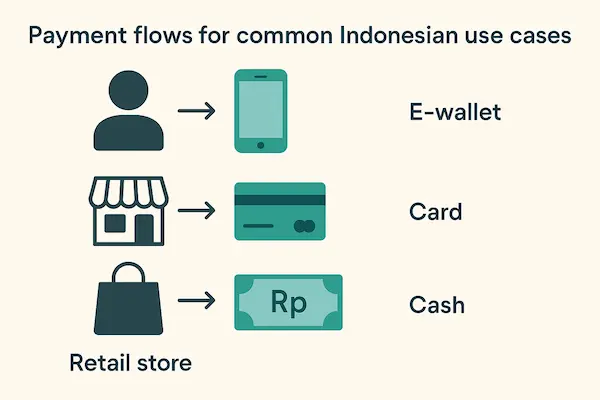
6. Payment flows for common Indonesian use cases
Once you integrate a crypto payment gateway in Indonesia, most real traffic falls into a few simple patterns. If these three flows are clear, the rest are just variations.
1. E commerce checkout and digital goods
The buyer checks out in IDR and sees an extra “Pay with crypto” option. Your app sends the IDR total to the gateway, which returns a crypto amount and an expiry timer. The customer sends funds, the gateway moves the payment from pending to confirmed, and your system marks the order as paid and follows the usual fulfilment and refund rules.
2. Travel, hospitality and tourism
For hotels, villas and tour operators, crypto often starts as a deposit rail. The booking engine creates a reservation in IDR, opens a crypto payment for the deposit and shows staff whether it is unpaid, partially paid or confirmed before check in or departure. Changes, upgrades or cancellations follow the same playbook you already use for cards or bank transfers, but actions are triggered through the gateway dashboard.
3. B2B invoicing and export services
Service firms and exporters issue invoices in IDR and attach a secure payment link from the gateway. The client pays in crypto or stablecoins on a hosted page, the gateway confirms settlement and tells you how much to book in IDR. Your ERP marks the invoice as paid, stores the reference, rate and fees, and finance keeps a clean audit trail without touching blockchain tools.
7. IDR pricing, FX and treasury for crypto payments in Indonesia
When you integrate a crypto payment gateway in Indonesia, money still starts and ends in rupiah for most of your reporting. The gateway just adds a crypto rail in the middle, so you need clear rules for how IDR prices turn into crypto amounts, how settlements come back and who owns those decisions inside the company.
1. Keep pricing in IDR and quote in crypto
The safest pattern is to keep all product and invoice prices in IDR, then let the gateway quote a crypto amount for each transaction. Your system sends the IDR total, the gateway returns how much crypto the customer should send and for how long that quote is valid. When the payment confirms, you store the final IDR value, the rate used and any fees so finance can see exactly how the on chain amount mapped back into rupiah.
2. Choose how you want to settle
Next, decide what you want to receive after the gateway does its work. Many Indonesian merchants keep it simple and take settlements only in IDR to a local bank account. Others may accept a mix of IDR and stablecoins if they pay suppliers, partners or staff in digital assets. Write this choice down so everyone knows whether the goal of the crypto rail is pure conversion to rupiah or a small, intentional exposure to on chain balances.
3. Set simple treasury rules and routines
Finally, turn those choices into a few plain rules. For example, convert everything to IDR on receipt, or keep a small cap on how much value you are willing to hold in crypto at any time. Pair that with a regular reconciliation rhythm, where finance checks gateway reports against bank statements and your own ledger. With a handful of clear rules and habits, adding a crypto payment gateway in Indonesia feels like extending your existing treasury playbook, not inventing a new one.
8. Risk, AML and compliance for crypto payments in Indonesia
Even if volumes start small, crypto payments still touch money, customers and regulators. When you integrate a crypto payment gateway in Indonesia, you should treat it like any other serious payment rail, not a side experiment that only tech cares about. This section is a practical view of risk, not formal legal advice, so your legal and compliance teams should still review any final setup.
1. What you get from the gateway
A good provider does a lot of heavy lifting for you. They screen addresses and transactions against sanctions lists, high risk patterns and known bad wallets, and they attach risk scores or flags to each payment. They keep detailed logs of amounts, timestamps, hashes, rates and payouts, and they offer exports that finance and compliance can store for audits. If a gateway cannot explain its screening, alerting and logging in simple terms, it is usually not a good fit.
2. What still belongs to you as the merchant
The gateway does not own your customer base or your strategy. You still decide which countries and segments you accept, what to do when a payment is flagged and who inside the company is allowed to override or block a transaction. Write down who reviews high risk alerts, how quickly they should respond and what evidence they should collect if they choose to proceed. This keeps risk decisions consistent, instead of being made ad hoc in support chats.
3. Records and reviews that keep banks and auditors calm
To keep your banking relationships smooth, treat every crypto payment like something you may need to explain a year from now. Store gateway reports, key transaction details, internal notes on any manual decisions and a short policy that describes your approach. Schedule regular reviews where finance and compliance look at a small sample of crypto payments, check that rules are followed and adjust limits if needed. With that discipline in place, adding a crypto rail to your Indonesian business looks like careful innovation, not uncontrolled risk.
9. Integration patterns by size and sector in Indonesia
Not every business needs the same level of complexity. Once you integrate a crypto payment gateway in Indonesia, the smartest move is to match the pattern to your size and sector instead of copying what a big exchange or a tiny shop is doing.
1. Small and mid sized merchants
Smaller ecommerce brands, agencies and SaaS teams usually do best with plugins or a simple hosted checkout. They let the gateway handle most of the heavy lifting, keep crypto limited to a few clear use cases and rely on the dashboard for reports and refunds. This keeps risk low and avoids turning your first integration into a full blown engineering project.
2. Large platforms and marketplaces
Bigger platforms and marketplaces often need a deeper API integration. They may route payments per seller, split fees, support multiple coins and show detailed status inside their own dashboards. Here the crypto rail is treated like any other core payment method, with proper test suites, SLAs and runbooks, because even short outages can impact thousands of users.
3. Web3 native and fintech players
Web3 projects, exchanges and fintechs are the most comfortable with crypto, but they still use gateways to bridge into banking and IDR. They tend to integrate a crypto payment gateway in Indonesia as one rail among many, with clear separation between user funds and platform revenue. The key for this group is to make flows simple enough that non technical users, partners and regulators can still understand how money moves end to end.
10. Performance, scalability and reliability for crypto payments in Indonesia
When you integrate a crypto payment gateway in Indonesia, you add one more moving part to your payment stack. If traffic grows or the market is volatile, a slow or fragile integration can hurt real revenue. It is better to think about performance and reliability early, while you are still in design and sandbox, not after the first outage.
1. Plan for peaks, not just the average
Crypto traffic often comes in spikes: campaigns, product launches, NFT drops, big invoices that all hit at once. Make sure your integration reuses HTTP connections, respects rate limits and backs off cleanly if the gateway starts to throttle. Run a simple load test in sandbox with realistic flows, so you see how your system behaves when many users try to pay at the same time.
2. Design for partial failure, not perfection
No provider or chain is online all the time. Decide what happens if the gateway is slow or unreachable: do you hide the crypto option, show a clear message, or let customers choose another method. Your goal is that when the crypto rail has a bad day, card and bank payments still work and staff can see a simple status page instead of guessing.
3. Monitor what really matters
Set up a few basic metrics that everyone understands: error rates on payment creation, webhook failures, typical confirmation time and delays between crypto payments and IDR settlements. Add alerts for unusual spikes or long delays and give support and operations a simple dashboard. With that in place, you can integrate a crypto payment gateway in Indonesia and see problems early, before customers start sending angry emails.
11. Build vs buy: direct integration vs using a crypto payment gateway in Indonesia
At some point, tech and product will ask whether you should build around exchanges and nodes yourself or simply plug into a provider. There is no single right answer, but when you integrate a crypto payment gateway in Indonesia you should be clear what you gain and what you take on in each path.
1. Direct exchange or node integration
Building directly on top of exchanges or your own nodes gives you maximum control. You decide how addresses are created, how rates are sourced and how funds move between wallets and bank accounts. This can make sense for Web3, fintech or very large platforms with strong in house teams and a clear reason to go deep. The trade off is that you also own uptime, security, FX logic, reporting and a lot more compliance work. What looks flexible on paper can become a permanent maintenance burden.
2. Local Indonesian providers vs regional or global gateways
Using a crypto payment gateway in Indonesia shifts much of that work to a specialist. Local providers may understand Indonesian rules, language and IDR settlement better, while regional or global gateways can give you multi country coverage and more assets in one place. Local partners can be easier when you need to explain things to banks or regulators, but they may support fewer corridors. Global players can be powerful if you serve many markets, but you will need to check how well they really handle Indonesian specifics.
3. How to choose the right approach for your business
For most small and mid sized merchants, and many enterprises too, the practical choice is to integrate a crypto payment gateway in Indonesia first and only consider direct builds later if there is a very clear need. If your core business is not payment infrastructure, it is usually better to buy that expertise and focus your engineering time on product and customer experience. A simple decision rule is: if you cannot commit a long term team to maintain nodes, risk rules and bank relationships, start with a gateway and treat it like any other critical vendor, with clear SLAs, tests and exit options.
12. 2025-2026 outlook for crypto payment gateways in Indonesia
The next one to two years will shape how normal it feels to integrate a crypto payment gateway in Indonesia. Rules are still evolving, more users hold digital assets and banks are slowly getting used to seeing crypto related flows in their clients’ statements. You do not need to predict everything, but you should know what to watch.
1. Regulatory trends to keep on the radar
Indonesia is likely to keep its core stance: rupiah as the only legal tender, crypto treated as a digital commodity and tighter expectations on reporting and risk. Over time you can expect clearer guidance on stablecoins, tax treatment and how payment flows should be documented. That means any serious setup should assume more questions from banks and auditors, not fewer, and keep records tidy from day one.
2. Market and customer behaviour
On the market side, more Indonesians will hold crypto through local exchanges and global apps, while cross border buyers and Web3 native users will keep looking for ways to pay without heavy card fees and FX noise. You may not see a flood of demand, but steady, focused pockets of customers asking for crypto or stablecoin options. Merchants that already tested a small rail will be in a better position than those starting from zero when that demand becomes too visible to ignore.
3. Staying flexible while everything moves
Because both rules and behaviour are still shifting, the safest approach is to build flexibility into your design. Treat the crypto rail as one configurable option in your payment stack, not as hard coded logic. Make it easy to turn assets on or off, adjust limits and change settlement preferences without rewrites. If you integrate a crypto payment gateway in Indonesia with that mindset, you can scale up when the environment is right, or scale back if needed, without tearing up your entire payment architecture.
FAQs: how to integrate a crypto payment gateway in Indonesia
1. What does it really mean to integrate a crypto payment gateway in Indonesia?
You still price in IDR, but let some customers pay in crypto or stablecoins. The gateway handles addresses, confirmations, FX and settlements.
2. Is it legal for Indonesian merchants to accept crypto payments?
Yes in principle, as long as rupiah stays the only legal tender, prices are in IDR and you follow local rules. Always let legal/compliance review.
3. Which businesses benefit most in Indonesia?
Exporters, SaaS with overseas clients, travel and hospitality, agencies and creators with international buyers. Purely local, low ticket retail rarely needs it.
4. How do we handle IDR pricing and FX?
You send the IDR total to the gateway, it returns a crypto amount and expiry. When paid, you record final IDR value, rate and fees for finance.
5. How long do crypto payments take?
Often a few minutes for normal tickets, longer for large ones. Payouts to IDR or stablecoins follow the settlement schedule you agree with the provider.
6. What are the main risks?
Volatility if you hold assets, tech failures, fraud and compliance issues. Reduce them with IDR pricing, a trusted provider, clear rules and good logs.
7. Do we need our own licence?
Usually no. Most merchants plug into a licensed or aligned provider, but you still need proper contracts, policies and records.
8. How should we test before going live?
Run end to end tests in sandbox, then a small live pilot with low limits and close monitoring. Only scale once payments and reconciliation are stable.
Conclusion: Is It Time To Integrate a Crypto Payment Gateway in Indonesia?
Over 2025 and 2026, more Indonesian users will hold digital assets, while regulators tighten how flows are reported and explained. You do not have to rush, but you should decide now whether to integrate a crypto payment gateway in Indonesia for the customers and corridors that matter most.
Table: Decision summary – should you integrate a crypto payment gateway in Indonesia?
| Area | Key question | Good signal for “yes” |
|---|---|---|
| Customers | Do we have real cross border or Web3 demand? | Overseas clients or travellers ask for crypto |
| Economics | Are FX and card fees hurting margins? | Margin loss on key international routes |
| Operations | Can we map crypto flows cleanly back to IDR? | Clear reports and internal reconcile process |
| Compliance | Can we explain flows to banks and auditors? | Written policy, logs and a simple playbook |
| Technology | Can we safely run one more payment rail? | Stable tests, monitoring and basic runbooks |
If you can say yes on most lines, a focused crypto rail is worth a serious pilot, not just a slide in a strategy deck.
Next step: run a controlled pilot with XaiGate
Instead of building everything yourself, you can let XaiGate handle the hard parts and keep your team on product and customers. A simple path looks like this:
- Create a XaiGate sandbox and plug in one Indonesian staging flow, for example a single checkout or invoice.
- Test full, partial, late and failed payments until tech, finance and compliance are all comfortable.
- Move to a small live pilot with low limits and tight monitoring.
If customers use the option, economics improve and reconciliation stays boring, you can route more volume and treat XaiGate as your main way to integrate a crypto payment gateway in Indonesia. If not, you can switch it off easily, knowing you tested the idea without risking your core payment stack.
For daily updates, subscribe to XAIGATE’s blog!
We may also be found on GitHub, and X (@mxaigate)!