With the rise of privacy-focused digital commerce, no-KYC crypto payment gateways are becoming the go-to solution for businesses needing speed, global reach, and anonymity. However, operating outside of identity verification protocols introduces significant risks. That’s why secure no-KYC crypto payments require a specialized approach to ensure safety and trust.
In this comprehensive 2026 guide, we break down the best security practices every business should adopt to stay ahead of fraud, protect customer assets, and comply with evolving crypto regulations—all without sacrificing user privacy.
Understanding No-KYC Crypto Payment Gateways
A no-KYC crypto payment gateway allows users to send and receive cryptocurrency payments without going through formal identity checks. Unlike traditional crypto processors, these platforms prioritize quick onboarding and decentralized access.
While they provide flexibility, they also demand advanced strategies to protect systems from misuse, money laundering, and other cyber threats.
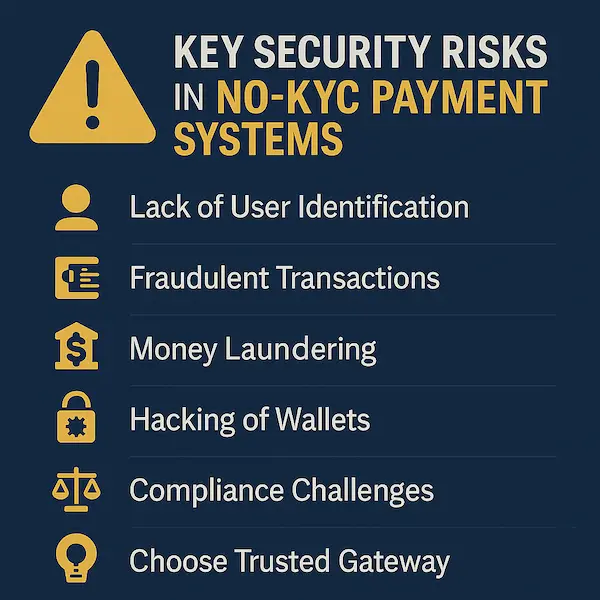
Key Security Risks in No-KYC Payment Systems
1. Fraud and Chargebacks
Even without credit cards, crypto payments can still suffer from fraudulent attempts using hacked wallets or manipulated transactions.
2. Double-Spending
Accepting payments before sufficient confirmations leaves merchants vulnerable to attackers who spend the same funds twice.
3. Wallet Hacks and Data Breaches
Improperly secured hot wallets are targets for malware, phishing, and backend intrusion.
4. Compliance Backlash
Authorities may investigate merchants who unknowingly process illegal funds through anonymous payments.
5. System Exploits
APIs left unprotected can be abused by bots or malicious actors flooding endpoints or draining resources.
If you’re exploring how to implement a privacy-friendly crypto payment system that doesn’t sacrifice security, XAIGATE offers a reliable solution. Learn more in our full guide on crypto payment gateway without KYC to see how it fits into your business strategy.
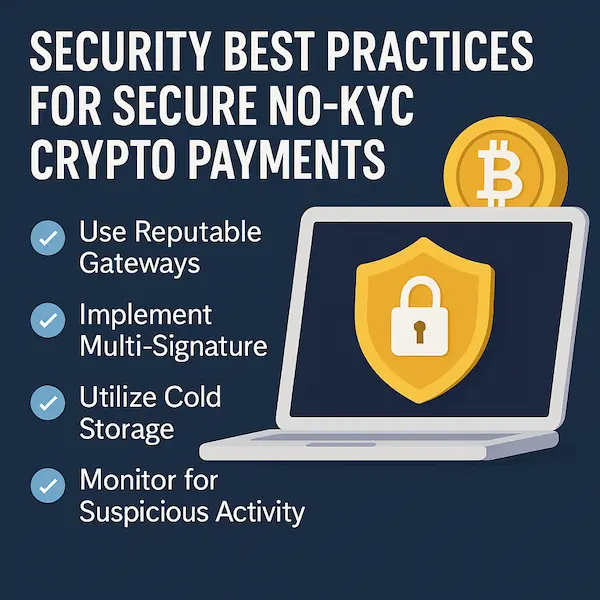
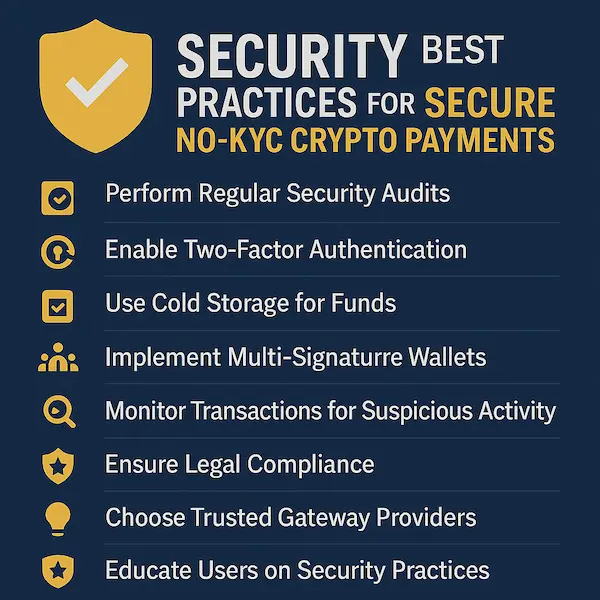
Security Best Practices for Secure No-KYC Crypto Payments
1. Cold Wallets for Long-Term Funds
Keep the majority of your crypto in cold storage (offline wallets) to prevent hacking. Only use hot wallets for active transactions.
2. Multisig Wallets for Transaction Approval
Requiring multiple signatures for any withdrawal ensures no single party has full control over funds, reducing insider threats.
3. Delayed Payment Confirmation
Configure your gateway to only accept payments after 3–6 network confirmations to minimize double-spend risk.
4. Blockchain Analytics Integration
Use tools like Chainalysis or Elliptic to flag suspicious wallet activity before confirming a transaction.
5. Secure API Access
Enforce IP whitelisting, OAuth 2.0, and rate limits. Add CAPTCHA or challenge-response protections for high-frequency endpoints.
6. Routine Key Rotation
Change access keys and API credentials regularly. Revoke unused tokens to limit exposure.
7. Real-Time Monitoring and Logging
Track transaction behavior using SIEM tools. Alert your team for anomalies such as multiple failed payments or unusual withdrawal patterns.
8. Staff Cybersecurity Training
Ensure that your employees understand private key safety, phishing detection, and wallet hygiene.
Finding the Balance: Privacy and Protection
The goal of a secure no-KYC crypto payment system is not to compromise on privacy but to layer security in ways that respect anonymity.
| Feature | Privacy-Oriented | Security Enhancement |
|---|---|---|
| KYC Info | None collected | Behavioral anomaly tracking |
| Wallet Access | Non-custodial | Optional multisig permissions |
| Logs | Minimal | Encrypted, pseudonymous logs |
Merchants should design systems that balance ethical data use with robust risk control.
Real-World Example: XAIGATE Implementation
A global digital subscription service integrated XAIGATE to offer secure no-KYC crypto payments. Key steps:
- Enabled 4-of-5 multisig wallet system
- Applied geographic API restrictions
- Integrated blacklisted address screening
Outcomes:
- 100% protection from confirmed fraud attempts
- Faster resolution of suspicious activity
- Customer satisfaction improved due to frictionless payments
XAIGATE demonstrated that secure no-KYC crypto payments are viable and scalable with the right protocols.
Legal and Compliance Tips for No-KYC Gateways
Even in no-KYC environments, businesses must prepare for compliance scrutiny:
- Display clear user terms and AML disclaimers
- Implement soft limits on daily transaction volumes
- Use blockchain analytics to audit large transactions
- Restrict usage in blacklisted regions or sanctioned countries
In jurisdictions like Panama, UAE, and El Salvador, these practices provide a safe legal cushion for operating anonymous payment systems.
Choosing a Secure No-KYC Crypto Gateway Provider
Use this checklist to evaluate your options:
| Criteria | Details |
| Wallet Security | Multisig, cold storage, 2FA admin access |
| API Protection | OAuth, throttling, key rotation |
| Blockchain Monitoring | Integrated analytics or alerts |
| Customization | Support for dApps, plugins, or white-label options |
| Reputation | Verified reviews, GitHub activity, community trust |
Top Choices:
- XAIGATE – Enterprise-level security with no KYC
- BTCPay Server – Developer-friendly, self-hosted
- OpenNode – For businesses needing hybrid KYC/no-KYC setups
What’s Next for No-KYC Crypto Security?
As innovation evolves, we expect:
- zk-SNARKs for anonymous yet verifiable payments
- On-chain fraud detection powered by AI
- Integration of self-sovereign identity (SSI)
- Secure plugins for DeFi protocols and DAOs
These technologies will help push the boundaries of anonymous transactions while still ensuring system integrity.
Conclusion
To sustain privacy-centric commerce, merchants must treat secure no-KYC crypto payments as a critical part of infrastructure—not just an optional feature. By following these best practices, businesses can protect themselves, comply with evolving expectations, and deliver seamless, anonymous crypto transactions.
Platforms like XAIGATE prove that with the right security stack, no-KYC doesn’t have to mean high risk—it can mean high trust.
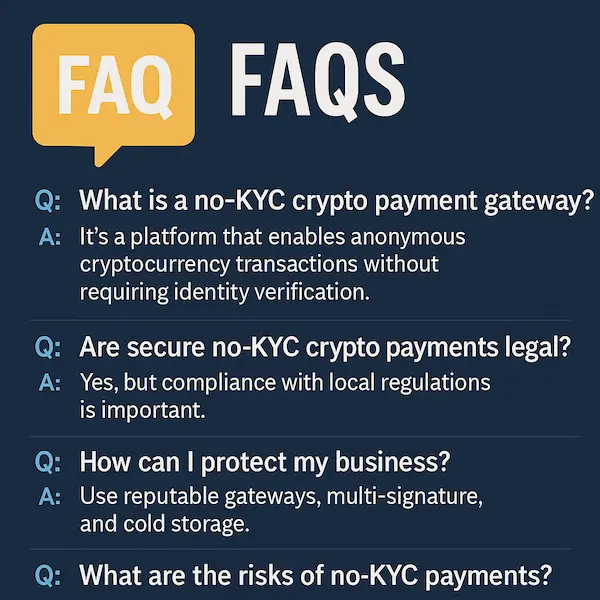
FAQs – Secure No-KYC Crypto Payments
1. Are no-KYC crypto payments secure for merchants and users?
Yes, they can be. When paired with proper wallet management, HTTPS encryption, and trusted gateways like XAIGATE, no-KYC payments can remain secure and private.
2. How can I protect my wallet when accepting crypto without KYC?
Use a non-custodial wallet with multi-signature options, enable two-factor authentication, and avoid sharing private keys. Cold storage is also recommended for large balances.
3. What’s the safest way to integrate no-KYC crypto payments into my website?
Choose a reputable gateway like XAIGATE with API-based integration. Use IP whitelisting, HTTPS, and secure API key storage to reduce exposure to exploits.
4. Can accepting crypto without KYC lead to legal trouble?
In most cases, no—especially if you follow local reporting thresholds and AML guidance. However, laws differ by region, so legal consultation is important.
5. What types of attacks should I watch out for with no-KYC systems?
Be alert for phishing, wallet spoofing, API key leakage, and DNS hijacking. Real-time monitoring and webhook verification can reduce these risks.
6. Is XAIGATE safe for no-KYC crypto payments?
Yes. XAIGATE is a non-custodial, smart-contract-based gateway that never touches user funds. It supports direct-to-wallet payments with no personal data stored.
7. Can I set transaction limits to reduce risk in no-KYC systems?
Absolutely. You can limit the maximum amount per transaction or per day, depending on your integration. This reduces potential exposure to misuse or fraud.
8. What if a customer sends the wrong amount or currency?
XAIGATE detects incorrect amounts and unsupported tokens in real time. Transactions won’t confirm unless they meet your invoice rules, reducing human error.
9. Do I need to monitor wallet activity manually?
Not necessarily. Gateways like XAIGATE offer webhook alerts and transaction logs to help you track payments automatically and securely.
10. Can I combine no-KYC crypto with basic compliance features?
Yes. You can enable optional KYC tiers or transaction triggers. For example, small payments may require no ID, while larger ones can prompt manual review.
Businesses looking to maintain user privacy without compromising on security are increasingly turning to platforms that enable secure no-KYC crypto payments. These gateways offer speed, anonymity, and global access—ideal for high-risk industries or privacy-first enterprises.
We may also be found on GitHub, and X (@mxaigate)! Follow us!
Don’t miss out on the opportunity to elevate your business with XAIGATE’s Cryptocurrency Payment Gateway without KYC . The three-step process is designed to be user-friendly, making it accessible for all businesses. Embrace this modern payment solution to provide customers with a secure and efficient way to pay. Take the first step towards a competitive edge in the digital realm and unlock the benefits of cryptocurrency payments for online casino today.