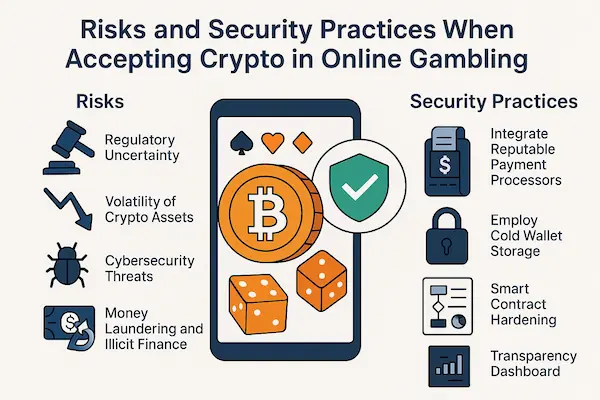
The fusion of cryptocurrency and online gambling has revolutionized the gaming landscape. With the promise of anonymous transactions, instant deposits, and borderless access, it’s no wonder that many iGaming platforms now allow crypto payments. Yet, as enticing as accepting crypto in online gambling may be, it is not without risk. Regulatory gray areas, volatile asset values, cyberattacks, and money laundering are just a few of the challenges gambling platforms must navigate.
This article delves into the multifaceted risks associated with accepting crypto in online gambling and the best security practices operators should adopt to build a secure and compliant ecosystem.
Why Online Gambling Platforms Are Accepting Crypto
Growing Demand for Privacy
Many users are turning to crypto to maintain anonymity while gambling online. Traditional fiat gateways require personal verification (KYC), while crypto can allow pseudonymous transactions.
Global Accessibility
Cryptocurrencies enable users from regions with strict financial restrictions or limited access to online gambling to bypass traditional banking systems.
Faster Payments Accepting Crypto in Online Gambling
Crypto transactions, particularly via stablecoins or layer-2 solutions, allow for near-instant deposits and withdrawals—something that traditional banks struggle to match.

Risks Involved in Accepting Crypto in Online Gambling
Despite the appeal, embracing crypto introduces a complex layer of risks that require careful mitigation strategies.
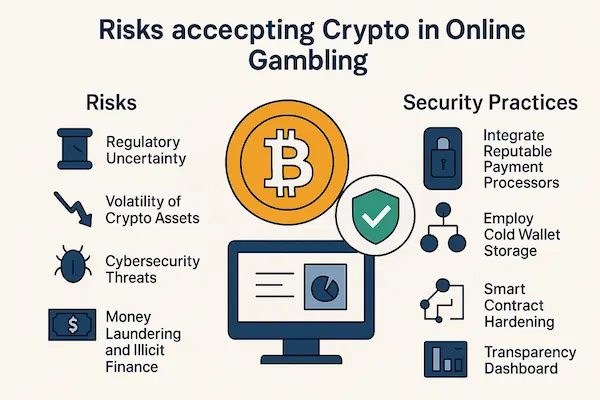
1. Regulatory Uncertainty when Accepting Crypto in Online Gambling
The Risk:
Gambling regulations vary significantly across jurisdictions, and adding crypto only compounds the uncertainty. Some regions ban online gambling altogether; others prohibit crypto payment solutions for casinos transactions.
Real-World Example:
In 2023, several gambling platforms faced operational bans in the UK and Germany due to non-compliance with crypto-related AML obligations.
Recommended Practice:
- Work with legal advisors to stay updated on jurisdiction-specific licensing and crypto compliance.
- Implement geo-blocking for users in high-risk regions.
2. Volatility of Crypto Assets
The Risk:
Crypto’s notorious volatility can create financial instability for gambling operators. A token may lose 20% of its value in a single day.
Recommended Practice:
- Auto-convert volatile cryptocurrencies to stablecoins or fiat through integrated payment processors.
- Offer USDT or USDC as primary tokens for deposits and withdrawals, Accepting Crypto in Online Gambling.
3. Cybersecurity Threats
The Risk:
Online casinos are prime targets for hackers. Crypto wallets, in particular, are vulnerable to phishing, DDoS attacks, and exploits.
Case Study:
In 2022, a mid-sized crypto-gambling platform lost $8 million due to a smart contract vulnerability.
Recommended Practice:
- Implement multi-sig wallets for treasury holdings.
- Regularly audit smart contracts and work with white-hat hackers.
- Enable two-factor authentication (2FA) for both admin and user accounts.
4. Money Laundering and Illicit Finance
The Risk when Accepting Crypto in Online Gambling:
Crypto is often associated with money laundering due to its pseudonymous nature. Regulators like the FATF and FinCEN are watching closely.
Recommended Practice:
- Adopt AML-compliant crypto payment gateways.
- Use blockchain analytics tools like Chainalysis or TRM Labs to flag suspicious wallets.
- Create transaction thresholds and flag limits for manual review.
5. Lack of Consumer Protection
The Risk:
When disputes occur, crypto transactions are irreversible, leaving players vulnerable to fraud or operational errors.
Recommended Practice:
- Use smart contracts for provably fair gameplay and conditional payouts.
- Set up automated refund mechanisms in case of failed transactions.
- Maintain a robust support ticketing system and dispute resolution protocol.
6. Reputation and Trust Issues
The Risk:
Being perceived as a “crypto-only” gambling site can raise concerns about legitimacy, especially among traditional players and investors.
Recommended Practice:
- Display audits, licenses, and compliance certificates publicly.
- Partner with well-known crypto security providers like CertiK or SlowMist.
- Consider hybrid payment models (fiat + crypto) to appeal to broader audiences.
Security Best Practices for Accepting Crypto in Online Gambling
1. Integrate Reputable Crypto Payment Gateways
Choose providers that specialize in crypto-gambling and offer KYC-optional flows, fraud protection, and token conversion Accepting Crypto in Online Gambling.
Top Options in 2025:
- XAIGATE – Tailored for casinos, no-KYC options, fiat conversion
- CoinsPaid – AML-compliant, integrated exchange
- NOWPayments – Easy API for over 100 cryptocurrencies
2. Employ Cold Wallet Storage
Keep user deposits in hot wallets only temporarily. Transfer large balances to offline cold wallets to prevent theft.
3. Smart Contract Hardening
Have every game and payment contract audited regularly by security professionals. Use tools like MythX, Certora, or Trail of Bits.
4. Onboard Through KYC-Lite Mechanisms
To balance compliance with UX, offer tiered onboarding:
- Tier 1 (no KYC) – Small deposits and limited withdrawals
- Tier 2 (light KYC) – Higher limits, flagged regions
5. Transparency Dashboard
Use a public dashboard to show:
- Crypto reserves
- Smart contract audit results
- Uptime & incident logs
This builds trust and prevents FUD (fear, uncertainty, doubt).

Accepting Crypto in Online Gambling: Strategic Integration for 2025
As digital currencies continue to disrupt traditional finance, accepting crypto in online gambling is no longer a fringe trend—it’s becoming an operational necessity. Forward-thinking operators are implementing cryptocurrency payment gateways for casino platforms not only to cater to tech-savvy players, but to achieve faster settlements, reduce transaction costs, and bypass geographic banking restrictions.
One of the most popular integrations in 2025 is the use of USDT payment gateways—thanks to their price stability, wide adoption, and compatibility with smart contract-based payout systems. Players benefit from near-instant deposits and withdrawals, while platforms avoid volatility risk.
Moreover, the rise of no-KYC crypto casino models introduces both opportunities and compliance challenges. While some jurisdictions permit no-KYC onboarding for low-risk users, most operators are now employing tiered KYC systems that balance privacy with AML obligations. This ensures casinos stay aligned with global standards while still appealing to users seeking anonymity.
Incorporating crypto into a gambling platform isn’t just about technology—it’s about building a secure, scalable, and regulation-ready infrastructure. From choosing the right payment gateway to designing wallet flows and transaction thresholds, every detail matters in today’s evolving iGaming market.
The Role of Blockchain Analytics in Risk Mitigation
Platforms like Elliptic, CipherTrace, and Scorechain allow gambling operators to:
- Monitor for illicit wallet behavior
- Detect cross-chain laundering techniques
- Screen wallets against OFAC and sanction lists
Actionable Tip: Integrate these APIs directly into your cashier module or KYC backend.
Legal Considerations for Operators in 2025
Online casinos accepting crypto must navigate laws that are evolving rapidly.
Key Considerations:
- Licensing: Secure a gaming license that explicitly allows crypto (e.g., Curaçao, Malta DLT add-ons).
- Data Protection: Comply with GDPR or regional privacy frameworks.
- Tax Reporting: Maintain transparent logs for tax audits.
Benefits of Secure Crypto Adoption in Gambling
When risks are well-managed, accepting crypto can yield major advantages:
- Global user base expansion
- Lower fees vs traditional PSPs
- Real-time fund availability
- Competitive differentiation
- Innovation through NFTs, tokenized rewards, and DeFi staking pools
Mitigating Smart Contract Vulnerabilities in Crypto Gambling
As crypto casinos move toward decentralized infrastructure, many rely on smart contracts to handle gameplay logic, payouts, and jackpots. However, these contracts are only as secure as the code they’re written in. Unpatched smart contract flaws can result in severe exploits, such as reentrancy attacks or front-running vulnerabilities.
To counter this:
- Every smart contract should undergo audit by reputable firms like CertiK or Trail of Bits before launch.
- Bug bounty programs should be established to incentivize white-hat discovery.
- Casinos should implement proxy upgradeable contracts, allowing hotfixes without redeploying the entire system.
By securing these elements, online gambling operators not only improve transactional integrity but also boost user confidence in crypto-based gameplay.
Conclusion: Accepting Crypto in Online Gambling
Accepting crypto in online gambling is not simply about adding a new payment method—it’s about redesigning the platform’s financial infrastructure, security model, and compliance protocol. While risks exist, a proactive security-first approach can unlock the full potential of crypto gambling.
Platforms that prioritize legal compliance, integrate cutting-edge analytics, and harden their systems through best practices will stand out as industry leaders in 2025 and beyond.
FAQs – Accepting Crypto in Online Gambling
Q1: Is it legal to accept crypto in online gambling?
It depends on your jurisdiction. Some countries fully allow it, others restrict or ban it. Always consult with a legal expert before accepting crypto payments.
Q2: What is the safest cryptocurrency for online casinos?
Stablecoins like USDT, USDC, and DAI are preferred due to low volatility. Bitcoin and Ethereum are also common but more volatile.
Q3: How do crypto casinos prevent money laundering?
They implement AML tools, transaction monitoring systems, and partner with analytics providers to detect suspicious behavior.
Q4: What are the top crypto payment gateways for casinos in 2025?
XAIGATE, NOWPayments, and CoinsPaid are leading options with advanced features like auto-conversion and regulatory compliance.
Q5: Can I offer anonymous gambling with crypto legally?
Offering fully anonymous services may breach AML regulations. Use tiered KYC models to balance privacy and compliance.
Many gambling operators are now switching to XAIGATE’s crypto payment gateway for online casinos due to its no-KYC flexibility and high transaction speed.
We may also be found on GitHub, and X (@mxaigate)! Follow us!
Don’t miss out on the opportunity to elevate your business with XAIGATE’s Cryptocurrency Payment Gateway for Casino. The three-step process is designed to be user-friendly, making it accessible for all businesses. Embrace this modern payment solution to provide customers with a secure and efficient way to pay. Take the first step towards a competitive edge in the digital realm and unlock the benefits of cryptocurrency payments for online casino today.