
A cryptocurrency payment gateway technical architecture diagram is more than a visual aid for developers. It acts like the blueprint of a modern payment engine, showing how each layer connects to process transactions safely, quickly, and at scale. For businesses entering crypto payments, the diagram helps translate a complex blockchain workflow into a system that operations teams, product managers, and engineers can actually build and manage. When each component is clearly mapped, companies reduce integration risk, strengthen security, and create a payment experience that feels simple for merchants and customers alike. Explore the details with XAIGATE in the article below.
Contents
- 1 What Is a Cryptocurrency payment gateway technical architecture diagram?
- 2 Core Components in a Cryptocurrency Payment Gateway Architecture Diagram
- 3 Cryptocurrency Payment Flow Explained in the Architecture Diagram
- 4 Key Security Considerations in Crypto Payment Gateway Architecture
- 5 Best Practices for Designing a Scalable Crypto Payment Gateway Architecture
- 6 Common Mistakes in Cryptocurrency Payment Gateway Architecture
- 7 Core Components at a Glance
- 8 FAQs – Cryptocurrency Payment Gateway Technical Architecture Diagram
- 9 Conclusion
What Is a Cryptocurrency payment gateway technical architecture diagram?
A technical architecture diagram gives structure to a payment gateway that would otherwise look fragmented and difficult to control. It turns a multi-step blockchain payment flow into a clear operational model.

Definition of a crypto payment gateway architecture
A crypto payment gateway architecture is a technical map that shows how payment requests move from a merchant checkout to blockchain validation, settlement, and reporting. It defines the main system layers, their responsibilities, and the data flow between them.
In practice, this diagram usually includes the merchant interface, API gateway, wallet management module, blockchain node layer, transaction monitoring engine, settlement services, and compliance controls. Each block exists for a reason, and removing one often creates operational or security gaps.
Why architecture diagrams matter for crypto payments
A strong architecture diagram helps technical teams see dependencies before development begins. That reduces confusion during implementation and limits the risk of building disconnected modules that later fail under transaction volume or compliance pressure.
It also improves communication across departments. A founder may focus on growth, while a developer focuses on infrastructure and a compliance officer focuses on AML controls. The diagram gives all of them one shared view of the system.
Key differences from traditional payment gateway architecture
Traditional payment gateways depend heavily on banking rails, card networks, and centralized authorization. A cryptocurrency payment gateway introduces blockchain interaction, on-chain confirmation logic, wallet infrastructure, and token-based settlement rules.
That means the architecture must handle decentralized payment inputs, volatile asset values, network fees, transaction finality, and sometimes cross-chain operations. In short, crypto payment architecture is not just a payment stack with new branding. It is a different operational model.

Core Components in a Cryptocurrency Payment Gateway Architecture Diagram
To understand the full crypto payment gateway architecture, businesses need to examine the function of each layer. The value of the diagram comes from showing how these components work together, not as isolated tools.
Merchant interface and checkout layer
The merchant interface is the layer customers see first during checkout. It creates the payment request, displays supported coins, generates QR codes or wallet instructions, and sends transaction data into the gateway.
This layer must feel simple, because customers do not care about the underlying architecture. They want a fast checkout, accurate payment amount, and confirmation that their transaction has been received.
See more: Top Crypto Payment Gateways 2026: Best Options for Global Merchants
API layer and transaction orchestration
The API layer is the control center of the gateway. It receives payment requests from merchant platforms, validates the request parameters, creates invoices, and routes tasks to wallet, monitoring, and settlement services.
The orchestration logic is especially important because crypto payments involve multiple asynchronous events. A payment may be initiated now, detected on-chain later, and fully confirmed after several blockchain confirmations. The orchestration layer keeps all of that synchronized.
Wallet management system
The wallet layer handles address generation, asset receipt, fund segregation, and internal routing. It may include hot wallets for active processing and cold wallets for long-term storage, depending on the business model and risk tolerance.
A mature wallet management system should support more than simple receipt of funds. It should also help define treasury logic, payout rules, and withdrawal controls for operational security.

Blockchain monitoring and node integration
This layer connects the gateway to blockchain networks through nodes or third-party infrastructure. Its role is to watch the chain, detect incoming transactions, read payment metadata, and update payment status in real time.
Without reliable blockchain monitoring, the gateway cannot determine whether a payment is still pending, has enough confirmations, or has failed due to underpayment or network issues. This is where technical reliability directly affects customer experience.
Payment processing and conversion engine
The processing engine validates whether the incoming amount matches the merchant invoice and determines how the funds should be handled afterward. Some businesses keep funds in crypto, while others need automatic conversion into stablecoins or fiat.
This component often integrates exchange rate feeds, liquidity providers, and fee calculation logic. It is essential for businesses that want predictable settlement outcomes despite crypto market volatility.
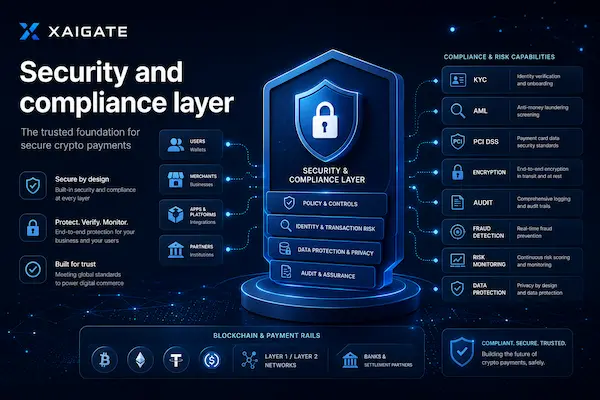
Security and compliance layer
This layer protects the gateway from internal and external risk. It usually includes authentication controls, encryption standards, transaction screening, suspicious activity rules, and integration with KYC or AML workflows.
For regulated or cross-border businesses, this module is not optional. A technically sound gateway without compliance controls may still fail in production because it cannot meet legal or partner requirements.
Settlement and reporting system
The settlement layer finalizes how funds are distributed after validation. It may send balances to merchant wallets, convert assets into another currency, or trigger batched settlement cycles based on merchant preferences.
Reporting is equally important because finance teams need reconciliation, audit visibility, transaction history, and fee reporting. This is often where product promises meet real business operations.
Cryptocurrency Payment Flow Explained in the Architecture Diagram
A blockchain payment gateway diagram becomes much more useful when paired with the actual transaction flow. Once the sequence is clear, businesses can identify where delays, exceptions, and security checks should happen.
Step 1: Payment initiation from merchant
The flow starts when a customer selects crypto as a payment method on the merchant website or app. The merchant system sends a request to the payment gateway with invoice amount, currency, order ID, and payment preferences.
Step 2: Wallet address generation and request creation
The gateway creates a unique payment request and often generates a dedicated wallet address or invoice reference. This step ensures the payment can be matched accurately to the right order.
Step 3: Blockchain transaction and confirmation tracking
The customer sends funds from a crypto wallet. The blockchain monitoring layer detects the transaction and begins tracking its confirmation status until the gateway’s required threshold is reached.
Step 4: Payment validation and webhook notification
After the transaction is verified, the system checks the amount, token type, network, and payment conditions. It then sends a webhook or callback to the merchant platform so the order can be updated automatically.
Step 5: Settlement and fund distribution
The final stage determines where the funds go next. They may remain in crypto, move into a treasury wallet, convert into another asset, or be settled to the merchant according to preconfigured rules.

Key Security Considerations in Crypto Payment Gateway Architecture
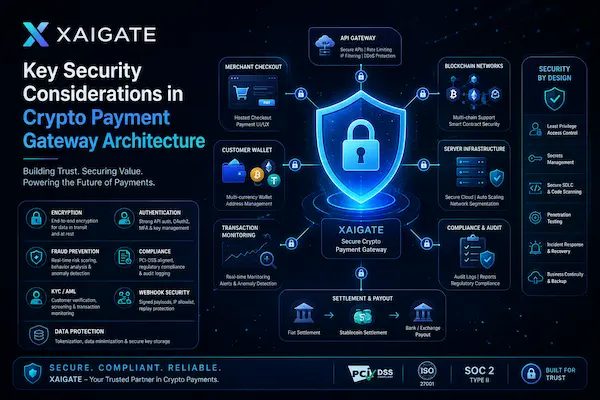
Security is one of the main reasons businesses study a cryptocurrency payment gateway technical architecture diagram before deployment. The diagram exposes where sensitive assets, credentials, and decision points must be protected.
Private key management and wallet security
Private keys should never be treated as a minor technical detail. The architecture must define how keys are created, stored, accessed, rotated, and protected through mechanisms such as HSMs, multi-signature controls, and strict permission models.
Fraud detection and transaction monitoring
Crypto payments can still face fraud risks even without card chargebacks. Businesses need transaction screening, anomaly detection, velocity checks, sanctions filtering, and behavioral monitoring to reduce exposure before funds move through the settlement layer.
Compliance with global regulations
Compliance requirements vary by region, but most serious payment gateways must consider KYC, AML, sanctions screening, and record retention. Architecture that ignores these needs often becomes expensive to redesign later.
Best Practices for Designing a Scalable Crypto Payment Gateway Architecture
Scalability should be designed into the diagram from the beginning, not added after transaction growth begins. A clean architecture helps businesses expand without constant rework.
A few best practices matter most:
- Use modular services: Separate wallet operations, transaction monitoring, settlement, and reporting so each service can scale without affecting the rest of the platform.
- Design for redundancy: Blockchain nodes, APIs, and webhook delivery should all have fallback logic to avoid single points of failure.
- Support real-time observability: Logging, metrics, and alerting help teams detect failed callbacks, stuck payments, and network congestion early.
- Prepare for multi-chain expansion: Even if the gateway starts with one network, the architecture should allow future support for additional chains and tokens.
- Build for reconciliation: Finance and compliance teams need accurate data matching between merchant orders, blockchain events, and settlement records.
See more: Top commercial benefits of crypto payment gateways
Common Mistakes in Cryptocurrency Payment Gateway Architecture
Many teams focus on the payment screen and underestimate the backend architecture. That usually creates technical debt that appears only after the gateway starts handling real transaction volume.
Some common mistakes include:
- Weak separation between layers: When wallet, monitoring, and settlement logic are tightly coupled, every change becomes risky and expensive.
- Poor webhook reliability: Missed callbacks can create duplicate fulfillment, delayed order approval, or payment disputes.
- Incomplete exception handling: Underpayments, overpayments, wrong-network deposits, and delayed confirmations need clear system responses.
- Limited security planning: Teams sometimes build core payment logic first and add key protection or access controls too late.
- No reconciliation framework: Without proper reporting and matching logic, finance teams struggle to trust settlement outcomes.
Core Components at a Glance
The table below summarizes the main building blocks inside a typical crypto payment system architecture.
| Component | Main Function | Why It Matters |
| Merchant Interface | Creates payment requests and checkout flow | Shapes customer experience and order accuracy |
| API / Orchestration Layer | Routes requests and manages event flow | Keeps all payment states synchronized |
| Wallet Management System | Generates addresses and routes funds | Protects assets and supports treasury control |
| Blockchain Monitoring | Detects and confirms transactions | Enables real-time payment status updates |
| Processing / Conversion Engine | Validates payments and manages asset conversion | Supports accurate settlement logic |
| Security / Compliance Layer | Enforces risk checks and regulatory controls | Reduces fraud and compliance exposure |
| Settlement / Reporting System | Distributes funds and records transactions | Supports operations, finance, and auditing |
FAQs – Cryptocurrency Payment Gateway Technical Architecture Diagram
1. What is a crypto payment gateway architecture diagram?
It maps how crypto payments move through a gateway system.
2. Why does the architecture diagram matter?
It reduces integration risk and improves system planning.
3. What is the merchant interface layer?
It creates checkout requests, wallet instructions, and QR codes.
4. What does the API layer do?
It validates requests, creates invoices, and routes payment events.
5. Why is wallet management important?
It handles address generation, fund routing, and wallet security.
6. What is blockchain monitoring?
It detects transactions and tracks confirmation status.
7. What does the conversion engine do?
It validates payments and manages crypto, stablecoin, or fiat conversion.
8. Why are webhooks important?
They update merchant order status after payment verification.
9. What security controls are needed?
Key protection, encryption, screening, access control, and AML checks.
10. What should merchants design first?
Design checkout, wallets, monitoring, settlement, reporting, and security.
Conclusion
A well-designed cryptocurrency payment gateway technical architecture diagram helps businesses move from concept to reliable execution. It shows how checkout, orchestration, wallets, blockchain monitoring, security, and settlement must work as one coordinated system. For companies planning to accept digital assets at scale, the architecture is not just documentation. It is the foundation of resilience, compliance, and growth. With the right structure in place, platforms like XAIGATE can help businesses turn crypto payments into a practical and secure part of modern commerce.
If your business is evaluating crypto payment infrastructure, XAIGATE can help you design a gateway architecture that is secure, scalable, and easier to integrate into real-world operations.
For daily updates, subscribe to XAIGATE’s blog!
We may also be found on GitHub, and X (@mxaigate)!