
As digital payments continue to grow rapidly, crypto payment gateway is becoming a new solution that helps businesses expand their global payment options. However, besides benefits such as fast transaction speed, low costs, and the ability to reach international markets, this system also comes with notable risks related to price volatility, security, and legal compliance. In the article below, XAIGATE will provide a detailed analysis of the pros and cons of crypto payment gateway in modern electronic payments, helping you gain a comprehensive view before adopting this solution.
How Crypto Payment Gateway works in payments
A crypto payment gateway is an intermediary payment solution that allows businesses to accept cryptocurrencies such as Bitcoin, Ethereum, or stablecoins during the online sales process. In essence, this system acts as a bridge between the buyer, the seller, and the blockchain network, making transactions faster, more automated, and more transparent.
Unlike traditional payments, which usually require banks or financial institutions as intermediaries, a crypto payment gateway uses blockchain technology to verify and record transactions in real time. This makes the payment process more direct and can reduce reliance on conventional financial infrastructure.

Basic operating process
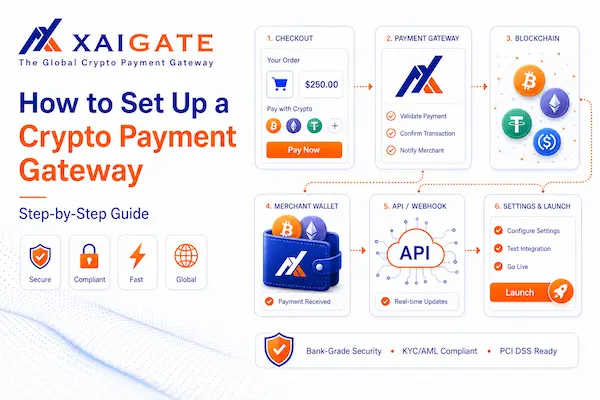
The crypto payment process usually takes place through the following steps:
- The customer selects crypto as the payment method on the website or app
- The system generates a wallet address or QR code that matches the order
- The customer sends payment from their personal wallet to the provided address
- The transaction is verified on the blockchain through a decentralized network
- The crypto payment gateway processes the conversion, if needed, into fiat currency and transfers the funds to the business account
This process is designed to be seamless and efficient, allowing merchants to receive payments without manually verifying every transaction.
How the system works behind the scenes
Behind the user-facing payment flow, the gateway performs several important functions automatically:
- The system continuously monitors the transaction status on the blockchain
- Once the transaction reaches enough confirmations, the order is marked as successful
- Some gateways support automatic exchange rate conversion to reduce the risk of price volatility
- Transaction data is stored transparently and cannot be altered
These features make the system reliable for businesses that need secure and trackable payment records, especially in cross-border transactions.
See more: Insight on Crypto Payment Gateway: A Detailed Analysis of Today’s Crypto Payment Systems
Key highlights of this payment mechanism
The biggest strength of this model is that it automates almost the entire payment workflow, which helps businesses:
- Reduce dependence on traditional financial intermediaries
- Shorten payment processing time
- Increase transparency and transaction verifiability
In addition, a crypto payment gateway can help businesses expand into international markets more easily, especially when serving customers who prefer digital assets over conventional payment methods.
Thanks to this modern operating mechanism, crypto payment gateway is becoming a new payment solution that is attracting growing interest from e-commerce businesses and digital service providers in the evolving global financial landscape.

Advantages of Crypto Payment Gateway
Crypto payment gateway is becoming a modern payment solution thanks to its ability to optimize transaction speed, reduce costs, and support global payments. For businesses, adopting this system offers many significant advantages compared with traditional payment methods.
Below are some of the most notable benefits to consider:
- Fast processing speed: Transactions can be completed within minutes without going through banks or traditional financial intermediaries
- Lower costs: It significantly reduces international transaction fees and foreign exchange conversion costs
- Global accessibility: It enables cross-border payments more easily without being restricted by banking systems
- High security: All transactions are recorded transparently on the blockchain, making them difficult to forge or alter
Beyond these core benefits, crypto payment gateway also helps businesses improve the customer payment experience by offering more flexibility in how users pay. This can be especially valuable for international e-commerce, SaaS platforms, and digital services that serve customers across multiple countries.
In many cases, the system also supports automation features such as instant payment confirmation, real-time transaction monitoring, and automatic settlement into fiat currency. These functions help reduce manual work, improve operational efficiency, and make payment management more convenient.
Thanks to these advantages, crypto payment gateway allows businesses to operate more efficiently, process payments faster, and gain greater flexibility than with traditional payment systems.
Disadvantages of Crypto Payment Gateway
In addition to its notable benefits, crypto payment gateway still has several limitations that businesses need to consider carefully before implementation.
- High price volatility: Cryptocurrency prices can change rapidly, which may directly affect revenue if funds are not converted in time
- Unclear legal frameworks: Many countries still do not have consistent regulations, making compliance and operation more challenging
- Wallet security risks: Losing a private key can mean losing all assets, with little or no chance of recovery
- Limited user adoption: Not all customers use crypto, and acceptance remains relatively low in many markets
Because of these challenges, businesses should carefully weigh both the benefits and the risks before adopting this payment system.

See more: What is a Crypto Payment Gateway? A Detailed Guide for Businesses
Comparison of Crypto Payment Gateway vs Traditional Payment Methods
Crypto payment gateways and traditional payment methods are both widely used in modern commerce. However, each has distinct operational characteristics and suitability depending on different business models.
| Criteria | Crypto Payment Gateway | Traditional Payment Methods |
| Transaction Speed | Fast (within minutes) | Slower (hours to days) |
| Cost | Low, fewer intermediaries | Higher due to bank and processing fees |
| Global Reach | Worldwide, borderless | Limited by financial systems |
| Transparency | High, powered by blockchain | Depends on banks/financial institutions |
| Value Stability | Highly volatile | More stable |
- Crypto payment gateways are suitable for businesses aiming to expand globally, reduce transaction costs, and accelerate payment processing.
- Traditional payment methods are better suited for environments with stable regulations, mainstream customers, and transactions requiring stable currency value.
Overall, each method has its own strengths. The choice depends on business strategy, target market, and the level of risk a company is willing to accept.

Conclusion
Crypto payment gateway is opening a new path for the digital payments industry, helping businesses optimize costs, expand market reach, and accelerate global transaction speed. However, these advantages also come with risks related to price volatility, legal compliance, and security, which businesses need to evaluate carefully before implementation.
If you are looking for a flexible international payment solution and want to integrate crypto payment gateway into your business system, you should carefully study the model that best fits your needs or consult a professional solution provider to ensure long-term safety and efficiency.
For daily updates, subscribe to XAIGATE’s blog!
We may also be found on GitHub, and X (@mxaigate)!
FAQs – Pros and Cons of Crypto Payment Gateway
1. What is a crypto payment gateway?
It helps businesses accept cryptocurrency payments from customers.
2. What are the main pros of crypto payment gateways?
Lower fees, faster payments, global reach, and fewer chargebacks.
3. What are the main cons of crypto payment gateways?
Volatility, compliance issues, refunds, and customer adoption limits.
4. Can crypto gateways reduce transaction fees?
Yes, they can reduce intermediaries and processing costs.
5. Do crypto payments settle faster?
Yes, many crypto payments settle faster than bank transfers.
6. Can crypto gateways reduce chargebacks?
Yes, blockchain payments are generally irreversible.
7. Is crypto volatility a risk?
Yes, but stablecoins or auto-conversion can reduce this risk.
8. Are crypto refunds difficult?
They can be, so businesses need a clear refund policy.
9. Is compliance still required?
Yes, businesses must review tax, KYC, AML, and local rules.
10. Should every business use crypto payments?
No, it depends on customer demand, risk tolerance, and integration needs.