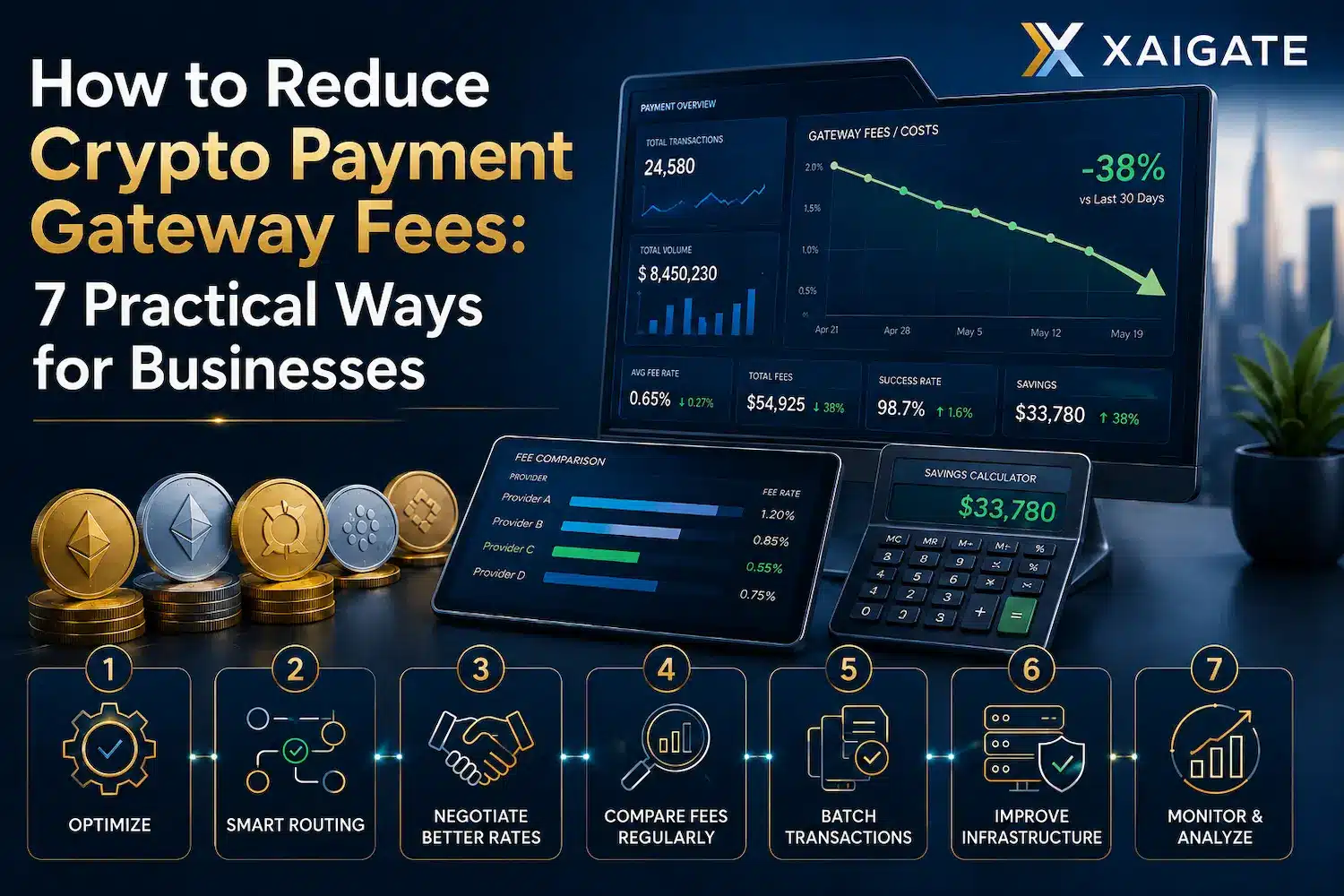
Crypto payments should make global transactions faster, not more expensive. Yet many businesses start accepting crypto and soon discover platform fees, network fees, settlement costs, and hidden charges. The good news is simple: you can reduce crypto payment gateway fees without making checkout harder. Like trimming friction from a payment engine, small decisions around gateway choice, networks, stablecoins, and integrations can create long-term savings. This guide explains how businesses can lower crypto payment costs while keeping payments secure, fast, and easy to manage. Explore the details withXAIGATE in the article below.
Contents
What Are Crypto Payment Gateway Fees?
Crypto payment gateway fees are the costs businesses pay to accept digital currencies such as BTC, USDT, USDC, or other cryptocurrencies. These fees may come from the gateway provider, blockchain network, wallet movement, exchange conversion, or settlement process.
For most merchants, the total cost is not just one visible percentage. It usually includes several layers:
- Platform fee: The fee charged by the crypto payment gateway for processing each transaction.
- Network fee: The blockchain fee required to confirm a transaction on a specific network.
- Conversion fee: The cost of converting crypto into fiat currency or another digital asset.
- Withdrawal fee: The fee charged when moving funds from the gateway or wallet.
- Hidden fee: Any unclear markup added through exchange rates, settlement terms, or extra services.
Understanding these layers is the first step in learning how to reduce crypto payment gateway fees effectively.

How to Reduce Crypto Payment Gateway Fees
Reducing crypto payment gateway fees is not about choosing the cheapest tool blindly. The goal is to lower unnecessary costs while keeping transactions reliable, transparent, and convenient for customers.
Choose a Low-Fee Crypto Payment Gateway
The most direct way to reduce crypto payment gateway fees is to start with a provider built around low processing costs. A gateway with a lower platform fee can save money on every transaction, especially for high-volume businesses.
When comparing gateways, look beyond marketing claims. Check whether the provider clearly explains transaction fees, supported coins, settlement rules, and withdrawal conditions.
A good low-fee crypto payment gateway should offer:
- Transparent pricing: You should know exactly what you pay per transaction.
- No unnecessary middle layers: Fewer intermediaries usually mean fewer extra costs.
- Simple settlement: The easier it is to receive funds, the lower the operational burden.
- Fast integration: API and plugin support reduce technical setup costs.
XAIGATE is positioned as a practical crypto payment gateway with very low fees around 0.2% per transaction, helping businesses reduce payment costs while accepting crypto globally.
See more: Why Businesses Should Use Crypto Payment Gateway: A Complete Guide for Companies
Accept Stablecoins on Cost-Efficient Networks
Stablecoins such as USDT and USDC are popular because they reduce price volatility. For businesses, they also make accounting, pricing, and settlement easier than highly volatile crypto assets.
However, stablecoin fees depend heavily on the blockchain network used. A USDT payment on one network may cost more than the same payment on another network.
To lower crypto transaction fees, businesses should:
- Support efficient networks: Choose networks known for lower transfer costs and faster confirmation.
- Match customer behavior: Offer networks your customers already use to reduce failed or abandoned payments.
- Avoid congested chains when possible: High congestion can increase network fees and slow checkout.
- Review network costs regularly: Fee conditions can change as blockchain usage changes.
Stablecoins are usually more business-friendly when paired with a gateway that supports multiple blockchain options.
Avoid Gateways With Hidden Charges
Hidden charges are one of the biggest reasons crypto payment gateway fees become expensive over time. These costs may appear in exchange rates, withdrawals, settlement delays, account maintenance, or technical add-ons.
Before choosing a provider, businesses should review the full fee structure carefully. A slightly higher transparent fee can sometimes be better than a low advertised fee with unclear markups.
Watch for these common hidden costs:
- Exchange rate spread: The gateway may convert crypto at a less favorable rate.
- Withdrawal minimums: You may need to reach a high balance before moving funds.
- Settlement charges: Some providers charge extra for specific settlement methods.
- Plugin or API limits: Advanced integration may require additional fees.
- Account or compliance charges: Some platforms add costs after onboarding.
The best way to reduce crypto payment processing costs is to choose a gateway that keeps pricing simple and predictable.
Use Non-Custodial Payment Flows
A non-custodial crypto payment gateway does not hold user funds in the same way as a traditional custodial platform. This can reduce dependency on intermediaries and give businesses more control over received payments.
Non-custodial flows may also reduce some operational risks linked to fund custody, withdrawal approvals, and locked balances. For merchants, that means fewer delays and a more direct payment experience.
The benefits include:
- More control over funds: Businesses can receive payments without relying heavily on third-party custody.
- Fewer withdrawal issues: Directer flows may reduce delays caused by platform approval processes.
- Better transparency: Merchants can track transactions on-chain.
- Lower operational friction: Teams spend less time managing fund release requests.
XAIGATE highlights a non-custodial approach, making it suitable for businesses that want simpler crypto payment operations with lower gateway dependency.
Optimize Payment Routing by Blockchain
Payment routing means choosing the right blockchain network for each transaction. This is especially important when a gateway supports multiple chains and coins.
For example, a customer may want to pay with USDT, but the business can offer different network options. Some networks may process the transaction faster and cheaper than others.
To optimize payment routing, businesses should consider:
- Transaction size: Small payments need low network fees to stay profitable.
- Confirmation speed: Faster networks improve checkout experience.
- Customer wallet support: The cheapest network is not useful if customers cannot use it.
- Settlement preference: Choose networks that fit your treasury and accounting process.
Smart routing helps businesses reduce crypto payment gateway fees without removing customer payment flexibility.
Reduce Conversion and Settlement Costs
Many businesses lose money not at the payment stage, but during conversion and settlement. If every transaction is converted immediately, exchange fees and spreads can add up quickly.
A better approach is to define when, how, and why conversion is needed. Some businesses may hold stablecoins for supplier payments, while others may settle periodically to reduce repeated conversion costs.
Practical ways to reduce settlement costs include:
- Batch settlements: Move funds less frequently when suitable.
- Use stablecoins for treasury: Keep value stable without converting every payment instantly.
- Compare conversion spreads: Review the real rate, not just the stated fee.
- Avoid unnecessary asset swaps: Each swap can create extra cost.
- Plan withdrawals: Reduce repeated small withdrawals that trigger fixed fees.
A low-fee gateway is valuable, but businesses also need a clear settlement strategy to protect margins.

Integrate Directly With API or Plugins
Poor integration can increase payment costs indirectly. Manual confirmation, failed checkout, payment errors, and reconciliation issues all create operational expense.
A gateway with API and plugin support helps businesses automate crypto checkout, payment tracking, order status updates, and transaction records. This reduces staff workload and improves customer experience.
For eCommerce and SaaS businesses, integration quality matters because:
- Automated checkout saves time: Orders can be confirmed without manual review.
- Plugins reduce development cost: Teams can launch faster on platforms like WooCommerce or similar systems.
- API support enables custom workflows: Businesses can connect payments with dashboards, invoices, or internal systems.
- Fewer payment errors reduce support tickets: Clear payment status improves customer trust.
XAIGATE supports API and plugin integration, making it easier for businesses to accept crypto without building a complex payment system from scratch.
See more: Pros and Cons of Crypto Payment Gateway in modern electronic payments
Crypto Payment Gateway Fees: What Should Businesses Compare?
Before choosing a crypto payment gateway, businesses should compare the full cost structure. A simple checklist can prevent expensive mistakes.
| Cost Factor | What to Check | Why It Matters |
| Platform fee | Percentage charged per transaction | Directly affects every sale |
| Network fee | Blockchain cost paid for confirmation | Can vary by coin and network |
| Conversion fee | Cost to convert crypto to fiat or stablecoin | Impacts real settlement value |
| Withdrawal fee | Fee for moving funds out | Affects treasury operations |
| Hidden markup | Exchange rate spread or unclear charges | Reduces net revenue |
| Integration cost | API, plugin, or developer effort | Impacts launch and maintenance |
| Custody model | Custodial or non-custodial flow | Affects control, risk, and speed |
The right gateway should not only be cheap. It should also be transparent, secure, easy to integrate, and suitable for your business model.
Why XAIGATE Is a Practical Option for Lower Payment Fees
XAIGATE is built for businesses that want a simple and cost-efficient way to accept crypto payments. Instead of making crypto checkout complex, it focuses on practical payment use cases for global merchants.
Its key advantages include:
- Very low fees: Around 0.2% per transaction for cost-conscious businesses.
- Non-custodial structure: More control over funds and fewer custody-related concerns.
- Multi-coin support: Accept BTC, USDT, USDC, and other crypto assets.
- Multi-chain flexibility: Support for different blockchain networks helps reduce transaction cost.
- API and plugin integration: Easier setup for websites, online stores, and digital platforms.
- No unnecessary complexity: Designed as a practical crypto payment gateway, not a complicated Web3 tool.
For businesses asking how to reduce crypto payment gateway fees, XAIGATE offers a clear direction: lower processing costs, simpler integration, and better payment flexibility.
FAQs – How to Reduce Crypto Payment Gateway Fees
1. What are crypto payment gateway fees?
They are costs for processing, confirming, converting, and settling crypto payments.
2. Why do crypto payment fees increase?
Fees rise due to network congestion, conversion costs, and hidden charges.
3. How can businesses reduce gateway fees?
Choose transparent pricing, low-fee networks, and efficient settlement.
4. Do stablecoins help reduce costs?
Yes, stablecoins can reduce volatility and simplify accounting.
5. Why does blockchain network choice matter?
Different networks have different speed, congestion, and fee levels.
6. Can hidden charges increase costs?
Yes, exchange spreads, withdrawals, and settlement fees can add up.
7. Does batching settlement save money?
Yes, batch settlements can reduce repeated withdrawal and conversion costs.
8. Are APIs and plugins useful?
Yes, automation reduces manual errors and operational costs.
9. Is XAIGATE low-cost?
Yes, XAIGATE positions its fee around 0.2% per transaction.
10. What should merchants compare first?
Compare platform fees, network fees, conversion, withdrawal, custody, and integration.
Conclusion
Learning how to reduce crypto payment gateway fees starts with understanding the full payment journey. Businesses should compare platform fees, network fees, conversion costs, settlement rules, custody models, and integration effort before choosing a provider.
The best strategy is not just paying less per transaction. It is building a payment flow that stays simple, transparent, and scalable as your business grows.
Choose XAIGATE to accept crypto payments with low fees, fast integration, and practical tools for global business growth.
For daily updates, subscribe to XAIGATE’s blog!
We may also be found on GitHub, and X (@mxaigate)! Follow us!