Global payments should not feel like a locked door. For many online businesses, cards, banks, and local payment rails still create limits through high fees, slow settlement, and regional restrictions. A multi currency crypto payment gateway flips that model. Instead of forcing customers into one currency or one country’s banking system, it lets businesses accept BTC, USDT, USDC, ETH, and other digital assets from buyers worldwide with less friction. Explore the details withXAIGATE in the article below.
What Is a Multi Currency Crypto Payment Gateway?
A multi currency crypto payment gateway is a payment system that allows merchants to accept different cryptocurrencies through one checkout, invoice, API, or plugin. Instead of supporting only Bitcoin or only stablecoins, the gateway can process multiple coins across different blockchain networks.
For businesses, this means customers can pay with the crypto they already use. A SaaS platform may accept USDT for subscriptions, an eCommerce store may accept BTC and ETH, while a digital service provider may prefer stablecoin settlement for predictable value.
In simple terms, it works like Stripe or PayPal for crypto payments. The difference is that transactions move through blockchain networks instead of card processors or banks.

How Multi Currency Crypto Payment Gateways Work
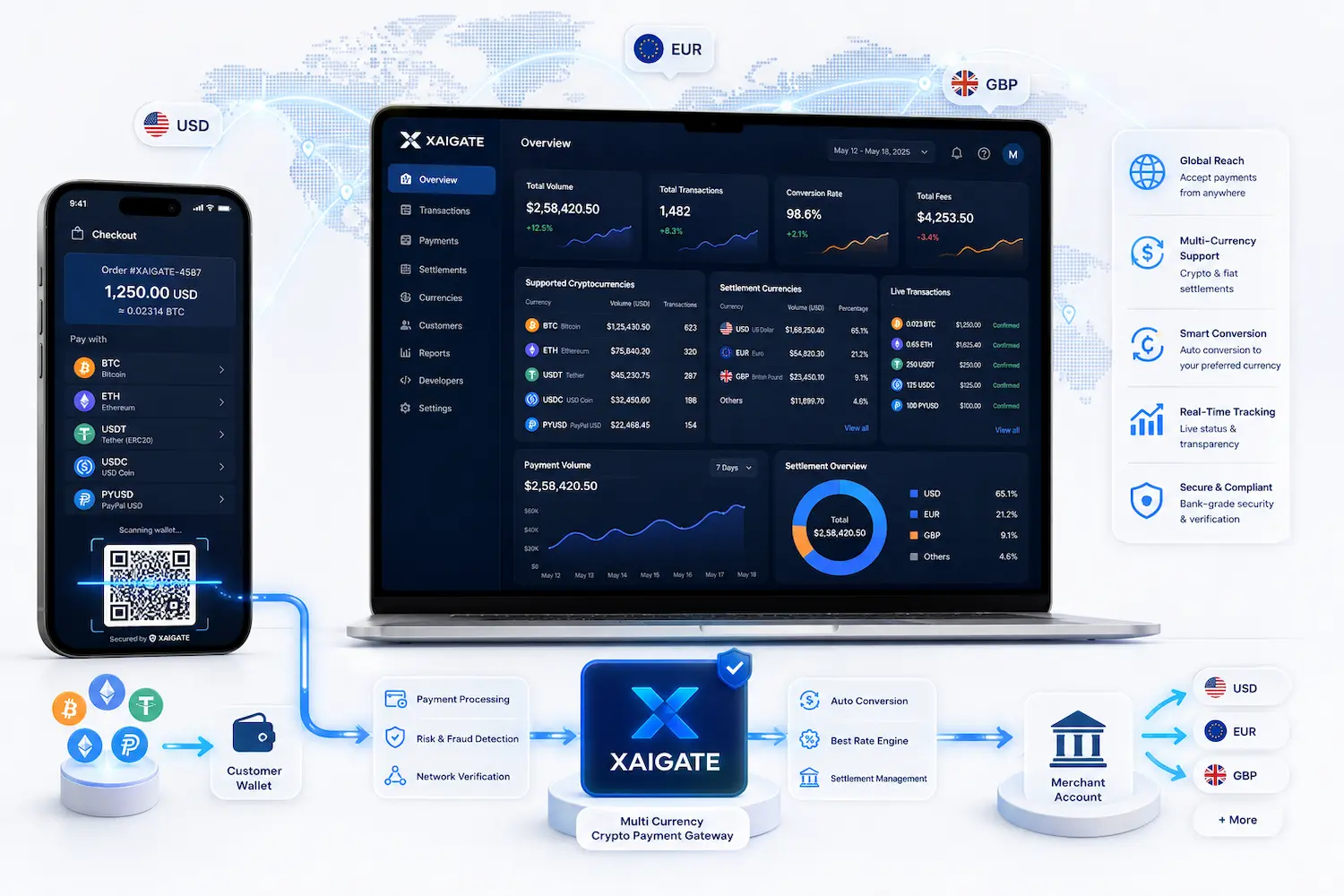
A multi currency crypto payment gateway connects the customer’s wallet, blockchain network, and merchant account into one payment flow. The goal is to make crypto payment simple for both sides.
Payment Flow from Customer Wallet to Merchant
The process starts when a customer selects crypto at checkout. The gateway generates a payment address, QR code, or payment link based on the chosen cryptocurrency.
The customer then sends payment from a wallet such as MetaMask, Trust Wallet, Binance Wallet, or another crypto wallet. After the transaction is sent, the system tracks it on-chain and updates the payment status.
Key steps usually include:
- Customer selects a coin: The buyer chooses BTC, USDT, USDC, ETH, or another supported asset.
- Gateway creates payment details: The system generates a unique wallet address or invoice.
- Customer sends funds: The buyer confirms payment from a crypto wallet.
- Merchant receives confirmation: The dashboard updates once the transaction is detected.
This flow reduces manual checking and helps merchants accept crypto without building blockchain infrastructure from scratch.
See more: Insight on Crypto Payment Gateway: A Detailed Analysis of Today’s Crypto Payment Systems
Blockchain Confirmation and Settlement Process
After payment is sent, the blockchain network must confirm the transaction. Confirmation time depends on the coin, network congestion, gas fees, and the gateway’s confirmation rules.
For example, stablecoins on fast networks may settle faster than Bitcoin during busy periods. A good gateway should show real-time status, detect underpayments, and update orders automatically.
Businesses should look at three factors:
- Confirmation speed: Faster networks help improve customer experience.
- Payment accuracy: The system should detect correct amount, wrong amount, or expired invoices.
- Settlement visibility: Merchants need clear records for order matching and accounting.
This is why automation matters. Without a gateway, merchants may need to check wallet activity manually, which is slow and risky.
Fiat Conversion vs Crypto Settlement Options
Some businesses want to hold crypto. Others prefer converting crypto into fiat or stablecoins to reduce volatility. A flexible gateway should support different settlement preferences.
For global merchants, stablecoin settlement is often practical. USDT and USDC can help reduce price swings while keeping the benefit of blockchain payments.
Common settlement options include:
- Crypto settlement: The merchant receives the same cryptocurrency paid by the customer.
- Stablecoin settlement: The merchant receives stablecoins for easier value tracking.
- Fiat conversion: The merchant converts crypto into local currency through supported partners.
The right option depends on cash flow, accounting, tax handling, and market risk tolerance.

Key Benefits of Using a Multi Currency Crypto Payment Gateway
A multi currency crypto payment gateway gives businesses more than another payment method. It can reduce friction, expand reach, and improve payment economics.
Accept Payments from Global Customers Without Borders
Traditional payment systems often depend on banks, card networks, local regulations, and regional availability. This can block customers in markets where cards are not common or cross-border payments are difficult.
Crypto payments remove many of these barriers. A customer in one country can pay a merchant in another country using the same blockchain network.
This is useful for:
- SaaS businesses: Sell subscriptions to global users without relying only on cards.
- Digital agencies: Receive international payments faster from clients.
- eCommerce stores: Offer more payment choices to crypto-native buyers.
- Gaming and Web3 platforms: Support users who already hold digital assets.
With multi-currency support, merchants do not force every customer into one coin. That flexibility can improve checkout completion.
Lower Transaction Fees Compared to Traditional Gateways
Card processors often charge percentage fees, fixed fees, currency conversion costs, and sometimes additional cross-border charges. For international businesses, these fees can reduce profit margins.
A crypto gateway can lower payment processing costs, especially when the provider has a simple fee model. XAIGATE, for example, is positioned around low-cost crypto payments with an advertised fee of about 0.2% per transaction.
Lower fees matter most when payment volume grows. A difference between 2.9% and 0.2% can become a major cost saving over hundreds or thousands of transactions.
Cost advantages may include:
- Lower gateway fees: Useful for high-volume merchants.
- Fewer intermediary costs: Blockchain payments reduce dependence on banks.
- Reduced chargeback exposure: Crypto transactions are generally irreversible.
- Better margin control: Businesses can price products more competitively.
However, merchants should still consider network fees, conversion fees, and withdrawal policies before choosing a gateway.
Faster Settlement and Improved Cash Flow
Settlement speed affects cash flow. Card and bank payments may take days to clear, especially for cross-border transactions. Crypto payments can often be confirmed and settled faster.
For online businesses, faster settlement means quicker access to funds. This supports inventory management, supplier payments, marketing budgets, and operational planning.
A strong gateway should help merchants:
- Track payments in real time: Orders update when the blockchain detects payment.
- Reduce pending payment delays: Customers get faster checkout confirmation.
- Improve liquidity: Funds become available sooner for business use.
- Avoid unnecessary banking delays: Cross-border payments move through blockchain rails.
This benefit is especially valuable for digital businesses that sell globally and need predictable payment operations.

Essential Features to Look for in a Multi Currency Crypto Payment Gateway
Choosing the right multi currency crypto payment gateway requires more than counting supported coins. Businesses should check usability, security, settlement, and integration quality.
- Multi-coin and multi-chain support: The gateway should support major assets such as BTC, ETH, USDT, and USDC across practical blockchain networks. This gives customers more freedom and helps merchants reach wider markets.
- Low transaction fees: A clear fee structure helps businesses calculate margins. XAIGATE’s low-fee positioning around 0.2% per transaction makes it attractive for merchants focused on cost control.
- Non-custodial payment processing: A non-custodial model means the gateway does not hold user funds unnecessarily. This can improve control, reduce custodial risk, and align with crypto-native expectations.
- Easy API and plugin integration: Merchants should look for APIs, payment links, invoices, and plugins for platforms like WooCommerce. Fast integration reduces development time and launch friction.
- Optional KYC flexibility: Some businesses need simpler onboarding. Optional or case-based KYC can make setup easier, depending on business type, jurisdiction, and risk level.
- Real-time payment tracking and invoices: The system should monitor transaction status, invoice expiration, payment amount, and order matching automatically. This reduces manual work for teams.

See more: How to Reduce Crypto Payment Gateway Fees
Multi Currency Crypto Payment Gateway vs Traditional Payment Systems
Traditional payment gateways still work well for many customers. However, crypto gateways solve different problems, especially for international, digital, and crypto-native businesses.
| Criteria | Multi Currency Crypto Payment Gateway | Traditional Payment Gateway |
| Supported currencies | BTC, ETH, USDT, USDC, and more | Mostly fiat currencies |
| Cross-border access | Global by design | Often limited by banks and regions |
| Settlement speed | Often faster, depending on network | Usually 1–7 business days |
| Transaction fees | Can be lower | Often higher with cross-border fees |
| Chargebacks | Generally irreversible | Chargeback risk exists |
| Integration | API, plugin, invoice, payment link | API, plugin, hosted checkout |
A business does not always need to replace traditional payments. In many cases, the best strategy is to add crypto as an extra payment option.
This hybrid approach lets merchants serve both mainstream card users and crypto-native customers.
Why XAIGATE Is a Practical Multi Currency Crypto Payment Gateway
XAIGATE is built for businesses that want crypto payments without unnecessary complexity. Its positioning is practical: simple setup, low fees, fast integration, and support for global crypto transactions.
For merchants, this matters because many crypto payment solutions are either too technical, too expensive, or too focused on Web3 complexity. XAIGATE focuses on what businesses need most: accepting payment, reducing cost, and expanding reach.
XAIGATE’s key strengths include low transaction fees, non-custodial processing, multi-coin support, API and plugin integration, and flexible onboarding. These features make it suitable for eCommerce stores, SaaS businesses, digital service providers, and global merchants.
Instead of treating crypto payment as a technical experiment, XAIGATE turns it into a practical business tool.

FAQs
1. What is a multi-currency crypto payment gateway?
It lets businesses accept payments in multiple cryptocurrencies.
2. Why do businesses need multi-currency crypto payments?
They help merchants serve global customers with more payment choices.
3. Which cryptocurrencies are commonly supported?
Common options include BTC, ETH, USDT, USDC, and other digital assets.
4. Are stablecoins important for multi-currency payments?
Yes, stablecoins help reduce volatility and improve settlement stability.
5. Can a multi-currency gateway reduce payment costs?
Yes, crypto payments can lower fees compared with some traditional methods.
6. Is it useful for international businesses?
Yes, it supports faster cross-border payments and global customer access.
7. Does XAIGATE support multi-currency crypto payments?
XAIGATE is built to help businesses accept crypto payments globally.
8. Is API integration important?
Yes, APIs and plugins make payment setup and order tracking easier.
9. Are crypto payments reversible?
No, blockchain payments are usually final, so clear refund rules are important.
10. What should merchants compare first?
Compare supported coins, fees, stablecoin options, security, API, and settlement speed.
Conclusion
A multi currency crypto payment gateway is a strong choice for businesses that sell globally, serve crypto users, or want to reduce payment costs. It helps merchants accept BTC, USDT, USDC, ETH, and other assets through one streamlined system.
For companies dealing with international customers, high gateway fees, slow settlement, or limited payment coverage, crypto payments can create a real operational advantage. The key is choosing a gateway that is simple, secure, low-cost, and easy to integrate.
XAIGATE is designed for that need. It gives businesses a practical way to accept global crypto payments without adding unnecessary friction.
Start accepting multi-currency crypto payments with XAIGATE today. Reduce payment costs. Reach global customers. Grow without borders.
For daily updates, subscribe to XAIGATE’s blog!
We may also be found on GitHub, and X (@mxaigate)! Follow us!