
Choosing the right crypto payment gateway is less like adding one more payment button and more like choosing the rails your revenue will travel on. The wrong choice creates friction at checkout, delays settlement, and adds hidden operational work for finance and compliance teams. The right choice helps you accept digital assets, manage volatility, support cross-border sales, and fit crypto into your existing payment stack. In 2026, that decision matters even more because businesses can now choose from broad-coverage gateways, self-custody tools, stablecoin-first payment flows, and hybrid platforms that bridge crypto and fiat. Explore the details with XAIGATE in the article below.
What defines the right crypto payment gateway
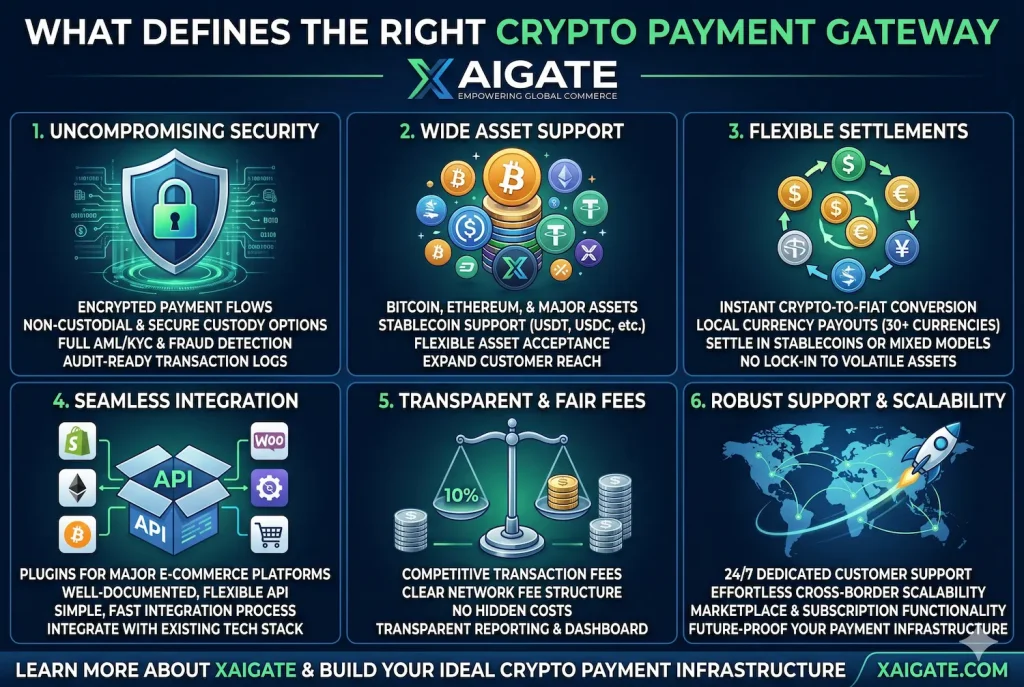
The right crypto payment gateway is not the one with the most marketing noise. It is the one that aligns with your business model, customer geography, preferred settlement method, integration stack, and internal risk tolerance.
Custodial, non-custodial, or self-hosted
Your first decision is operational control. Some gateways act as managed service providers, while others lean toward self-custody or self-hosted infrastructure. BTCPay Server is explicit here: it is self-hosted, open-source, and positions itself around 0% processing fees with no third party in the transaction flow.
- Custodial or managed gateways suit speed and simplicity: They are usually easier for mainstream businesses starting with crypto acceptance.
- Non-custodial options appeal to control-focused teams: They reduce dependence on a third party for fund custody.
- Self-hosted tools fit technical teams: They offer more ownership, but require more internal capability and support.
Settlement options and treasury fit
Settlement determines whether crypto payments become practical or painful. Some businesses want direct crypto settlement, some want stablecoins, and many want local currency in a bank-linked flow. Stripe’s stablecoin setup and CoinGate’s conversion tools show how much the market is moving toward flexible payout design rather than pure coin collection.
- Choose fiat settlement if accounting simplicity comes first: This usually works best for mainstream commerce operations.
- Choose stablecoin settlement for cross-border efficiency: It can reduce FX friction while keeping value more stable.
- Choose crypto settlement only when there is a clear treasury rationale: That may include supplier payments, on-chain operations, or deliberate asset exposure.
Integration depth and operational tools
A gateway should not stop at invoice creation. Strong platforms offer APIs, plugins, payout tools, and support for recurring or mass payment workflows. NOWPayments highlights APIs, subscriptions, POS tools, plugins, and mass payouts, which makes it attractive for merchants that need more than a simple payment button.
- Plugins help fast-moving ecommerce teams: This is useful for Shopify, WooCommerce, and similar stores.
- APIs matter for SaaS and platforms: They make custom flows and embedded payments easier to build.
- Payout and subscription features extend use cases: A gateway becomes more valuable when it supports collections and disbursements.
See more: Pros and Cons of Crypto Payment Gateway in modern electronic payments
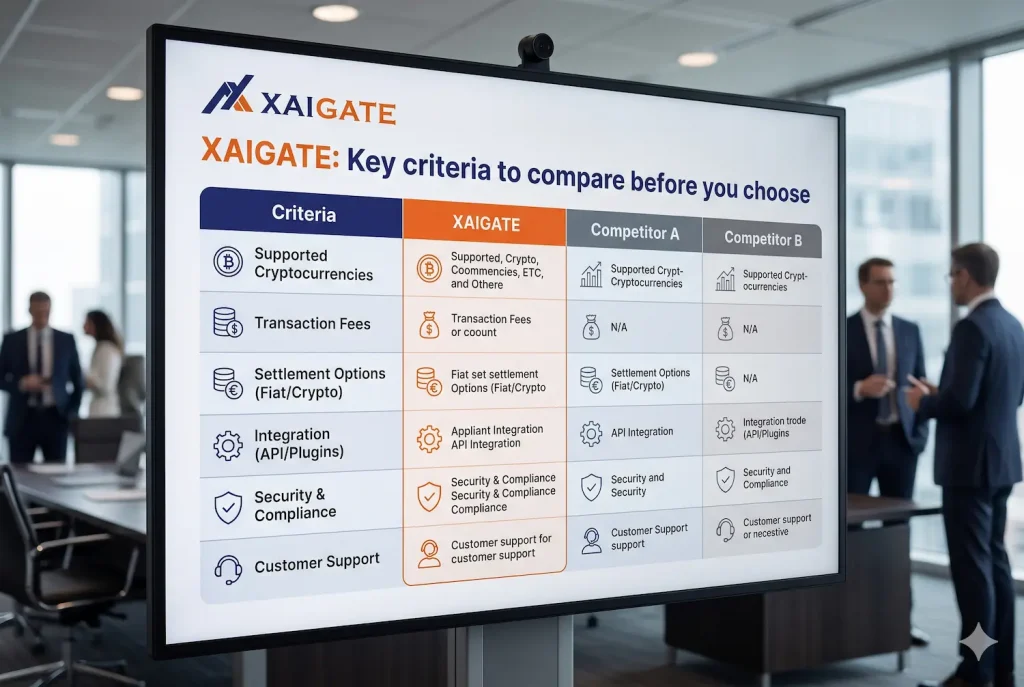
Key criteria to compare before you choose
Before you shortlist providers, compare the factors that change operational cost, customer experience, and risk. This is where most businesses separate a workable gateway from the truly right one.
Compare fees, not just headline processing rates
Published fees can look simple, but the real cost may include conversion, payout, or network-related charges. NOWPayments lists 0.5% for payments without exchange and 1% for multi-currency exchange processing. CoinGate lists a standard 1% payment processing fee, while BitPay’s merchant pricing starts at 2% + 25 cents under lower monthly volume and scales down with higher volume.
| Provider | Published core fee | Notes |
| NOWPayments | 0.5% | 1% for multi-currency exchange payments |
| CoinGate | 1% | Additional payout and conversion costs may apply |
| BitPay | 2% + $0.25 at lower volume | Lower rates at higher monthly volume |
| BTCPay Server | 0% processing fee | Hosting and internal management still apply |
Check supported assets and networks against real customer demand
Large numbers look impressive, but supported coins only matter if they match buyer behavior and the networks you want to promote. NOWPayments advertises 350+ currencies, BitPay says it supports payments across 100+ cryptocurrencies and blockchains, while Binance Pay says businesses can accept 100+ cryptocurrencies. CoinGate’s supported-currencies page also shows broad multichain support for major assets such as BTC, ETH, USDC, SOL, and others.
- Prioritize stablecoins and major chains first: These often drive the most practical business use.
- Validate network support, not just token names: USDC on one chain is not the same operationally as USDC on another.
- Avoid overpaying for unused breadth: Huge coverage is useful only if it helps conversion or expansion.
Evaluate the merchant model you actually need
Different gateways solve different problems. BitPay leans toward established merchant tooling and broader crypto acceptance. NOWPayments fits merchants that want asset breadth and flexible integrations. BTCPay Server suits control-first businesses with technical resources. Stripe is increasingly relevant for merchants that want stablecoin acceptance inside a broader fiat payments environment.
| Business type | Best-fit gateway traits |
| Ecommerce store | Plugins, wallet compatibility, stablecoin support, simple refunds |
| SaaS platform | API-first setup, subscriptions, reconciliation, payout controls |
| Cross-border merchant | Stablecoin settlement, FX flexibility, broad wallet support |
| Technical or privacy-focused business | Self-hosted or self-custody model, low third-party dependence |
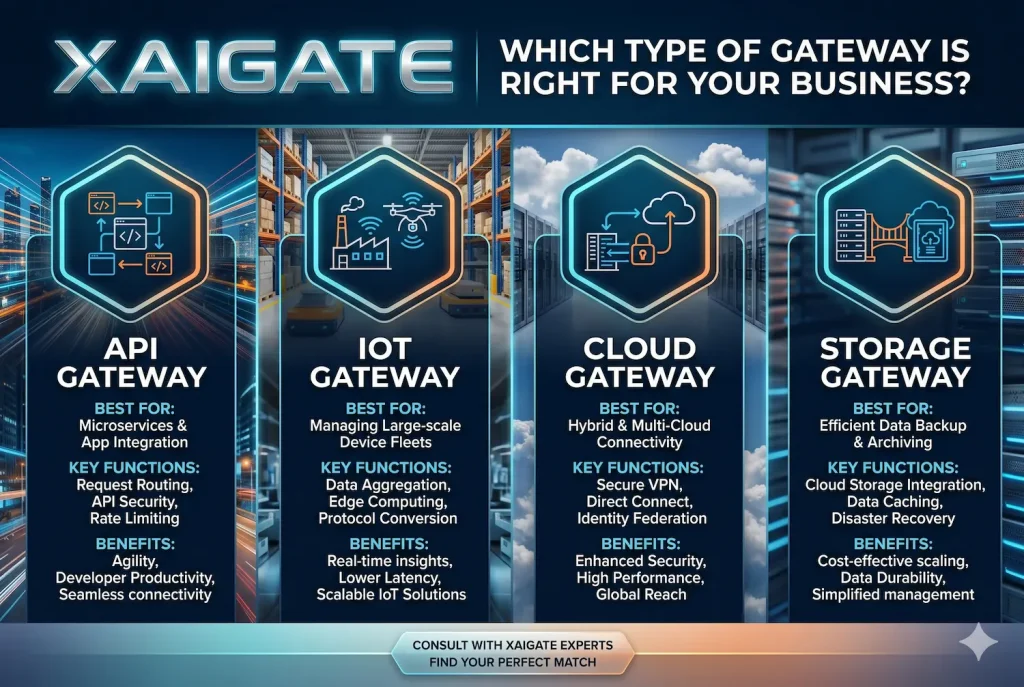
Which type of gateway is right for your business
The right crypto payment gateway depends less on brand recognition and more on business context. Below is the most practical way to think about fit.
For ecommerce brands and online retailers
Retailers usually need simple integration, reliable confirmations, and the option to settle in fiat or stablecoins. A plugin-rich provider or a payment partner that reduces volatility exposure often makes the most sense. The main priority is minimizing checkout friction while keeping operations manageable.
For SaaS, platforms, and marketplaces
These businesses usually care more about APIs, subscriptions, recurring billing potential, and payout flexibility. They may also need to collect in one asset while disbursing in another. Providers with developer tooling and operational extensibility are stronger candidates in this segment.
For cross-border and B2B payment flows
Here, stablecoin settlement, conversion options, and efficient treasury handling often matter more than broad altcoin support. Businesses expanding internationally should focus on gateways that reduce FX friction, support traceable settlement, and fit compliance expectations in target markets.
See more: Insight on Crypto Payment Gateway: A Detailed Analysis of Today’s Crypto Payment Systems
Common mistakes when choosing a crypto gateway
Many merchants choose based on popularity, then discover operational gaps after launch. The better path is to evaluate the whole payment lifecycle from checkout to settlement to reporting.
- Choosing based only on the lowest fee: A cheaper headline rate can hide conversion, payout, or support limitations.
- Ignoring settlement design: Accepting crypto is easy; receiving funds the way your finance team needs is harder.
- Overvaluing coin count: Wide coverage is useful, but only when it matches customer demand and supported networks.
- Underestimating integration and reporting needs: What works for a small store may break at scale for a SaaS or marketplace.
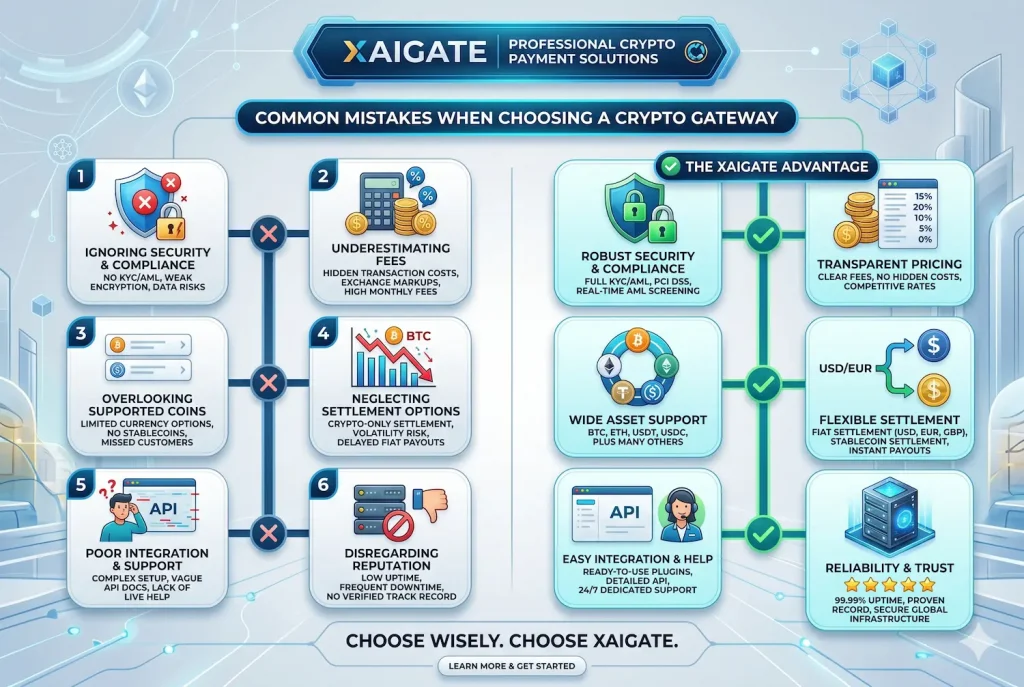
Final takeaway: how to choose the right crypto payment gateway
The right crypto payment gateway is the one that fits your revenue flow, not the one with the loudest brand. Start with four questions: how your customers want to pay, how your finance team wants to settle, how much control your business needs over custody, and how deeply the gateway must integrate with your current systems. Once those answers are clear, provider selection becomes much easier.
If XAIGATE is positioning this topic for conversion, the smartest CTA is not to promise that one gateway fits every merchant. It is to help prospects evaluate the right setup for their model, risk profile, and target markets.
For daily updates, subscribe to XAIGATE’s blog!
We may also be found on GitHub, and X (@mxaigate)!
FAQs – Right Crypto Payment Gateway
1. What is the right crypto payment gateway?
It is the gateway that fits your business model and payment flow.
2. What should merchants compare first?
Compare fees, settlement, supported coins, APIs, and reporting.
3. Is the lowest fee always best?
No, hidden conversion or payout costs may apply.
4. Why does settlement matter?
Settlement affects accounting, cash flow, and volatility risk.
5. Should businesses accept stablecoins?
Yes, stablecoins can reduce price volatility.
6. Are supported coins important?
Yes, but only if they match real customer demand.
7. Do APIs matter for crypto payments?
Yes, APIs support custom checkout and platform workflows.
8. Are plugins useful for ecommerce stores?
Yes, plugins make integration faster and simpler.
9. Is self-custody better than custodial service?
It depends on control needs, risk tolerance, and technical resources.
10. What is the best first step?
Map your checkout, settlement, compliance, and integration needs.