
A business payment system is like a front door. If someone else controls the key, they can decide how fast you enter, how much you pay, and what data you share. A self hosted crypto payment gateway flips that model. Instead of depending fully on a third-party processor, businesses can manage crypto payments through their own infrastructure. This gives merchants more control over settlement, payment data, wallet connection, and integration logic. For companies that want to accept crypto payments with fewer intermediaries, self-hosting can become a strategic payment advantage. Explore the details with XAIGATE in the article below.
Contents
- 1 What Is a Self Hosted Crypto Payment Gateway?
- 2 Self Hosted vs Hosted Crypto Payment Gateway
- 3 Key Benefits of a Self Hosted Crypto Payment Gateway
- 4 Challenges Businesses Should Know Before Self Hosting
- 5 Essential Features to Look for in a Self Hosted Crypto Payment Gateway
- 6 FAQs – Self Hosted Crypto Payment Gateway
- 7 Conclusion
What Is a Self Hosted Crypto Payment Gateway?
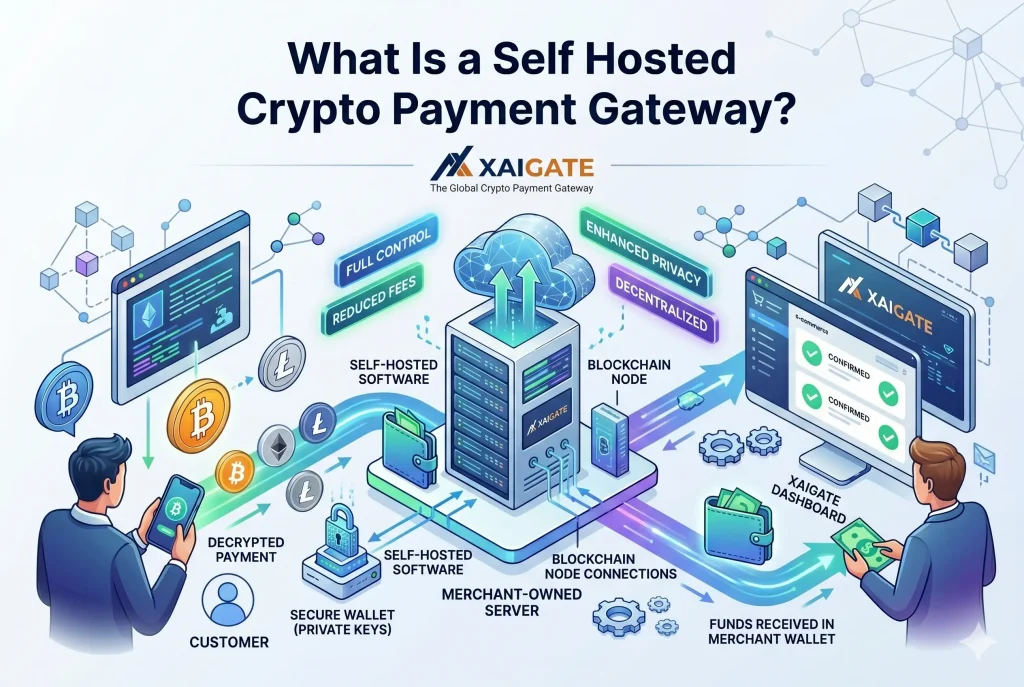
A self hosted crypto payment gateway is a payment solution that runs on infrastructure controlled by the merchant. It helps businesses accept crypto payments while keeping more ownership over payment flow, wallet settlement, and transaction data.
Definition of a self hosted crypto payment gateway
A self hosted crypto payment gateway allows businesses to process cryptocurrency payments through their own server or controlled environment. Unlike a fully hosted crypto payment processor, the merchant does not rely entirely on a third-party platform to manage every payment step.
In this model, the gateway helps generate payment invoices, track blockchain confirmations, connect wallets, and update order status. The business can decide which cryptocurrencies to accept, how invoices appear, and how payment data is handled.
The main value is control. A merchant can build a payment setup that matches its technical needs, risk policy, and customer experience instead of accepting fixed rules from a centralized provider.
How self hosted crypto payments work
A self hosted cryptocurrency payment gateway follows a clear payment flow. The customer selects crypto at checkout, the gateway creates an invoice, and the customer sends funds to the provided wallet address.
After the transaction reaches the blockchain, the gateway tracks confirmation status and updates the merchant system. Depending on configuration, funds can settle directly into the merchant’s wallet instead of passing through a custodial processor.
The typical flow includes:
- Invoice generation: The gateway creates a payment request with amount, currency, wallet address, and expiration time.
- Blockchain monitoring: The system checks whether the customer has sent the correct amount to the correct address.
- Payment confirmation: Once the transaction meets confirmation rules, the order status changes automatically.
- Wallet settlement: Funds move directly to the merchant-controlled wallet or configured payment address.
This flow gives businesses more visibility into each transaction. It also reduces reliance on external payment intermediaries during settlement.
Self Hosted vs Hosted Crypto Payment Gateway
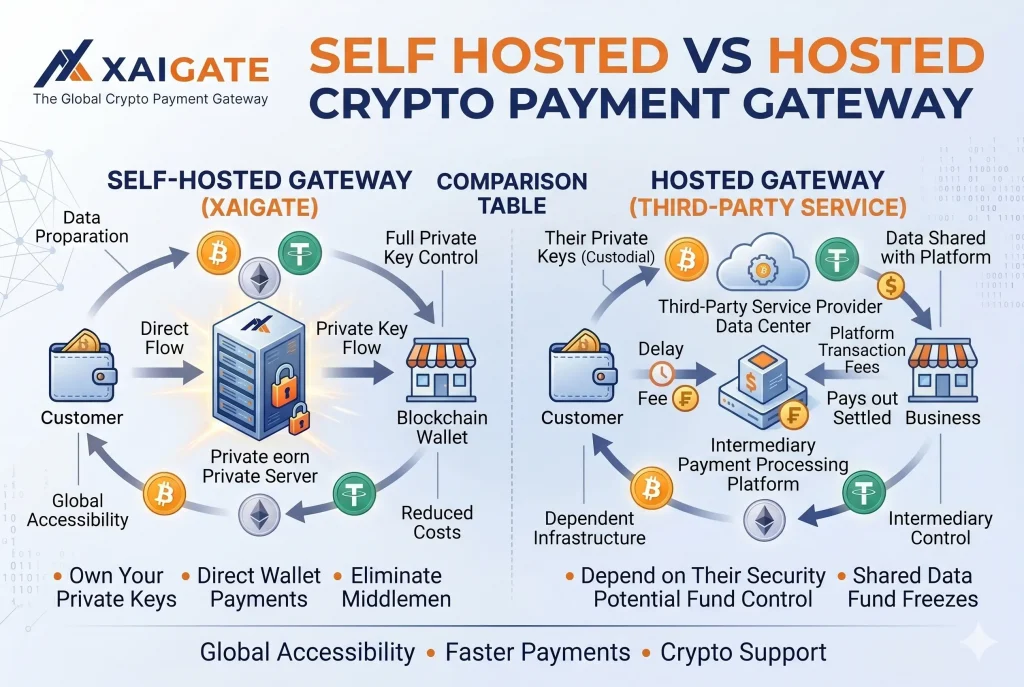
The main difference between self hosted and hosted crypto payment gateway models is ownership. One prioritizes control and flexibility, while the other prioritizes convenience and managed operation.
Custody and control over funds
With a hosted crypto payment gateway, the provider may manage major parts of the payment process. In some models, the provider can also hold funds before payout to the merchant.
A self hosted crypto payment gateway gives the merchant stronger control over wallet settlement. Payments can move directly to a business-controlled wallet, reducing dependence on custodial platforms.
This difference matters because custody affects risk. When a third party holds funds, merchants must trust its security, payout policy, account rules, and operational stability. With non-custodial settlement, the business controls access to its own crypto assets.
See more: Top Crypto Payment Gateways for Businesses in 2026
Setup, maintenance, and technical responsibility
A hosted payment processor is usually easier to start. The merchant creates an account, connects a plugin or API, and follows the provider’s onboarding process.
Self-hosting requires more technical responsibility. The business may need to configure servers, connect wallets, manage updates, monitor uptime, and secure admin access. This creates more work, especially for teams without technical resources.
However, that responsibility also creates flexibility. Businesses can customize checkout rules, supported assets, invoice logic, payment notifications, and internal reporting. For technical teams, this control can be more valuable than a plug-and-play setup.
Privacy, compliance, and business data ownership
A hosted crypto payment processor usually stores more payment data inside its own system. This may simplify reporting, but it can also limit the merchant’s control over customer and transaction information.
With a self hosted crypto payment gateway, businesses can keep more payment data inside their own environment. This supports stronger data ownership and can help teams design internal reporting workflows.
However, self-hosting does not remove compliance obligations. Merchants still need to manage tax records, accounting processes, refund policies, AML considerations, and local regulatory requirements based on their market.
Key Benefits of a Self Hosted Crypto Payment Gateway
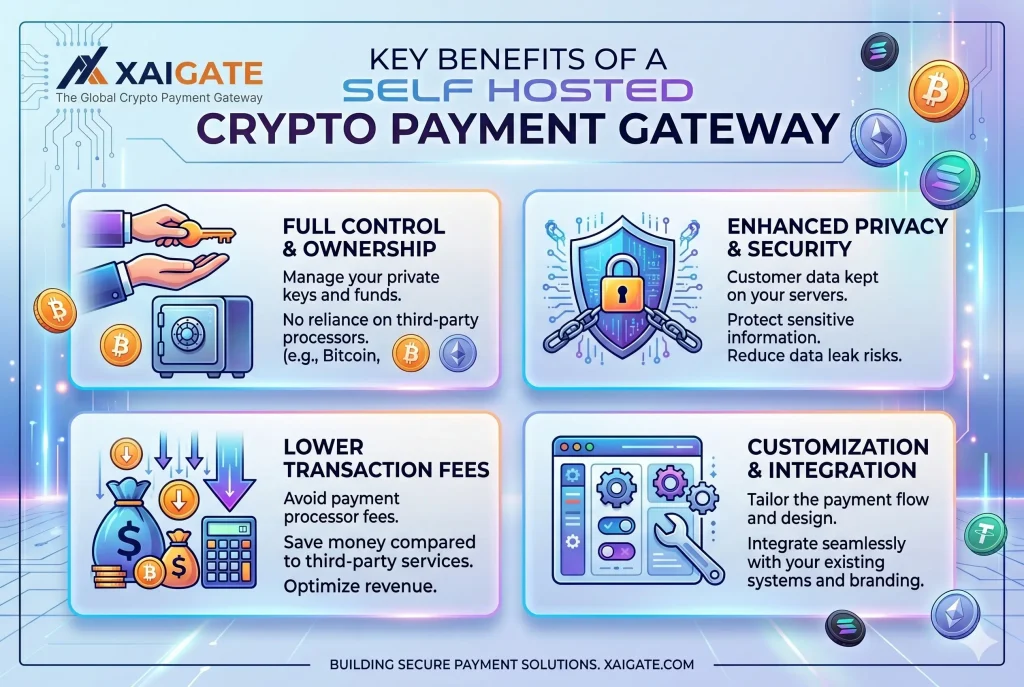
The biggest benefit of a self hosted crypto payment gateway is not only lower cost. It is the ability to build a crypto payment flow around business control, customer needs, and operational independence.
Lower payment processing costs
Traditional payment systems often include multiple intermediaries. Card networks, banks, processors, and settlement providers can add fees at different stages of the payment journey.
A self hosted crypto payment gateway can reduce some of these layers. Since blockchain payments can settle directly between customer and merchant wallet, businesses may avoid unnecessary third-party processing charges.
Cost benefits usually come from:
- Fewer intermediaries: Direct crypto settlement can reduce reliance on payment middlemen.
- Lower processor dependency: Merchants do not need to route every transaction through a centralized payment account.
- Flexible asset choice: Businesses can accept stablecoins or selected crypto assets based on cost, speed, and customer demand.
- Better fee visibility: Blockchain transaction fees are easier to track inside a transparent payment flow.
The exact savings depend on network fees, transaction volume, asset selection, and internal setup cost. Still, for high-volume businesses, fee control can become a major advantage.
Better control over crypto payment infrastructure
A self hosted crypto payment gateway allows businesses to design payment infrastructure around their own workflow. This is useful for merchants that need more than a generic checkout button.
A business can decide which coins to accept, which wallets to connect, how many confirmations are required, how invoices expire, and how payment events trigger internal systems.
This control supports:
- Custom checkout experience: Merchants can align crypto payments with brand, product, and customer journey.
- API-based automation: Payment events can connect with order systems, CRM, accounting, or internal dashboards.
- Asset management rules: Businesses can choose supported cryptocurrencies, stablecoins, and wallet structures.
- Operational visibility: Teams can track crypto invoices, transaction status, and settlement behavior more clearly.
For companies with technical teams, this flexibility helps turn crypto payments into a controlled business infrastructure layer.
Non-custodial settlement and reduced intermediary risk
A non-custodial crypto payment gateway helps merchants receive payments without handing full control of funds to an external processor. This reduces exposure to payout delays, frozen accounts, and third-party custody risk.
When funds settle into a merchant-controlled wallet, the business can manage its own asset storage, treasury process, and conversion strategy. This is important for companies that want direct access to crypto revenue.
Reduced intermediary risk does not mean zero risk. The merchant must still protect wallet access, private keys, seed phrases, and server credentials. However, the risk changes from relying on another company to managing internal security correctly.
Challenges Businesses Should Know Before Self Hosting
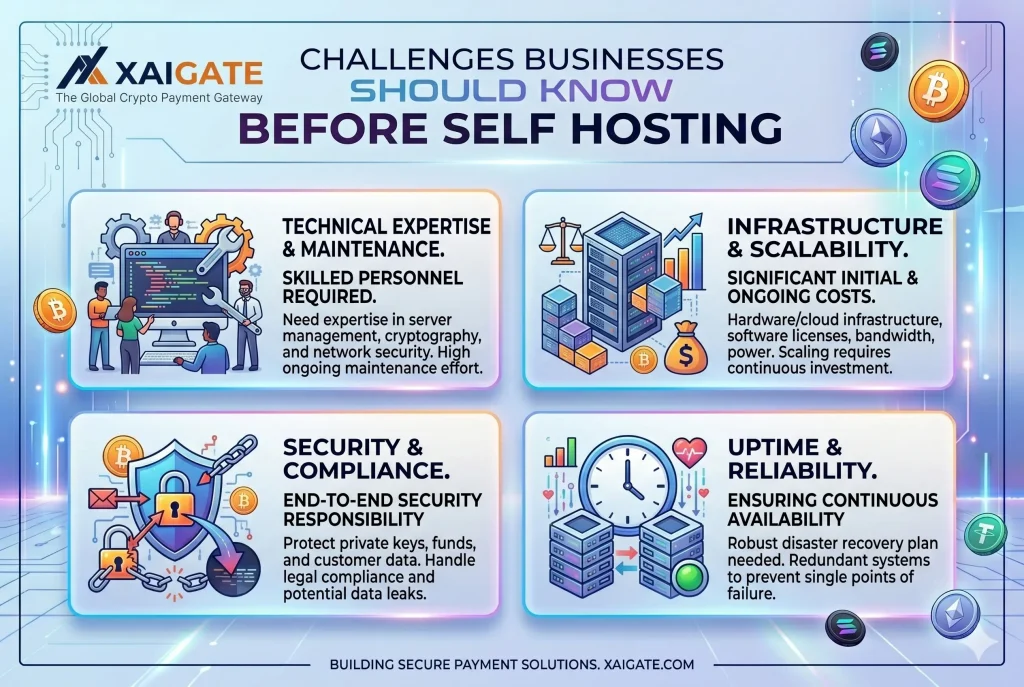
Self-hosting gives control, but it also shifts responsibility to the business. Before choosing this model, merchants should evaluate whether they have the right technical, security, and operational foundation.
Key challenges include:
- Technical setup: Businesses need server configuration, payment gateway deployment, wallet connection, domain setup, SSL, and system testing before going live.
- Security responsibility: The merchant must protect admin accounts, wallet access, private keys, API credentials, backups, and server permissions from unauthorized access.
- Maintenance: A self hosted crypto payment gateway needs updates, uptime monitoring, bug fixes, node connection checks, and regular security reviews.
- Compliance: Self-hosting does not remove tax, accounting, reporting, AML, or local regulatory duties. Each merchant must follow the rules in its operating markets.
- User experience: Checkout speed, payment instructions, invoice expiration, network selection, refund policy, and confirmation handling still need careful design.
For many businesses, the decision is not about whether self-hosting is better in every case. The real question is whether the business values ownership enough to manage the extra responsibility.
See more: Top Crypto Payment Gateways 2026: Best Options for Global Merchants
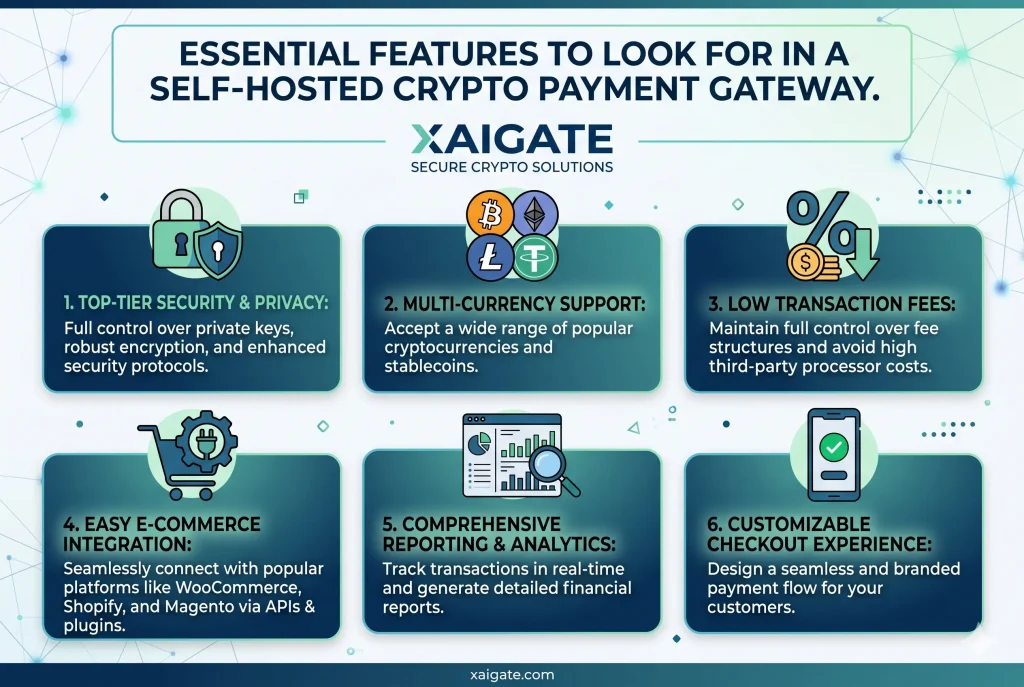
Essential Features to Look for in a Self Hosted Crypto Payment Gateway
A good self hosted crypto payment gateway should give businesses control without making daily operations too complicated. Focus on features that support secure settlement, smooth checkout, and easy integration.
- Non-custodial wallet settlement: The gateway should let merchants receive funds directly into wallets they control. This reduces reliance on third-party custody and gives businesses clearer ownership over crypto revenue.
- Multi-currency support: Businesses should be able to accept major cryptocurrencies and stablecoins based on customer demand. Stablecoin support is especially useful because it reduces pricing volatility during checkout.
- API and webhook integration: APIs help connect crypto payments with websites, apps, order systems, and internal dashboards. Webhooks allow the system to update payment status automatically when an invoice is paid, expired, or underpaid.
- Merchant dashboard: A clear dashboard helps teams manage invoices, track transactions, check payment status, and review settlement activity without relying only on developers.
- Checkout customization: The gateway should allow businesses to adjust payment instructions, invoice expiration time, supported assets, and confirmation rules to match their customer journey.
- Security controls: Look for admin permission settings, secure access management, wallet protection, backup support, and regular update options. Self-hosting gives control, but security must stay simple to manage.
- Reporting and reconciliation: Businesses need exportable transaction records, invoice history, and settlement data for accounting, tax preparation, and financial review.
- Scalability: The gateway should handle growing transaction volume, more payment assets, and future integration needs as the business expands.
FAQs – Self Hosted Crypto Payment Gateway
1. What is a self hosted crypto payment gateway?
It lets businesses accept crypto through their own infrastructure.
2. How does self hosted crypto payment work?
It creates invoices, tracks blockchain confirmations, and updates orders.
3. What is the main benefit of self hosting?
Businesses get more control over payments, data, and settlement.
4. Is self hosted better than hosted?
It depends on control needs, technical resources, and risk tolerance.
5. Does self hosting support non-custodial settlement?
Yes, funds can settle directly into merchant-controlled wallets.
6. What are the main challenges?
Setup, security, maintenance, compliance, and user experience.
7. Do businesses need technical skills?
Yes, self hosting requires server, wallet, and security management.
8. Are APIs and webhooks important?
Yes, they connect payments with orders, dashboards, and reports.
9. Is compliance still required?
Yes, tax, accounting, AML, and local rules still apply.
10. What should merchants check first?
Check wallets, security, uptime, coins, reporting, and support.
Conclusion
A self hosted crypto payment gateway gives businesses more ownership over how they accept, track, and settle crypto payments. It reduces dependence on intermediaries, improves control over payment data, and supports flexible integration with business systems.
Self-hosting is not only a technical decision. It is a strategic choice for companies that want stronger control over payment infrastructure, customer checkout, wallet settlement, and crypto revenue flow.
XAIGATE helps businesses accept crypto payments with a more flexible and scalable payment setup. Start building a payment flow that gives your business more control, clearer settlement, and a stronger path into crypto commerce.
For daily updates, subscribe to XAIGATE’s blog!
We may also be found on GitHub, and X (@mxaigate)!