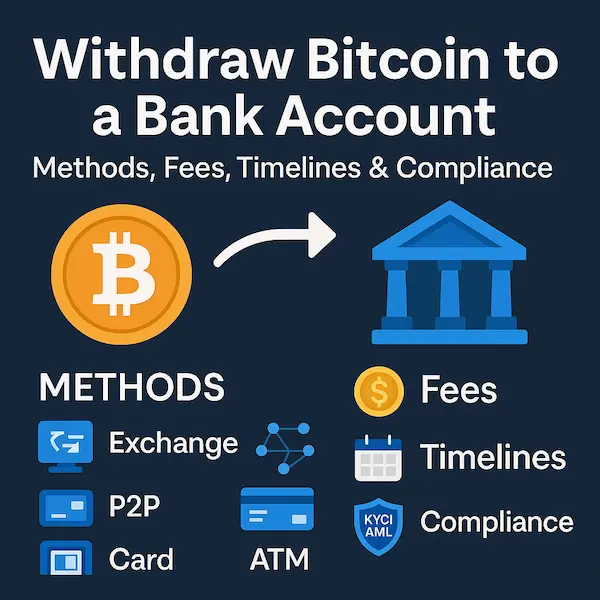
Getting funds from BTC into traditional finance isn’t “send-to-bank.” To withdraw Bitcoin to bank account, you must first convert BTC to fiat through a regulated off-ramp, then push a bank transfer over local rails (ACH/SEPA/FPS/SWIFT). Below is a clear, compliant path that balances speed, cost, and documentation.
Featured Answer:
You can’t send Bitcoin directly to a bank account. First convert BTC to fiat using a regulated off-ramp—a centralized exchange, a reputable P2P marketplace, or a licensed cash-out app—then withdraw by bank transfer (ACH/SEPA/FPS/SWIFT). Expect KYC, a trading spread, withdrawal fees, and settlement times ranging from near-instant to 1–5 business days.
1. Can You Withdraw Bitcoin to Bank Account?
Short answer: not directly. Blockchains and bank ledgers live in different worlds—one records crypto assets, the other manages fiat balances. The bridge between them is called an off-ramp. When you “withdraw bitcoin to a bank account,” what actually happens is:
-
Sell BTC on a compliant platform →
-
Receive fiat (USD/EUR/GBP, etc.) as an account balance on that platform →
-
Initiate a bank transfer to your personal/business bank account.
On-Chain vs. Banking Rails
-
On-chain (BTC): peer-to-peer, probabilistic finality, transaction fees paid to miners/validators.
-
Banking rails (fiat): account-based, governed by banking rules, settlement windows, cut-off times, and compliance checks.
-
Implication: a bank cannot “receive BTC”; it can only receive fiat after the BTC is converted.
Off-Ramp 101 (What “Direct” Really Means)
-
Centralized exchanges (CEX): You deposit BTC, sell to fiat at market/limit, then withdraw via ACH/SEPA/FPS/SWIFT.
-
P2P marketplaces: You trade with a verified buyer who pays you via your preferred local bank rail; escrow protects both sides.
-
Licensed off-ramp apps/OTC: You get a live quote for BTC→fiat and receive a payout to your bank—simple, often pricier per transaction.
Why Banks Ask for Documentation
To reduce fraud and AML risk, banks and off-ramps will often request KYC (identity checks) and sometimes source-of-funds (e.g., exchange logs, invoices, mining records). This is normal and, when prepared, speeds up reviews.
Table 1: Bank Transfer Rails by Region (Speed, Limits, Notes)
| Rail | Region(s) | Typical Speed (ETA) | Indicative Per-Tx Limit* | Cut-Off Sensitivity | Best For | Notes |
|---|---|---|---|---|---|---|
| ACH | US | 1–3 business days | Up to ~$25k+ (platform/bank dependent) | High | Low-cost retail & SME payouts | Cheap; slower around weekends/holidays |
| SEPA | EU | Same/next business day | €15k–€100k+ (varies) | Medium | Cost-efficient EUR settlements | Strict name matching |
| SEPA Instant | EU (participating banks) | Near-instant (24/7) | €5k–€100k (bank dependent) | Low | Urgent retail/SME payouts | Both sender & receiver must support Instant |
| Faster Payments (FPS) | UK | Near-instant | £20k–£1m (bank/tier dependent) | Low | UK retail/SME | Receiver profile may cap limits |
| NPP/Osko | AU | Near-instant | A$20k–A$250k (bank dependent) | Low | SME/payroll | Limits vary by tier/profile |
| UPI/IMPS | India | Instant | ₹100k–₹500k+ | Low | Domestic retail | App/bank-level caps apply |
| PIX | Brazil | Instant | R$5k–R$50k+ | Low | Domestic retail | 24/7; dynamic risk-based limits |
| SPEI | Mexico | Near-instant | MXN 20k–MXN 100k+ | Low–Med | Domestic SME | Maintenance windows occur |
| SWIFT | Global | 1–5 business days | Very high | High | Cross-border wires | Intermediary fees; exact memo required |
2. How to Withdraw Bitcoin to Bank Account (3 Proven Methods)
Your best method depends on speed, fees/spread, limits, and how much paperwork you can provide. Start small (test withdrawal), then scale.
Method 1: Centralized Exchange (CEX)
Best for: consistent pricing, high liquidity, clear audit trail.
Step-by-step
-
Create & verify your account (KYC). Complete ID + liveness; add your legal name as on your bank account.
-
Deposit BTC. Send BTC from your wallet to the exchange deposit address; wait for required confirmations.
-
Sell BTC for fiat. Use a market order for immediacy or limit order to control price; note the trading fee and spread.
-
Add your bank beneficiary. Enter accurate details (ACH/SEPA/FPS/SWIFT); some regions require a small test transfer.
-
Withdraw to your bank. Confirm fees and cut-off times; track status. Weekends/holidays may delay settlement.
Pros: low spread, high liquidity, exportable CSVs, better for larger sums.
Cons: funds are custodial until sold; occasional compliance holds if documents are incomplete.
Pro tips
-
Use withdrawal whitelists and 2FA to secure your account.
-
Prefer SEPA Instant/FPS where available for near-instant arrival.
-
Keep trade IDs and bank references aligned for easy reconciliation.
Method 2: P2P Marketplace
Best for: instant local payments, flexible rates, regions with strong real-time rails.
Step-by-step Withdraw Bitcoin to bank account
-
Filter buyers carefully. Check payment method, rating, completed trades, and whether they passed KYC on the platform.
-
Lock the trade in escrow. Never move to private chat; follow on-platform instructions only.
-
Wait for funds to clear in your bank. Confirm cleared (not just “initiated”) before you release BTC from escrow.
-
Release BTC only after verifying your bank balance and saving the payment proof.
Pros: potentially near-instant payouts via local rails; wide payment options.
Cons: higher fraud risk if you bypass escrow; dispute resolution can take time.
Pro tips
-
Start with small trades to build reputation and learn the flow.
-
Reject buyers who pressure you to release early or switch channels.
-
Save screenshots/receipts and bank confirmations for records.
Method 3: Licensed Off-Ramp App / OTC
Best for: larger or urgent transfers, concierge onboarding, pre-cleared limits.
Step-by-step
-
KYC + link your bank. Business accounts may need corporate docs and authorized signatories.
-
Request a live quote. See BTC→fiat rate, spread, and payout fee; many desks hold quotes for a short window.
-
Send BTC & receive payout. After on-chain confirmations, fiat is sent to your bank—often same day (T+0) or next day (T+1).
Pros: simple UX, dedicated support, higher limits, predictable settlement.
Cons: per-transaction fees/spreads can be higher than CEX.
Pro tips
-
Ask for pre-clearance on expected volumes and jurisdictions.
-
Use a test wire before a large transfer to validate beneficiary details.
-
Keep a documentation pack (IDs, bank letters, invoices, wallet logs) ready to accelerate reviews.
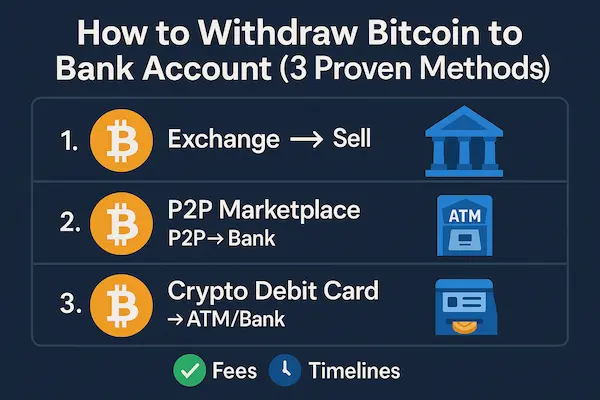
3. Fees, Limits & Settlement Times When You Withdraw Bitcoin to Bank Account
Before you withdraw bitcoin to bank account, calculate the all-in cost and your realistic timeline. Don’t chase the lowest fee in isolation—optimize for spread, rail speed, and documentation that avoids compliance holds.
Total Cost (Think in Layers, Not Line Items)
-
BTC network fee: on-chain send from your wallet to the off-ramp.
-
Trading fee: percentage on the BTC→fiat conversion.
-
Spread: the silent cost between bid/ask; usually tighter on liquid CEXs, wider during volatility or on thin books.
-
Fiat withdrawal fee: platform charge for ACH/SEPA/FPS/SWIFT; some banks add incoming wire fees.
-
FX & extras (when applicable): cross-currency conversion, intermediary bank charges on SWIFT.
For small, urgent cash-outs, a slightly higher spread on fast local rails can be worth it. For large tickets, prioritize liquidity (lower spread) and clean audit trails.
Limits Scale With Verification
-
Per-transaction / daily / 30-day limits rise with KYC tiers and source-of-funds clarity.
-
Personal vs. business: business accounts (with corporate docs) can unlock higher ceilings and dedicated reviews.
-
Pre-clearance: if you’ll cash out regularly, ask the provider to pre-approve your expected volumes and jurisdictions.
How Fast Do Funds Arrive?
-
ACH (US): ~1–3 business days (cut-offs matter).
-
SEPA / SEPA Instant (EU): same/next day; Instant can be near-instant between supported banks.
-
Faster Payments (UK): near-instant, subject to platform/bank limits.
-
SWIFT (global): ~1–5 business days depending on corridors and intermediaries.
Cut-off & calendar effects: requests after platform cut-off, weekends, and bank holidays push settlement to the next window. Track the withdrawal reference and keep the platform status page handy.
4. Regional Playbook: Best Rails & Practices by Market
Your approach to withdraw bitcoin to bank account changes by region because rails, limits, and bank policies differ. Choose the rail that matches urgency, amount, and documentation comfort.
1. United States (ACH & Domestic Wires)
-
Rails: ACH for low cost, domestic wire for same-day finality; SWIFT for cross-border USD.
-
Best fit: Liquid CEX for predictable pricing; OTC for $50k+ with pre-approved limits.
-
Operational notes: ensure legal-name matching, keep trade IDs ⇄ bank references aligned, export CSV logs for taxes.
Useful variants to sprinkle in copy: cash out bitcoin to bank (US), convert BTC to USD, off-ramp crypto to ACH.
2. European Union (SEPA / SEPA Instant)
-
Rails: SEPA credit transfer (same/next day); SEPA Instant for near-instant within participating banks.
-
Best fit: EUR order books on major exchanges minimize spread; OTC for high-value corporate flows.
-
Operational notes: strict name matching, occasional proof-of-funds checks; keep invoices/mining records if relevant.
Variants: withdraw crypto to bank (EU), convert BTC to EUR, transfer bitcoin to bank account via SEPA.
3. United Kingdom (Faster Payments / CHAPS)
-
Rails: FPS near-instant for most retail flows; CHAPS for high-value; SWIFT for cross-border GBP.
-
Best fit: GBP pairs on CEX; vetted P2P can be very fast when escrow rules are followed.
-
Operational notes: robust AML; repeated crypto credits may trigger enhanced due diligence—prepare documents in advance.
Variants: withdraw BTC to GBP bank, off-ramp bitcoin via Faster Payments.
4. APAC (India, Singapore, HK, AU—varies)
-
Rails: UPI/IMPS (IN), FAST/PayNow (SG), FPS (HK), NPP/Osko (AU); SWIFT for cross-border.
-
Best fit: local CEX/P2P for retail speed; licensed off-ramp apps/OTC for larger or cross-border settlements.
-
Operational notes: country-specific KYC (tax IDs, address proofs) and occasional bank inquiries on crypto proceeds.
Variants: convert BTC to fiat locally, crypto off-ramp to bank in APAC.
LATAM (PIX, SPEI, etc.)
-
Rails: PIX (BR) and SPEI (MX) offer rapid domestic transfers; SWIFT for USD/EUR wires.
-
Best fit: P2P with escrow is common—confirm cleared funds before releasing BTC; reputable CEXs where available.
-
Operational notes: FX rules can shift; maintain a secondary rail (second exchange or OTC) as contingency.
Variants: Withdraw Bitcoin to bank account via PIX/SPEI, cash out BTC to local bank.
Table 2: Off-Ramp Methods – Risk, Docs & When to Choose
| Method | Fraud Risk | Compliance Friction | Docs Required | Common Pitfalls | Choose When |
|---|---|---|---|---|---|
| CEX (Centralized Exchange) | Low–Med | Med–High (KYC/SoF) | ID, trade/deposit/withdrawal CSVs, withdrawal reference | Cut-off delays, name mismatches | $5k–$20k; need tight spread and clean bookkeeping |
| P2P (with Escrow) | Medium | Low–Med | Trade receipt, bank credit proof | Off-platform scams, “release early” pressure | ≤$2k; need instant local rails (SEPA Instant/FPS/PIX) |
| Licensed Off-Ramp / OTC | Low | High (for large tickets) | ID/Corp docs, source-of-funds, deal ticket | Higher nominal fees, onboarding time | ≥$25k; need T+0/T+1 certainty and bank comfort |
5. Compliance, Risk & Taxes
Before you withdraw bitcoin to bank account, assume platforms and banks will check identity, source of funds, and transaction history. Being documentation-ready cuts delays and protects your account.
KYC/AML & Source of Funds
-
KYC: government ID, liveness, address proof; business flows need corporate docs + signatories.
-
SoF: exchange logs, wallet provenance, invoices/contracts, mining records. Keep hashes/TxIDs and dates aligned with fiat receipts.
-
Name match: platform account name must equal bank account holder—mismatches trigger holds.
Sanctions, Privacy Tools & Taint
-
Funds touching mixers/sanctioned entities may be flagged. Use coin-control where supported; avoid high-risk UTXOs.
-
If flagged, provide a clear flow narrative (wallet → exchange → sale → bank) with timestamps.
Taxable Events & Reporting
-
Selling BTC for fiat is usually a taxable disposal (capital gains/income by jurisdiction).
-
Track cost basis, acquisition dates, sale price, fees/spread, and fiat received.
-
Export CSVs (trades, deposits, withdrawals) and keep bank statements for 5–7 years.
Record-Keeping & Reconciliation
-
Maintain a single ledger mapping: TxID ⇄ trade ID ⇄ withdrawal reference ⇄ bank credit.
-
Save invoices (OTC), escrow receipts (P2P), and support tickets tied to each payout.
-
For recurring large transfers, ask your provider for a pre-clearance letter and defined review SLAs.
6. Safety Checklist Before You Withdraw
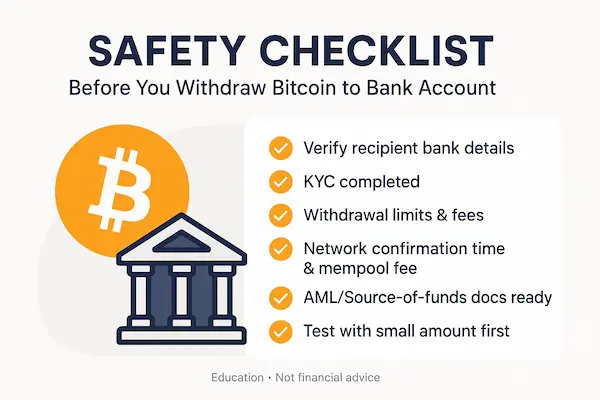
Security and process discipline matter as much as fees. Use this list each time you withdraw bitcoin to bank account—start small, then scale.
Counterparty & Platform Hygiene
-
Reputation first: verified platforms, escrow on P2P, no off-platform chats.
-
Test trade: run a small pilot to validate rails, cut-offs, and reconciliation.
-
Payment confirmation: release BTC only after funds clear (not just “initiated”).
Account & Wallet Security
-
2FA + passkeys; enable withdrawal whitelists and anti-phishing codes.
-
Segregate hot vs. cold funds; send from clean UTXOs; label addresses for audit trails.
-
Monitor login alerts; lock API keys you don’t use.
Payment Notes, Cut-Offs & Calendars
-
Follow required memos/notes on withdrawals; wrong notes can cause rejections.
-
Check cut-off times, weekend/holiday calendars, and intermediary bank windows.
-
Prefer instant rails (SEPA Instant/FPS/PIX/UPI) when available and limits suffice.
Dispute & Escalation Readiness
-
Keep a documentation pack (ID, SoF logs, invoices, TxIDs, bank refs) ready.
-
If a payout is delayed, contact support with a concise timeline and attached evidence.
-
Maintain a fallback rail (second exchange or OTC) for time-critical settlements.
7. Case Studies
Case 1: €1,800 Freelancer Payout via SEPA Instant (Fast, Controlled Spread)
Profile: Portugal-based designer paid in BTC; wants near-instant EUR to cover rent.
Rail chosen: Reputable P2P (escrow) → SEPA Instant to Revolut/Lusobank.
Execution
-
Filtered buyers: ≥99% completion, EU KYC passed, only “SEPA Instant” offers.
-
Escrow opened; buyer’s transfer hit as SEPA Instant (credit confirmed in-app).
-
Released BTC after cleared funds and saved PDF receipt.
Numbers
-
BTC gross @ €63,400/BTC × 0.0284 BTC = €1,800.
-
Quote spread: 0.45% (P2P) → €8.10
-
Platform/escrow fee: €1.40
-
Net received: €1,790.50
-
ETA: 9 minutes (trade lock → bank credit)
Docs pack: Trade receipt, SEPA Instant credit PDF, wallet TxID.
Outcome: Rent paid instantly; small premium over CEX offset by time value.
Lesson: For sub-€2k with deadline pressure, P2P + SEPA Instant is optimal if you follow escrow rules and confirm cleared funds before release.
Case 2: $14,500 Contractor Tax Reserve via CEX + ACH (Low Spread, Clean Ledger)
Profile: US developer consolidating BTC income into USD for quarterly taxes.
Rail chosen: Centralized exchange (USD book) → ACH to Chase.
Execution
-
Deposited 0.2170 BTC; set limit sell at mid-price to trim spread.
-
Added beneficiary; initiated ACH before 4:30 pm ET cut-off.
-
Synced exchange CSV with accounting; tagged transfer “Q4-Tax-Reserve”.
Numbers
-
BTC gross @ $66,850/BTC × 0.2170 = $14,505.
-
Achieved price improvement vs. market: +$7.60
-
Trading fee 0.10%: $14.51
-
ACH withdrawal fee: $0.00 (exchange), bank inbound: $0
-
Net received: $14,497.49
-
ETA: 2 business days (submitted Thu → settled Mon)
Docs pack: Deposits/trades/withdrawals CSV, bank ACH detail, tax workpaper with cost basis.
Outcome: Tight all-in cost; fully auditable for IRS.
Lesson: For mid-size sums and bookkeeping needs, CEX + ACH wins on spread and records—even if it’s not instant.
Case 3: A$120,000 Treasury Rebalance via Licensed OTC (Pre-Cleared, T+0)
Profile: Australia-based Web3 studio moving part of BTC treasury to AUD payroll float.
Rail chosen: Licensed OTC desk → NPP/Osko same-day payout to NAB.
Execution
-
Corporate KYC (ACN/ABN, directors), source-of-funds (wallet history, prior exchange logs).
-
Pre-cleared monthly band A$100k–A$300k; compliance SLA agreed.
-
Quote 0.24% spread locked for 10 minutes; sent 1.75 BTC; received same-day Osko.
Numbers
-
BTC gross @ A$68,600/BTC × 1.75 = A$120,050.
-
OTC spread 0.24%: A$288.12
-
Payout fee: A$10.00
-
Net received: A$119,751.88
-
ETA: T+0 (funds credited 2h after confirmations)
Docs pack: Deal ticket, quote confirmation, Osko receipt, compliance pre-approval email.
Outcome: Predictable same-day settlement with bank-friendly paperwork.
Lesson: For high-value tickets needing certainty and bank comfort, OTC with pre-clearance beats chasing lowest nominal fees.
FAQs: Withdraw Bitcoin to Bank Account
1. Can I withdraw Bitcoin directly to my bank account?
No. You must first sell BTC for fiat on a regulated off-ramp (exchange, P2P with escrow, or licensed OTC), then transfer the fiat via ACH/SEPA/FPS/SWIFT.
2. What’s the fastest way to cash out BTC to a bank?
Use platforms that support instant local rails (SEPA Instant/FPS/PIX). Speed still depends on cut-off times, limits, and your bank’s policies.
3. How much does it cost to withdraw bitcoin to a bank account?
Total cost = network fee + trading fee + spread + fiat withdrawal fee. Some banks also charge for incoming wires, especially on SWIFT.
4. Do I need KYC to withdraw crypto to my bank?
Yes, for most regulated off-ramps. Higher limits usually require enhanced verification and source-of-funds documents.
5. How long do bank transfers take after selling BTC?
Typical windows: ACH 1–3 business days, SEPA same/next day (Instant can be near-instant), Faster Payments near-instant, SWIFT 1–5 business days.
6. Is P2P safe for withdrawing to a bank account?
Yes—when you use escrow, verify counterparties, keep all chats on-platform, and release BTC only after funds clear in your bank.
7. Will I owe taxes when I cash out Bitcoin?
Selling BTC for fiat is usually a taxable event. Keep cost basis, timestamps, trade CSVs, and bank statements for reporting.
8. Why did my bank flag or hold my crypto withdrawal?
Banks run compliance reviews on crypto-linked credits. Respond with ID, exchange logs, TxIDs, invoices/mining records, and a concise flow narrative.
Conclusion & Next Steps
If your goal is to withdraw bitcoin to a bank account, pick the rail that fits your amount, deadline, and paperwork appetite—then run a tiny test before scaling. Keep a clean documentation trail (TxIDs ⇄ trade IDs ⇄ bank references), align names across accounts, and plan around cut-offs/weekends to avoid avoidable delays.
Quick Summary
| Scenario | Best Method | Why It Wins | ETA | Cost Signal | Docs to Prepare |
|---|---|---|---|---|---|
| ≤ $2k, need it fast | P2P + instant local rail (SEPA Instant/FPS/PIX) | Near-instant with escrow | Minutes–hours | Medium (spread) | Trade receipt, bank credit proof, wallet TxID |
| $5k–$20k, cost-sensitive | CEX + local rail (SEPA/ACH/FPS) | Tight spread, clean CSVs | Same day–T+2 | Low–Medium | Exchange CSVs, withdrawal reference, bank statement |
| ≥ $25k or strict timing | Licensed OTC / off-ramp app | Pre-cleared limits, concierge support | T+0–T+1 | Medium (explicit fee) | IDs/Corp docs, source-of-funds pack, deal ticket |
What’s New to Watch
-
Instant rails coverage: Some EU/UK banks continue expanding SEPA Instant/FPS availability—check whether your receiving bank supports instant credits and its per-tx limits.
-
Compliance friction: Providers increasingly ask for source-of-funds on repeated crypto credits—keep a ready folder with exchange logs, invoices/mining records, and bank letters.
-
Fee transparency: Platforms are surfacing clearer all-in quotes (spread + fees). Always compare the net to bank rather than headline fees.
-
Cut-off reminders: Late-day requests still miss settlement windows; schedule withdrawals earlier on Fridays and before public holidays.
Do This Now
- Estimate your net: use the fee/time calculator in this guide to preview spread, platform fees, and ETA.
- Run a micro-withdrawal today ($50–$200) to verify bank details, memos, and reconciliation flow.
- Assemble your evidence pack: ID, exchange CSVs (deposits/trades/withdrawals), wallet TxIDs, invoices/mining records.
- Scale with confidence: move your target amount once your test settles cleanly and records are aligned.
For daily updates, subscribe to XAIGATE’s blog!
We may also be found on GitHub, and X (@mxaigate)!