As digital payments continue to grow rapidly, a crypto-friendly payment gateway is becoming an effective solution for businesses that want to accept cryptocurrency payments such as Bitcoin, Ethereum, and many other digital assets. Beyond expanding access to global customers, crypto-friendly payment gateways also support faster transaction processing, lower intermediary costs, and greater operational flexibility. In this article, XAIGATE will help you understand how crypto-friendly payment gateways work and how to integrate them effectively into your business in 2026.
Contents
How a Crypto-Friendly Payment Gateway Works
A crypto-friendly payment gateway acts as an intermediary layer connecting buyers, merchants, and blockchain networks. Through this system, businesses can accept cryptocurrency payments easily without having to directly handle the technical complexity of blockchain infrastructure.

In general, the payment process works as follows:
- The customer selects crypto as the payment method at checkout on a website or application.
- The system generates a unique wallet address or QR code corresponding to the transaction amount.
- The customer transfers cryptocurrency from their personal wallet to the provided address.
- The gateway verifies the transaction on the blockchain, usually based on multiple confirmations to ensure accuracy.
- Once confirmed, the transaction is marked as successful, and both the buyer and merchant receive a notification.
- If auto-conversion is enabled, the crypto payment can be automatically converted into fiat currency such as USD or EUR and transferred to the business account.
A key feature of many modern crypto payment gateways is auto-conversion, which helps businesses reduce exposure to cryptocurrency price volatility during the transaction confirmation period.
Benefits of Using a Crypto-Friendly Payment Gateway for Businesses
Integrating a crypto-friendly payment gateway is not only about adding another payment method. It can also create a clear competitive advantage for businesses operating in the fast-growing digital commerce landscape.
- Expanding international markets: Businesses can reach crypto users worldwide, especially in markets where traditional cross-border payment methods are limited.
- Reducing transaction costs: Compared to credit cards or international payment processors, crypto transaction fees are often lower, helping businesses optimize long-term operating costs.
- Increasing payment speed: Transactions can be confirmed on the blockchain within a short period, improving cash flow and reducing processing delays.
- Reducing chargeback risks: Unlike card payments, crypto transactions are generally irreversible, helping minimize fraud and payment disputes.
- Improving financial flexibility: Businesses can choose to hold crypto as a reserve asset or convert it immediately into fiat currency, depending on their capital management strategy.
- Enhancing modern brand image: Accepting crypto payments shows that a business is forward-thinking and open to financial technology innovation, which can appeal to younger and international customers.
- Reducing dependence on traditional banking systems: Businesses gain an additional independent payment channel, reducing the risk of disruption when banking systems face limitations or downtime.
- Supporting 24/7 cross-border transactions: Crypto payments are not limited by banking hours or holidays, allowing transactions to be processed continuously at any time.

See more: Tips to Develop a Secure Crypto Payment Gateway
Common Methods for Integrating a Crypto-Friendly Payment Gateway
Integrating a crypto-friendly payment gateway today is no longer a complex, experimental process. Instead, it has evolved into a set of standardized implementation models. Each model reflects different levels of technical maturity, operational capacity, and business strategy. Depending on company size, infrastructure, and scalability needs, the integration approach can significantly impact cost efficiency, user experience, and long-term flexibility.
Direct API Integration – Maximum Control with High Technical Demand
This is the core model used by advanced digital platforms.
- The payment gateway is connected directly via API
- The entire payment workflow is fully automated, from wallet creation to transaction confirmation
- Businesses can deeply customize checkout flows, UI, and payment logic
In-depth analysis:
- Provides full control over the payment infrastructure and user experience
- Highly suitable for companies building proprietary fintech ecosystems
- Requires strong in-house development teams and ongoing maintenance capacity
- Security management becomes critical, especially around API keys and transaction validation
Best suited for large-scale eCommerce platforms and fintech-driven businesses with long-term technical strategy.
eCommerce Platform Plugins – Fast Deployment with Limited Flexibility
This is the most widely used solution among SMEs.
- Easy installation on platforms like Shopify, WooCommerce, or Magento
- No advanced coding or technical expertise required
- Pre-built payment functions simplify crypto acceptance
In-depth analysis:
- Strong advantage in rapid deployment and low entry barrier
- Limited customization capabilities compared to API-based systems
- Businesses become dependent on third-party plugin providers
- Scalability may become an issue as transaction volume and complexity grow
Ideal for small and medium-sized businesses testing crypto payments with minimal investment.

Hosted Payment Page – Simplified Infrastructure with External Processing
This model shifts the entire payment process to a third-party environment.
- Customers are redirected to an external payment page
- The gateway handles all blockchain interactions and returns the result
- Businesses avoid direct exposure to blockchain complexity
In-depth analysis:
- Significantly reduces technical and security responsibilities
- However, it introduces friction in user experience due to redirection
- May negatively affect conversion rates if not well optimized
- Relies heavily on the trust and reliability of the payment provider
Suitable for businesses prioritizing speed of deployment over full UX control.
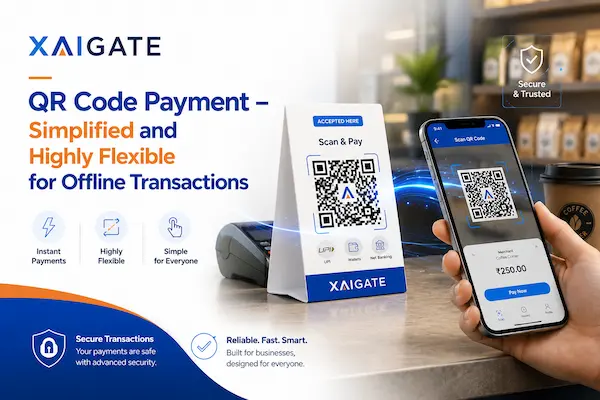
QR Code Payment – Simplified and Highly Flexible for Offline Transactions
This is the most straightforward and user-friendly method.
- A unique QR code is generated for each transaction
- Customers scan and pay directly using their crypto wallet
- No complex backend integration is required
In-depth analysis:
- Extremely effective for retail environments and face-to-face transactions
- Low technical barrier makes adoption easy for non-digital-native businesses
- Limited suitability for complex eCommerce workflows
- Depends on customer familiarity with crypto wallets
Best for physical stores, events, and instant payment scenarios.
White-Label Solution – Full Branding with Outsourced Infrastructure
This is the most advanced and business-oriented model.
- The payment system is fully branded under the company’s identity
- The underlying infrastructure is managed by the gateway provider
- Businesses can scale without building core systems from scratch
In-depth analysis:
- Enables companies to position themselves as fintech or payment service providers
- Strong scalability potential across multiple markets
- Higher cost structure compared to other integration methods
- Dependency on provider remains at the infrastructure level
Ideal for large enterprises or startups aiming to build a financial brand ecosystem.
See more: Tips for Developing a Crypto Payment Gateway: What Businesses Must Get Right From Day One
Crypto-Friendly Payment Gateway vs. Traditional Payment Gateway
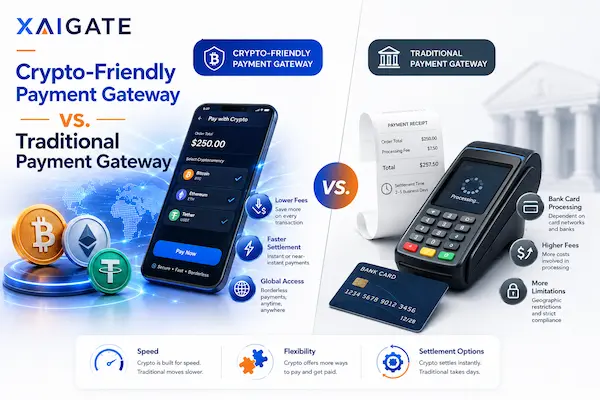
Crypto-friendly payment gateways and traditional payment gateways both process transactions, but their operating models and characteristics are very different. The table below highlights the key differences between the two:
| Criteria | Crypto Payment Gateway | Traditional Payment Gateway |
| Transaction speed | Fast, usually from a few minutes to several dozen minutes | Slower, often 1–3 days depending on the bank and country |
| Transaction fees | Lower, especially for cross-border transactions | Higher due to multiple intermediaries such as banks and card networks |
| Chargebacks | Almost no chargeback mechanism | Payment disputes and chargebacks may occur |
| Operating scope | Borderless and global | Depends on banking systems and supported regions |
| Value stability | Subject to crypto market volatility | Stable according to fiat currency value |
| Intermediary requirements | Few or almost none | Multiple intermediaries involved in processing |
In general, a crypto-friendly payment gateway stands out for its fast processing speed, lower costs, and global accessibility. Meanwhile, traditional payment gateways still maintain advantages in value stability, widespread adoption, and clearer regulatory frameworks.
FAQs – Crypto-Friendly Payment Gateway
1. What is a crypto-friendly payment gateway?
It lets businesses accept cryptocurrency payments securely.
2. How does a crypto-friendly gateway work?
It creates a wallet address, verifies payment, and updates the transaction.
3. Which coins can businesses accept?
Common options include Bitcoin, Ethereum, stablecoins, and other digital assets.
4. Can it generate QR codes?
Yes, many gateways generate wallet addresses or QR codes.
5. Can crypto convert to fiat?
Yes, auto-conversion can reduce volatility risk.
6. What integration methods are common?
APIs, plugins, hosted pages, QR codes, and white-label solutions.
7. Are plugins good for small businesses?
Yes, plugins allow faster setup with less coding.
8. Why do businesses use crypto gateways?
They offer lower costs, faster payments, and global reach.
9. Are crypto payments reversible?
No, confirmed crypto payments are generally irreversible.
10. What should merchants check first?
Check coins, fees, settlement, security, integration, and support.
Conclusion
A crypto-friendly payment gateway is becoming an important trend in the digital payment ecosystem, helping businesses reach global customers and optimize transaction costs. However, choosing the right solution and integrating it properly will determine the actual effectiveness of implementation.
For businesses looking to expand modern payment options, exploring and adopting a crypto-friendly payment gateway early can create a significant competitive advantage in 2026.
For daily updates, subscribe to XAIGATE’s blog!
We may also be found on GitHub, and X (@mxaigate)!