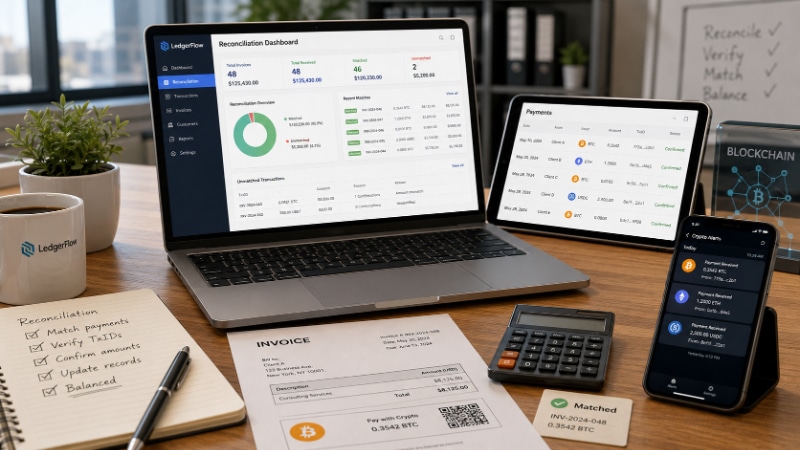
As more businesses begin accepting cryptocurrency payments, accurate and timely transaction reconciliation has become a critical requirement. Crypto payment reconciliation is emerging as a key solution for automating reconciliation processes, reducing accounting errors, and improving financial transparency. In this article, XAIGATE explains why this solution is gaining traction among businesses and highlights its key benefits as digital payments continue to grow.
Why Is Crypto Payment Reconciliation Becoming a New Trend?
The rapid adoption of cryptocurrency payments is creating a growing need for faster and more accurate transaction reconciliation. Unlike traditional payment methods, crypto payments may be processed through different blockchains, digital wallets, exchanges, and payment gateways. When transaction volumes increase, manually checking and recording each payment can become complicated, time-consuming, and prone to errors.
This is why crypto payment reconciliation is becoming an increasingly important solution for businesses. The main factors driving this trend include:
- Growing adoption of cryptocurrency payments: More businesses are allowing customers to pay with cryptocurrencies such as Bitcoin, Ethereum, stablecoins, and other digital assets.
- Transactions across multiple platforms: Crypto payments can come from different wallets, blockchains, payment processors, and gateways, making centralized reconciliation more important.
- Reduced manual accounting workload: Automated reconciliation can compare blockchain transaction data with invoices, payment records, and accounting systems without requiring finance teams to check every transaction manually.
- Improved accuracy: Automation helps reduce mistakes caused by incorrect transaction IDs, payment amounts, wallet addresses, duplicate entries, or missing records.
- Faster payment verification: Businesses can identify whether payments have been received and matched with the correct invoice or customer order much more quickly.
- Better management of high transaction volumes: As the number of crypto payments grows, automated reconciliation platforms can process large amounts of transaction data more efficiently than manual methods.
- Increasing demand across different industries: E-commerce, SaaS, travel, gaming, financial services, and digital businesses are increasingly integrating cryptocurrency payments into their payment ecosystems.
As crypto payments become more common, reconciliation is no longer simply an accounting task. It is becoming an essential part of crypto payment infrastructure, helping businesses maintain accurate financial records, improve operational efficiency, and manage digital asset transactions at scale.

Benefits of Crypto Payment Reconciliation for Businesses
Crypto payment reconciliation helps businesses manage digital asset transactions more efficiently by connecting blockchain payment data with invoices, orders, and accounting records. Instead of relying heavily on manual verification, businesses can automate many repetitive reconciliation tasks while improving accuracy, transparency, and financial control.
The main benefits of crypto payment reconciliation include:
Automates the Reconciliation Process
Crypto reconciliation systems can automatically compare blockchain transactions with internal financial records, including:
- Customer invoices and payment requests.
- E-commerce orders and transaction records.
- Blockchain wallet transactions.
- Crypto payment gateway data.
- Accounting and financial management systems.
By automating these processes, businesses can significantly reduce the amount of time spent checking transactions manually. Finance teams can therefore focus more on financial analysis, reporting, and other higher-value activities.
Reduces Accounting Errors
Cryptocurrency transactions can involve different blockchain networks, wallet addresses, transaction IDs, and digital assets. In addition, the value of many cryptocurrencies may fluctuate over time, making manual accounting more complex.
Automated reconciliation helps businesses:
- Reduce manual data entry mistakes.
- Detect missing transactions.
- Identify duplicate transaction records.
- Match payments with the correct invoice or order.
- Verify transaction amounts and transaction IDs more accurately.
As a result, businesses can maintain more consistent accounting records and reduce discrepancies between blockchain data and internal financial systems.
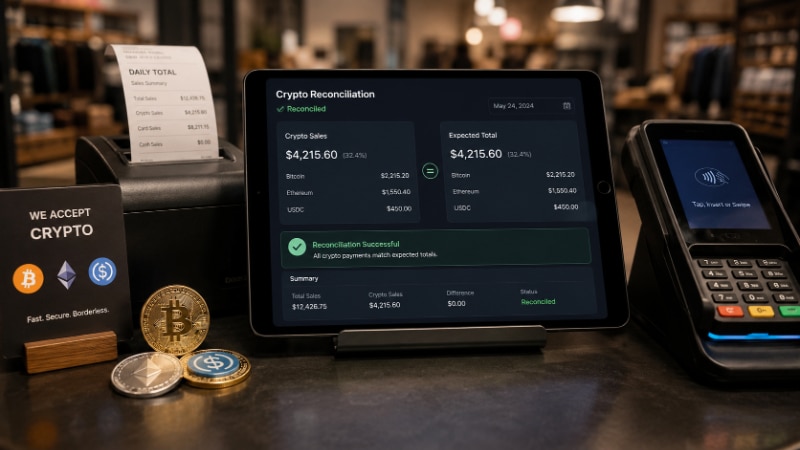
Improves Financial Transparency
One of the major advantages of blockchain technology is that transactions can be recorded and verified through distributed ledger networks. When blockchain transaction data is combined with reconciliation software, businesses gain greater visibility into their digital payment activities.
Finance teams can more easily:
- Review historical crypto transactions.
- Track incoming and outgoing payments.
- Identify matched and unmatched transactions.
- Generate detailed reconciliation reports.
- Prepare financial information for internal reviews or audits.
Greater transparency also helps businesses maintain stronger financial controls and better understand how digital assets move through their payment ecosystem.
See more: How to Build a USDT Checkout With an API: A Guide to Building a USDT Payment Gateway
Supports Multiple Digital Assets
Modern businesses may receive payments through Bitcoin, Ethereum, stablecoins, and various other digital assets. Managing each cryptocurrency through a separate reconciliation workflow can quickly become inefficient as transaction volumes increase.
A centralized crypto payment reconciliation platform can help businesses:
- Manage multiple cryptocurrencies in one place.
- Monitor transactions across different blockchain networks.
- Consolidate payment information from multiple wallets or gateways.
- Standardize reconciliation procedures across different digital assets.
This centralized approach simplifies payment management and makes it easier for businesses to expand their cryptocurrency payment options.
Enhances Financial Management
Real-time or near-real-time transaction data gives finance teams a clearer view of cryptocurrency payment activities and overall cash flow.
With more accurate and timely financial information, businesses can:
- Monitor incoming crypto payments more effectively.
- Identify outstanding or unmatched transactions.
- Detect unusual transaction activity.
- Improve cash flow visibility.
- Make faster, data-driven financial decisions.
Overall, crypto payment reconciliation provides businesses with a more structured way to manage digital asset transactions. By combining automation, accuracy, transparency, and centralized financial data, reconciliation solutions can help organizations reduce operational complexity while building a more efficient digital payment infrastructure.

Challenges of Implementing Crypto Payment Reconciliation
Although crypto payment reconciliation can improve efficiency and financial visibility, implementing it is not always straightforward. Businesses must deal with differences between blockchain networks, cryptocurrency valuation, existing accounting infrastructure, regulatory requirements, and cybersecurity risks. Addressing these challenges is essential for building a reliable and scalable reconciliation process.
Some of the main challenges businesses may encounter include:
Data Across Multiple Blockchains
Different blockchain networks can use different transaction structures, confirmation methods, processing speeds, and technical standards. This makes collecting and standardizing transaction data more complicated, especially for businesses that accept multiple cryptocurrencies.
Common challenges include:
- Different transaction formats across blockchain networks.
- Varying confirmation requirements and settlement times.
- Multiple wallet addresses and payment sources.
- Different methods for retrieving transaction data.
- Difficulty creating a standardized reconciliation workflow.
To manage these differences effectively, businesses need reconciliation systems with flexible integration capabilities and support for multiple blockchain networks.
Cryptocurrency Price Volatility
The value of many cryptocurrencies can change significantly within short periods. As a result, the value of a transaction when the payment is initiated may differ from its value when it is confirmed, settled, or recorded in the accounting system.
Businesses therefore need to clearly define:
- Which exchange rate should be used.
- The source of cryptocurrency pricing data.
- The exact valuation time for each transaction.
- How gains or losses caused by price fluctuations are recorded.
- How cryptocurrency values are converted into the company’s reporting currency.
Establishing consistent valuation rules is important for maintaining accurate financial records and avoiding discrepancies during accounting or reporting.

Integration with Existing Systems
Many traditional ERP, accounting, invoicing, and financial management systems were originally designed around fiat currencies rather than blockchain-based payments.
Integrating crypto reconciliation solutions with existing systems may therefore require:
- API development and system configuration.
- Data mapping between blockchain and accounting records.
- Integration with ERP or accounting software.
- Synchronization with invoices and customer orders.
- Additional testing before full implementation.
Without effective integration, businesses may still need to transfer data manually between systems, reducing the efficiency benefits of automated reconciliation.
See more: What Is Crypto Transaction Monitoring in AML and Crypto Regulatory Compliance?
Regulatory Compliance
Cryptocurrency regulations and digital asset reporting requirements can vary between jurisdictions and may continue to change as governments develop new regulatory frameworks.
Businesses accepting crypto payments may need to consider:
- Accounting and financial reporting requirements.
- Tax reporting obligations.
- Anti-money laundering requirements where applicable.
- Transaction record retention policies.
- Internal audit and compliance procedures.
For this reason, reconciliation processes should be flexible enough to support accurate transaction records and reporting as regulatory requirements evolve.

Data Security
Crypto reconciliation platforms often handle sensitive financial information, wallet transaction data, customer payment records, and integrations with accounting systems. Protecting this information is therefore a critical part of implementation.
Important security measures may include:
- Data encryption during storage and transmission.
- Role-based access control.
- Multi-factor authentication.
- Secure API connections.
- Activity logs and access monitoring.
- Regular security reviews and system updates.
Strong security controls can help reduce unauthorized access, data breaches, and other cybersecurity risks associated with financial systems.
Overall, implementing crypto payment reconciliation requires more than simply connecting blockchain transactions to accounting software. Businesses must carefully manage blockchain compatibility, valuation methods, system integrations, compliance requirements, and data security to create a reconciliation process that remains accurate, secure, and scalable as cryptocurrency payment volumes grow.
Future Trends of Crypto Payment Reconciliation
As the digital economy continues to expand, crypto payment reconciliation is expected to become more intelligent, automated, and closely integrated with enterprise financial systems. Businesses will increasingly require reconciliation solutions that can process large transaction volumes, support multiple digital assets, and provide accurate financial data in real time.
Several key trends are expected to shape the future of crypto payment reconciliation:
- Integration of Artificial Intelligence (AI): AI can help identify unusual transaction patterns, detect potential fraud, and improve the accuracy of automated payment matching.
- Multi-blockchain and multi-asset support: Future reconciliation platforms will increasingly support transactions across different blockchain networks, cryptocurrencies, stablecoins, and other digital assets within a single system.
- Direct integration with ERP and accounting systems: Reconciliation solutions will connect more closely with ERP, CRM, invoicing platforms, and enterprise accounting software to create a more unified financial workflow.
- Real-time transaction reconciliation: Instead of waiting for periodic reconciliation cycles, businesses will be able to monitor, verify, and match crypto payments as transactions occur.
- Improved cash flow visibility: Real-time reconciliation can provide finance teams with more accurate information about incoming payments, outstanding transactions, and available digital assets.
- Automated compliance and reporting: Advanced platforms will increasingly generate structured, audit-ready reports while supporting businesses in meeting accounting, tax, and regulatory requirements.
- Greater use of automation: From transaction matching and wallet monitoring to exception handling and reporting, more reconciliation processes will be automated to reduce manual workloads.
As cryptocurrency adoption continues to expand across e-commerce, SaaS, gaming, travel, financial services, and other digital industries, advanced crypto payment reconciliation solutions are likely to become an essential part of modern financial infrastructure. Their role will extend beyond simply matching transactions, helping businesses improve financial visibility, strengthen internal controls, and manage digital payments more efficiently at scale.

Conclusion
Crypto payment reconciliation is more than just an automation tool—it helps businesses improve transaction accuracy, financial transparency, and operational efficiency. As digital asset payments become increasingly common, investing in a reliable reconciliation solution can reduce operating costs, minimize financial risks, and prepare organizations for the future of digital commerce.
If your business is looking for a modern crypto payment reconciliation solution, choose a platform that supports multiple blockchains, provides real-time reconciliation, and offers enterprise-grade security and compliance features to optimize your payment management processes.