Building a payment system used to mean choosing a card processor and connecting a checkout page. Today, the model is shifting. Businesses that sell globally now want faster settlement, lower transaction costs, and fewer barriers across borders. That is why many teams are exploring how to develop a crypto payment gateway that fits modern commerce. The real challenge is not only technical execution. It is designing a system that balances blockchain integration, merchant usability, security controls, and operational scalability. When those parts work together, a crypto gateway becomes a practical revenue tool rather than a risky experiment. Explore the details with XAIGATE in the article below.
Contents
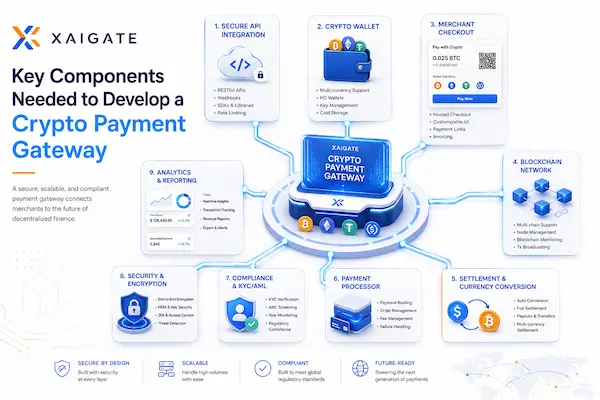
Key Components Needed to Develop a Crypto Payment Gateway
Before any coding begins, businesses need a clear view of the system architecture. A strong crypto gateway depends on several core modules working together without friction.
Wallet Infrastructure and Custody Models
Wallet infrastructure is the foundation of any payment gateway because it controls how funds are received, stored, routed, and reconciled across the payment lifecycle. The first major decision is whether the system will use a custodial or non-custodial model. A custodial structure gives the platform more control over fund handling, while a non-custodial design gives merchants greater asset ownership and reduces custody complexity.
Key areas to define early include:
- Wallet generation and address management: The gateway must create or assign payment addresses accurately, while making transaction tracking easy for both merchants and internal systems.
- Private key protection and access controls: Security policies should define how keys are stored, encrypted, rotated, and restricted across development, operations, and finance teams.
- Hot wallet and cold wallet allocation: Businesses need clear rules for liquidity, settlement speed, and reserve protection so funds remain accessible without increasing risk exposure.
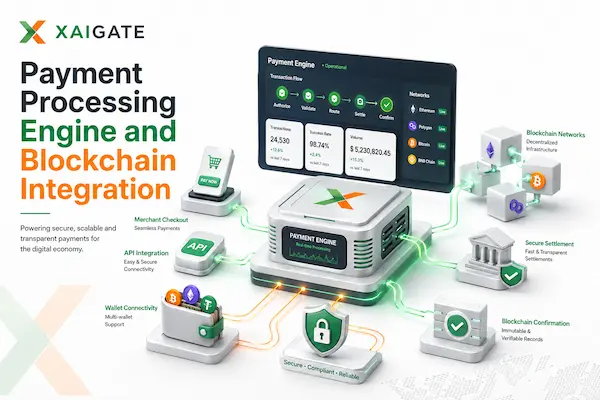
Payment Processing Engine and Blockchain Integration
The payment processing engine handles the movement from checkout request to confirmed blockchain payment. This layer listens for incoming transactions, verifies amounts, checks network confirmations, and updates payment status. It must also manage blockchain-specific logic because different networks have different speed, fee, and confirmation behaviors. Without a reliable processing engine, even a strong front end will fail under real transaction volume.
The engine should be designed around:
- Multi-chain transaction monitoring: The system needs to detect inbound transfers across supported networks and match each transaction to the correct payment request.
- Confirmation logic and payment status rules: Merchants need clear states such as pending, partially paid, confirmed, expired, or failed to reduce accounting confusion.
- Fee calculation and exchange rate handling: The gateway should calculate payable amounts correctly, especially when merchants price goods in fiat while customers pay in crypto.
See more: Pros and Cons of Crypto Payment Gateway in modern electronic payments
Merchant Dashboard and API Integration
A crypto gateway is not useful if merchants cannot operate it easily. That is why the merchant dashboard and API layer are central to product adoption. The dashboard should give merchants a simple way to monitor transactions, issue invoices, review settlement status, and manage account settings. At the same time, the API must allow websites, apps, and commerce platforms to connect payment functions without unnecessary development overhead.
Important dashboard and API features include:
- Real-time transaction visibility: Merchants should be able to see incoming payments, status changes, failed attempts, and settlement summaries from one interface.
- Developer-friendly integration tools: APIs, webhooks, SDKs, and plugins help merchants connect the gateway to checkout flows, subscriptions, and billing systems.
- Reporting and reconciliation support: Clear export tools and payment logs make it easier for finance teams to match transactions with orders and internal accounting records.
Security Systems and Risk Management
Security is not a support function in crypto payments. It is a core product requirement. A payment gateway handles sensitive financial flows, blockchain transactions, merchant data, and access permissions across several layers. That makes it a prime target for fraud, misuse, and infrastructure abuse. The best gateways are built with risk controls from the start rather than patched later after vulnerabilities appear.
The security stack should include:
- Authentication and permission controls: Multi-factor authentication, role-based access, and session controls reduce the risk of unauthorized administrative actions.
- Transaction monitoring and anomaly detection: Suspicious wallet behavior, unusual payment patterns, and high-risk address interactions should trigger alerts or review workflows.
- Infrastructure hardening and encryption: Sensitive data should be encrypted in transit and at rest, while internal services should be isolated and regularly audited.
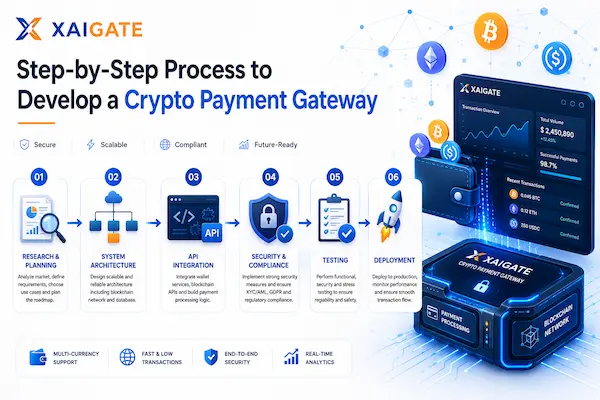
Step-by-Step Process to Develop a Crypto Payment Gateway
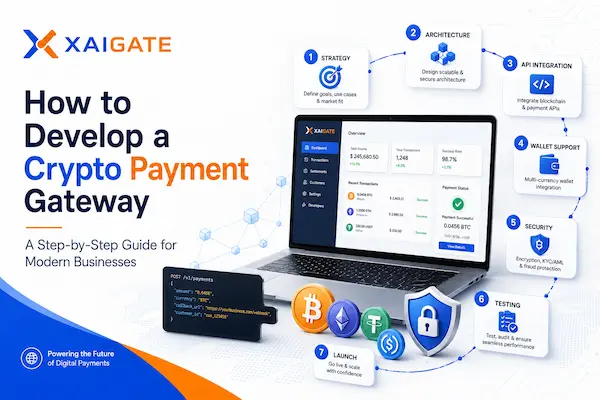
A successful gateway is built through staged execution, not rushed feature delivery. The process should move from business planning to infrastructure design, then into compliance, testing, and scale.
Step 1 – Define Business Model and Supported Cryptocurrencies
The first step is deciding what kind of payment problem the gateway will solve. Some businesses need a gateway for eCommerce merchants, while others want support for SaaS billing, marketplaces, digital services, or high-volume international payments. That business model shapes everything from supported assets to settlement workflows. It also helps the product team avoid overbuilding features that do not fit the target market.
This planning stage should cover:
- Target customer profile: Define whether the gateway is for startups, online merchants, enterprise platforms, or cross-border service providers.
- Supported cryptocurrencies and stablecoins: Choose assets based on payment demand, volatility tolerance, and operational practicality rather than market hype alone.
- Settlement preferences: Decide whether merchants will receive crypto, stablecoins, or converted fiat equivalents through connected financial channels.
Step 2 – Choose Blockchain Network and Technology Stack
The second step is selecting the infrastructure that will carry payments in production. Some businesses support only one chain for simplicity, while others choose multi-chain support to increase customer flexibility. The technology stack should also define whether the team will run its own nodes or use third-party infrastructure services. This choice affects reliability, cost, maintenance load, and development speed.
Technical planning should include:
- Network selection criteria: Compare chains based on transaction speed, fee stability, ecosystem maturity, and merchant demand.
- Backend and infrastructure architecture: Build around scalable services that support transaction listening, status updates, APIs, and secure internal operations.
- Node strategy and external dependencies: Decide where self-hosted infrastructure adds control and where third-party services can reduce time to market.
Step 3 – Build Core Payment Infrastructure
Once the foundation is set, the team can begin building the main payment flow. This includes invoice creation, address generation, blockchain listening, payment matching, and order confirmation logic. The checkout experience should remain simple even when the underlying infrastructure is complex. Merchants care about whether customers can complete payment quickly and whether the system reports payment status accurately.
Core development priorities include:
- Payment request and invoice logic: Each transaction should be tied to a unique request with clear expiration, amount rules, and callback behavior.
- Address generation and payment detection: The system must assign the correct address or wallet route for every order and monitor incoming transfers reliably.
- Webhook and order update handling: Once payment is confirmed, external merchant systems should receive status updates without delays or duplicate triggers.
Step 4 – Implement Security and Compliance Measures
A crypto gateway cannot scale commercially without compliance planning. Even when regulations vary by market, businesses still need a framework for transaction monitoring, customer risk review, and internal auditability. Security and compliance should be implemented during development rather than added after launch. That reduces operational risk and builds trust with merchants, partners, and payment stakeholders.
This stage usually includes:
- KYC and AML workflow design: Depending on the business model, the platform may need merchant onboarding checks, sanctions screening, and suspicious activity review.
- Access policies and audit trails: Administrative actions, configuration changes, and financial approvals should be logged and reviewable.
- Data handling and governance rules: Sensitive merchant and payment data should follow structured retention, encryption, and access standards.
Step 5 – Testing, Deployment, and Scaling
The final stage is validating how the gateway performs under real conditions. Functional testing alone is not enough. The team also needs to test edge cases, chain delays, failed callbacks, and spikes in payment volume. Deployment should be gradual, with monitoring and rollback plans already in place. That approach reduces production risk and helps the team improve the gateway through measured iteration.
Deployment readiness depends on:
- Testnet and sandbox validation: Teams should simulate different transaction outcomes before exposing merchants to a live environment.
- Load testing and failure scenario review: The gateway must stay stable during traffic spikes, webhook retries, and blockchain latency changes.
- Monitoring and scale planning: Real-time alerts, system metrics, and incident playbooks help operations teams respond quickly after launch.
See more: Insight on Crypto Payment Gateway: A Detailed Analysis of Today’s Crypto Payment Systems
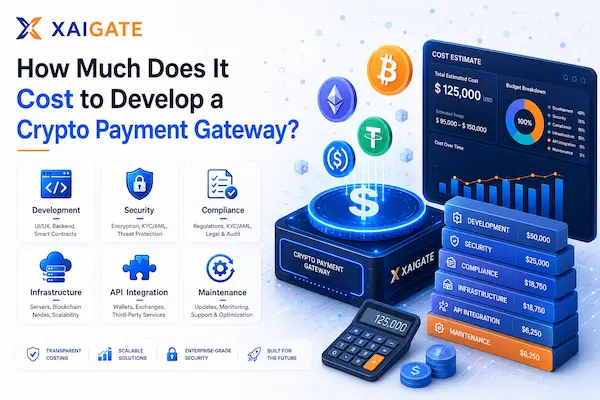
How Much Does It Cost to Develop a Crypto Payment Gateway?
Cost planning should be realistic from the beginning. The total budget depends on feature depth, compliance scope, supported chains, and whether the business builds from scratch or reuses infrastructure.
A simple gateway MVP may cost far less than an enterprise-ready platform, but the hidden expenses usually appear in security, monitoring, compliance, and ongoing maintenance. Businesses often underestimate how much post-launch support is required. Beyond development, the operating model must cover infrastructure uptime, wallet management, network monitoring, and support for merchants using the gateway in live commerce settings.
| Component | Estimated Cost Range |
| Product planning and architecture | $5,000 – $15,000 |
| Wallet and blockchain integration | $15,000 – $40,000 |
| Payment engine and APIs | $20,000 – $50,000 |
| Merchant dashboard | $10,000 – $25,000 |
| Security and compliance implementation | $15,000 – $40,000 |
| QA, testing, and deployment | $8,000 – $20,000 |
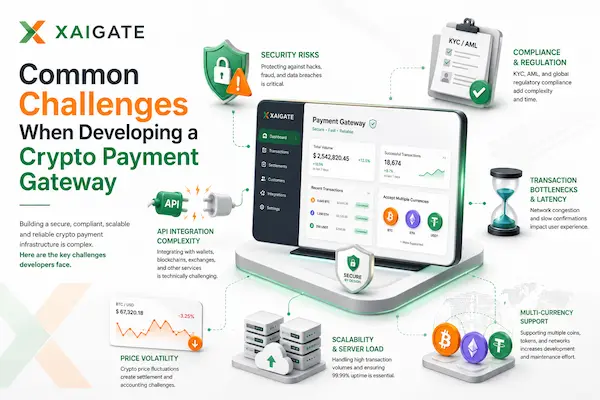
Common Challenges When Developing a Crypto Payment Gateway
Most teams do not fail because the concept is weak. They struggle because payment infrastructure creates technical and operational complexity faster than expected.
- Regulatory uncertainty: Requirements differ by region, so businesses need market-specific planning before expanding payment coverage.
- Blockchain performance variation: Different networks create different confirmation times, fees, and operational trade-offs for merchants.
- Security risk concentration: Weak wallet controls or poor permissions can expose the platform to severe financial loss.
- Merchant experience issues: Complex checkout flows and unclear payment states can reduce conversion and support trust.
Conclusion
To develop a crypto payment gateway successfully, businesses need more than blockchain access and wallet support. They need a complete payment system built around merchant usability, security discipline, and scalable infrastructure. For some companies, building from scratch is the right strategic move. For many others, the better path is adopting a faster, lower-risk model that still delivers modern crypto payment capabilities.
If your business wants to launch crypto payments without wasting time on avoidable complexity, XAIGATE can help you move from idea to execution with a clearer roadmap and a more practical gateway strategy.
For daily updates, subscribe to XAIGATE’s blog!
We may also be found on GitHub, and X (@mxaigate)!
FAQs – Travel Crypto Payment Gateway
1. What is a travel crypto payment gateway?
It lets travel brands accept crypto payments for bookings.
2. Why do travel companies use crypto payments?
They help reduce cross-border payment friction.
3. Can travelers pay with stablecoins?
Yes, many gateways support USDT, USDC, and similar stablecoins.
4. Do crypto payments settle faster?
Yes, they can support faster payment confirmation and settlement.
5. Can crypto reduce travel chargebacks?
Yes, crypto payments are generally irreversible.
6. Is API integration important for travel brands?
Yes, APIs connect crypto checkout to booking systems.
7. Can hotels accept crypto payments?
Yes, hotels can accept crypto for rooms and services.
8. Can travel agencies use payment links?
Yes, payment links are useful for deposits and custom trips.
9. Is XAIGATE suitable for travel businesses?
Yes, it supports stablecoins, APIs, invoices, and merchant tools.
10. What should travel brands check first?
Check fees, settlement, coins, refunds, compliance, and integration.