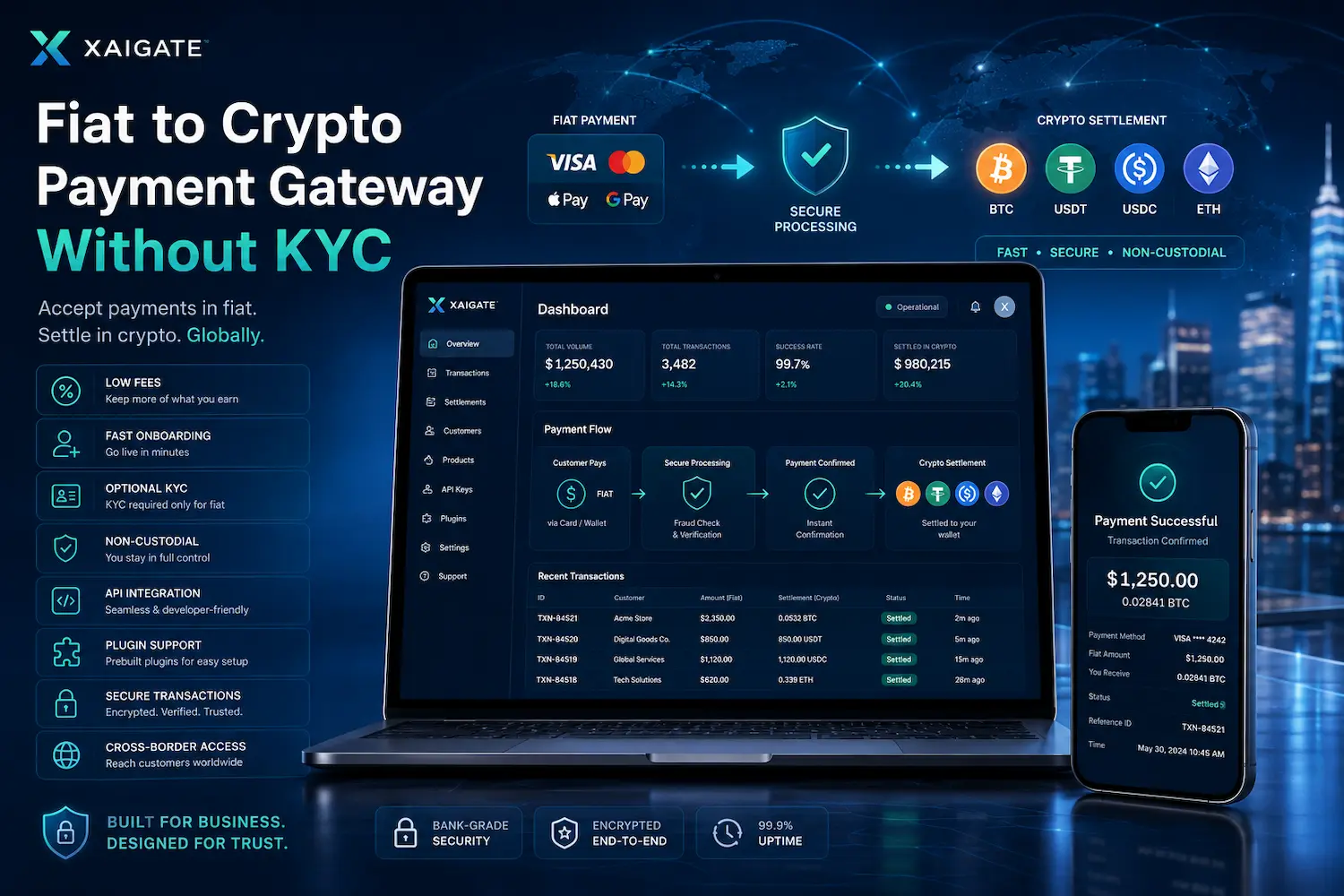
A fiat to crypto payment gateway without KYC sounds like a shortcut. In reality, it is closer to a faster bridge between traditional money and crypto payments. Businesses want fewer forms, lower fees, quicker onboarding, and easier global checkout. The challenge is choosing a gateway that reduces friction without creating operational risk. XAIGATE fits this need by focusing on simple crypto payment acceptance, low fees, non-custodial processing, fast integration, and optional or case-based KYC depending on requirements.
What Is a Fiat to Crypto Payment Gateway Without KYC?
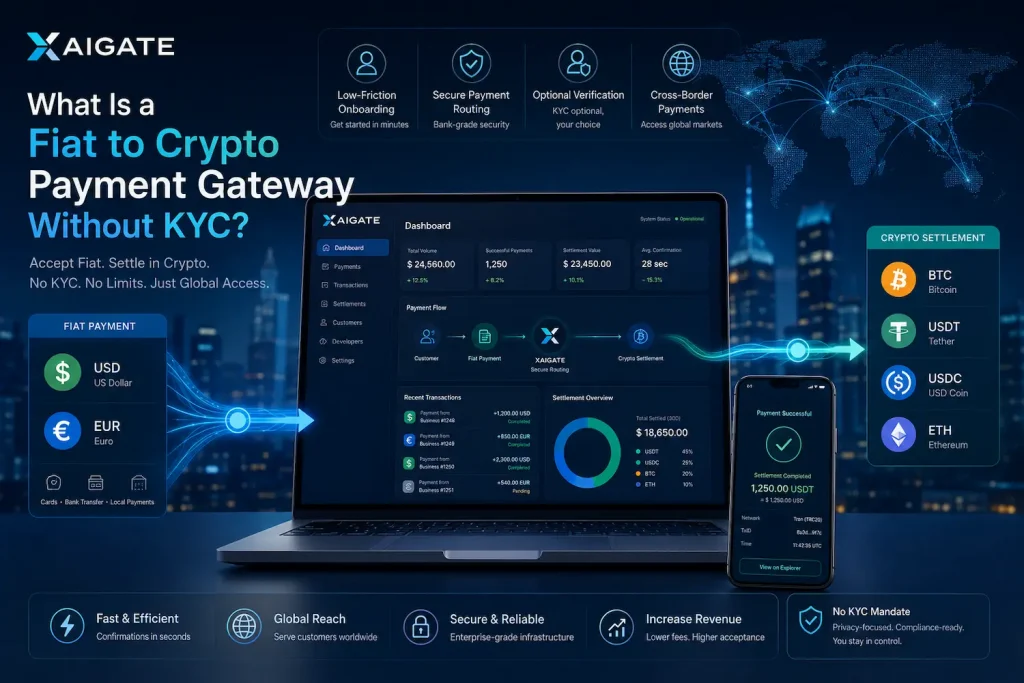
A fiat to crypto payment gateway without KYC helps businesses handle crypto-related payments with less identity verification friction than traditional financial platforms.
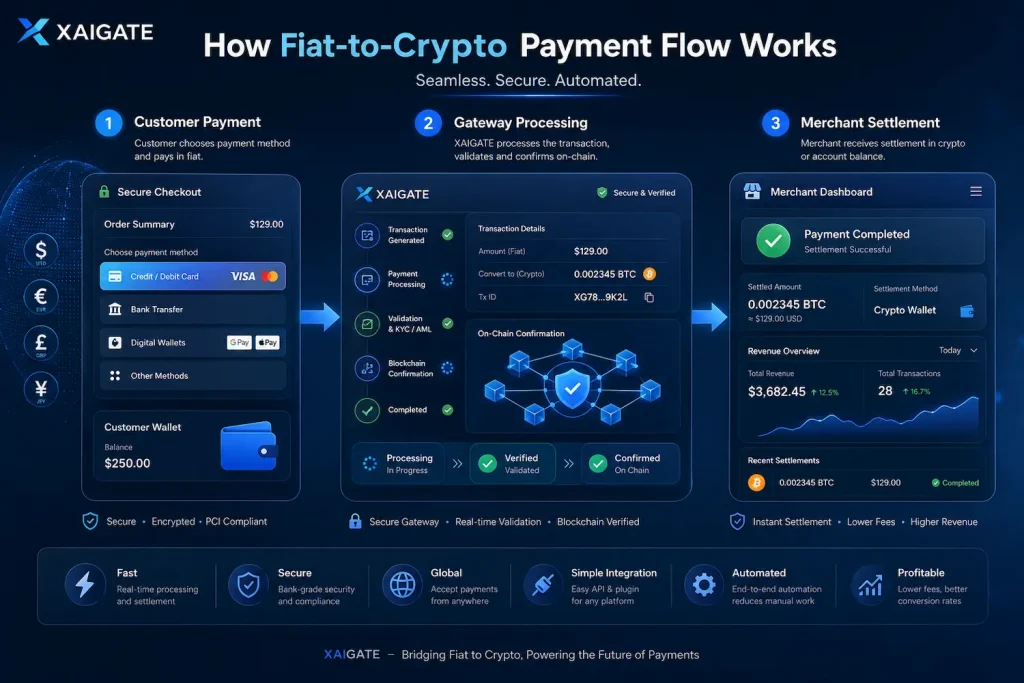
How fiat-to-crypto payment flow works
In a typical payment flow, the customer starts with a fiat-related payment need or chooses a crypto checkout option. The gateway then helps route, confirm, and settle the transaction through supported crypto networks.
For businesses, the goal is simple: receive value without depending fully on slow bank rails. Instead of managing wallets, confirmations, and blockchain details manually, merchants use a payment gateway to automate the process.
The basic flow usually includes:
- Customer payment: the buyer selects a supported crypto or crypto-linked payment option.
- Gateway processing: the system generates the payment address, tracks confirmation, and validates the transaction.
- Merchant settlement: the business receives funds according to the gateway’s supported settlement model.
This structure helps merchants accept global payments while reducing technical complexity.
What “without KYC” usually means in crypto payments
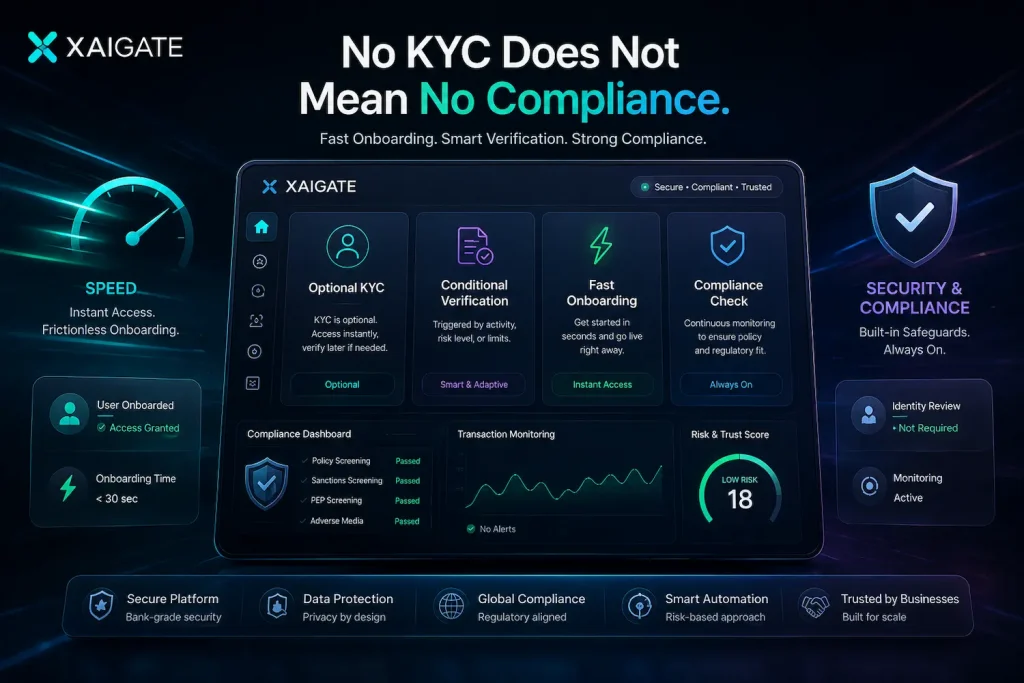
“No KYC” does not always mean zero checks in every situation. In many cases, it means the gateway allows faster onboarding, fewer documents, or optional verification for eligible users.
This matters because crypto payment regulations differ by country, transaction size, industry, and settlement model. A gateway may not require KYC for standard merchant use but may still request verification for high-risk activity, large volumes, or regulated cases.
Businesses should understand three practical points:
- No-KYC onboarding: merchants can start faster without long approval cycles.
- Conditional verification: some cases may still require checks for compliance or security.
- Merchant responsibility: businesses must follow their local laws, even when the gateway is flexible.
The best approach is not avoiding compliance completely. It is choosing a gateway that removes unnecessary friction while keeping payment operations safe.
See more: Top Crypto Payment Gateways 2026: Best Options for Global Merchants
Difference between fiat-to-crypto, crypto checkout, and crypto settlement
These terms are often mixed together, but they are not identical. Understanding the difference helps businesses choose the right payment setup.
| Term | Meaning | Best For |
| Fiat-to-crypto gateway | Helps connect fiat payment demand with crypto payment infrastructure | Businesses serving users moving between fiat and crypto |
| Crypto checkout | Lets customers pay directly with crypto at checkout | E-commerce, SaaS, digital products |
| Crypto settlement | Allows merchants to receive funds in crypto after payment confirmation | Global businesses wanting faster settlement |
XAIGATE is positioned as a practical crypto payment gateway, helping businesses accept crypto payments without complex Web3 infrastructure. It supports fast processing, cross-border payments, API/plugin integration, and low transaction costs.
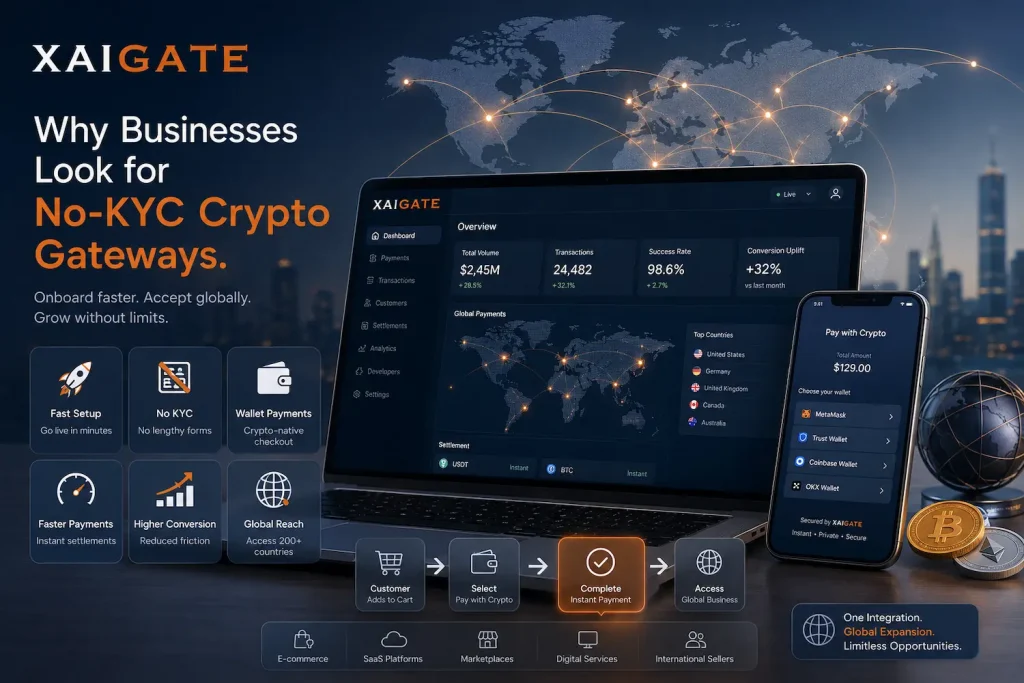
Why Businesses Look for No-KYC Fiat to Crypto Payment Gateways
Businesses search for no-KYC payment gateways because traditional onboarding often slows growth, especially for international and crypto-native markets.
Faster onboarding for global merchants
Traditional payment processors can take days or weeks to review business documents, banking records, and compliance details. For smaller businesses, this creates a major delay.
A no-KYC or low-KYC crypto gateway can reduce this barrier. Merchants can test crypto payments faster, launch new markets sooner, and avoid long approval queues.
This is especially useful for:
- Startups: they can validate demand before building complex payment infrastructure.
- Digital businesses: they can accept global payments without waiting for banking approval.
- International sellers: they can reach customers in regions where card payments are limited.
Speed matters because checkout friction directly affects conversion.
Lower payment friction for crypto-native customers
Crypto-native users often prefer paying from their wallets instead of entering card details or passing through bank-based payment flows. A smooth crypto checkout matches their existing behavior.
For merchants, this means fewer abandoned payments and better access to customers who already hold BTC, USDT, USDC, ETH, or other supported assets.
The payment experience becomes more direct:
- No card decline issues: crypto payments do not depend on card issuer approval.
- Fewer regional restrictions: customers can pay from different countries.
- Clearer settlement path: blockchain transactions can be tracked once sent.
A gateway like XAIGATE helps simplify this process by acting as the payment layer between customer wallets and merchant systems.
Better access to cross-border transactions
Cross-border payments through banks can involve high fees, currency conversion costs, delays, and failed transfers. Crypto payments help solve part of this problem by using blockchain rails.
A fiat to crypto payment gateway without KYC friction can help businesses reach customers who prefer digital assets over traditional payment methods.
Common use cases include:
- Global e-commerce: merchants sell to customers across different countries.
- SaaS platforms: businesses collect recurring or one-time payments from international users.
- Digital services: freelancers, agencies, and creators receive borderless payments.
The main advantage is flexibility. Businesses can add crypto as a payment option without replacing their entire checkout system.
Key Benefits and Risks to Consider
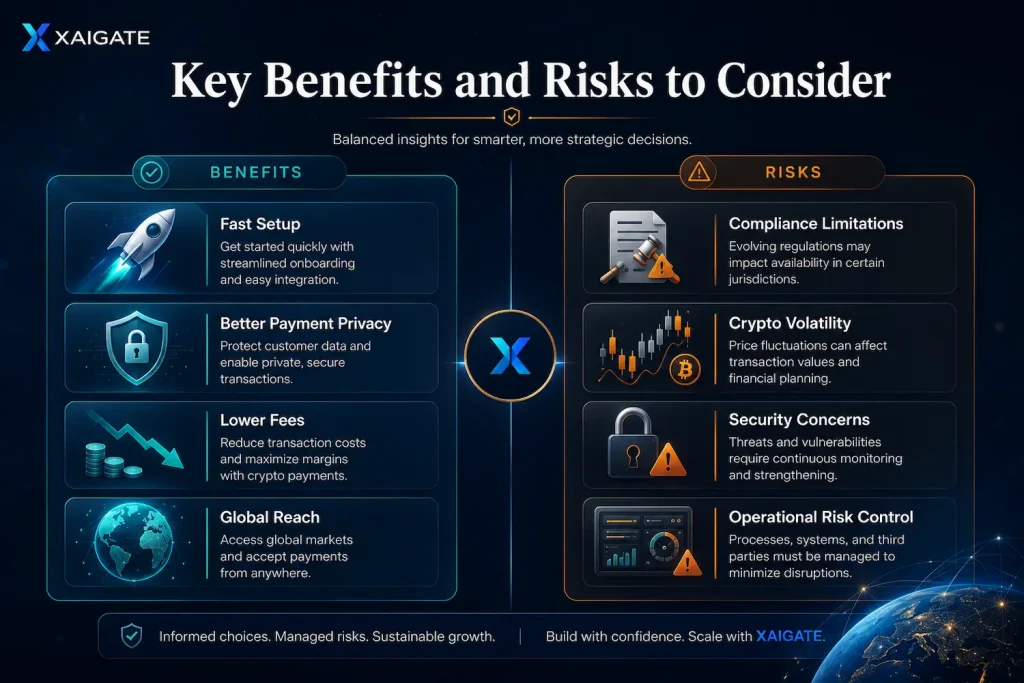
A no-KYC crypto gateway can reduce payment friction, but businesses still need to evaluate cost, compliance, security, and customer experience.
Key benefits and risks include:
- Lower setup complexity: merchants can start accepting crypto payments without building blockchain infrastructure from scratch.
- Better payment privacy: eligible users may complete transactions with less personal data exposure.
- Reduced processing fees: crypto gateway fees can be lower than card networks and traditional cross-border payment providers.
- Faster international reach: businesses can serve crypto users globally without depending only on banks.
- Compliance limitations: rules may vary by jurisdiction, industry, transaction value, and customer type.
- Volatility exposure: businesses should manage price movement if they hold crypto after settlement.
The right gateway should not only be fast. It should also give merchants practical tools for secure, trackable, and cost-efficient payment acceptance.
See more: Top Crypto Payment Gateways for Businesses in 2026
How XAIGATE Helps Businesses Accept Crypto Payments With Less Friction
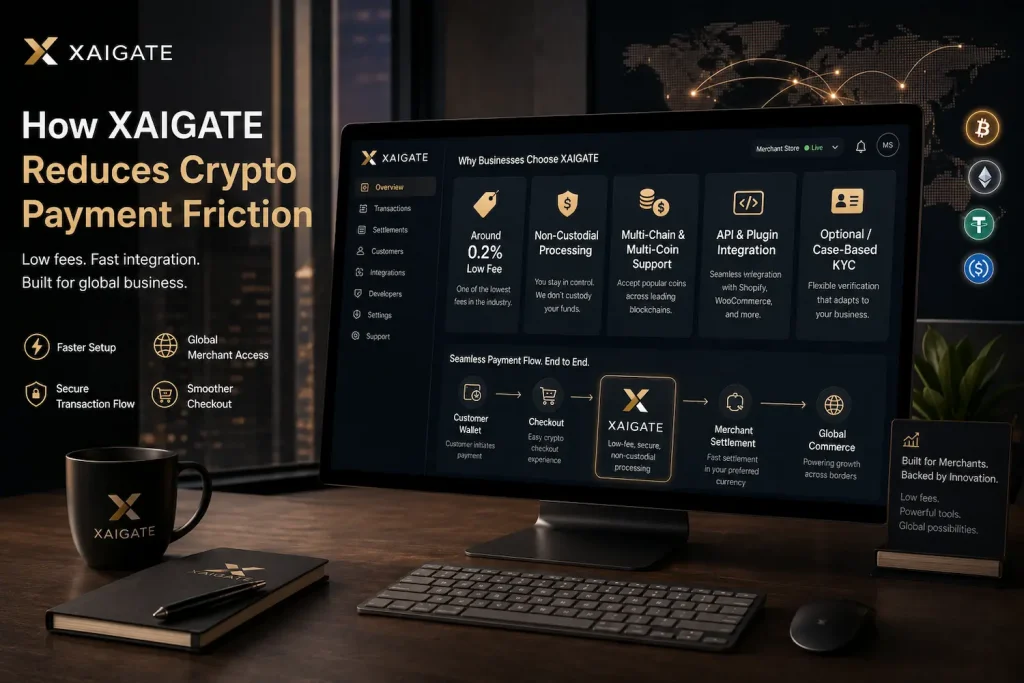
XAIGATE is built for businesses that want a practical crypto payment gateway without unnecessary complexity. It focuses on simple onboarding, low fees, and flexible integration.
Its main advantages include:
- Low transaction fee: XAIGATE highlights a fee of around 0.2% per transaction, helping merchants reduce payment costs.
- Non-custodial structure: the platform does not hold user funds, which gives businesses more control over payment flow.
- Multi-chain and multi-coin support: merchants can serve different customer preferences across crypto networks.
- API and plugin integration: businesses can connect crypto payments to websites, platforms, and checkout systems faster.
- Optional or case-based KYC: XAIGATE supports a less-rigid onboarding model depending on the use case and requirements.
This makes XAIGATE suitable for merchants that want crypto payment acceptance without turning checkout into a complicated technical project.
When Should You Choose a No-KYC Crypto Payment Gateway?
A no-KYC crypto payment gateway is useful when speed, global access, and low payment friction are more important than traditional banking workflows.
You should consider this type of gateway if:
- You sell digital products or SaaS: customers can pay from anywhere without relying only on cards or banks.
- You run global e-commerce: crypto checkout helps serve buyers in multiple countries.
- You want lower payment costs: gateway fees may be more competitive than traditional processors.
- You serve crypto-native users: wallet-based checkout matches their payment habits.
- You need faster setup: API and plugin options help reduce development time.
However, businesses should still review local regulations before choosing a fiat to crypto payment gateway without KYC. The best solution balances speed, privacy, security, and compliance.
FAQs – Fiat to Crypto Payment Gateway Without KYC
1. What is a fiat to crypto payment gateway without KYC?
It helps businesses accept crypto payments with less verification friction.
2. Does no-KYC mean zero checks?
No, some cases may still require verification.
3. Why do businesses look for no-KYC gateways?
They want faster onboarding and lower checkout friction.
4. Is compliance still important?
Yes, businesses must follow local laws and regulations.
5. Can no-KYC gateways support global payments?
Yes, they can help merchants reach international crypto users.
6. What payments can customers make?
Customers can pay with supported crypto or crypto-linked options.
7. Can merchants reduce payment fees?
Yes, crypto gateways may lower cross-border payment costs.
8. Is XAIGATE suitable for low-friction crypto payments?
Yes, XAIGATE supports low fees, APIs, plugins, and flexible onboarding.
9. When might KYC still be needed?
High-risk activity, large volumes, or regulated cases may require checks.
10. What should merchants check first?
Check compliance, fees, coins, settlement, security, and integration.
Conclusion
A fiat to crypto payment gateway without KYC can help businesses reduce onboarding friction, lower transaction costs, and reach global crypto users faster. It is not about ignoring compliance. It is about removing unnecessary barriers from payment acceptance.
XAIGATE gives merchants a practical way to accept crypto payments with low fees, non-custodial processing, multi-coin support, and simple integration. For businesses that want faster checkout and broader global access, it is a strong option to consider.
Start accepting crypto payments with XAIGATE today. Keep setup simple. Reduce payment costs. Reach customers worldwide.
For daily updates, subscribe to XAIGATE’s blog!
We may also be found on GitHub, and X (@mxaigate)!