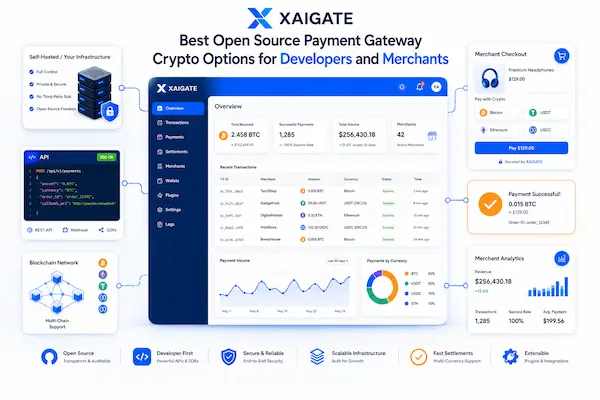
Choosing an open source payment gateway crypto solution can feel like choosing the engine room for your digital business. On the surface, it looks simple: accept crypto, confirm transactions, and deliver the product. In reality, the gateway controls payment flow, wallet security, checkout experience, reporting, and long-term scalability. For developers, open source means flexibility and code-level control. For merchants, it means lower dependency on third parties. The right choice depends on one question: do you need maximum control, or do you need a business-ready payment system that works with less technical effort? Explore the details with XAIGATE in the article below.
Contents
- 1 Best Open Source Crypto Payment Gateway Options to Consider
- 2 Comparison Table: Open Source Crypto Payment Gateway Options
- 3 Key Factors to Evaluate Before Choosing a Crypto Payment Gateway
- 4 When an Open Source Crypto Payment Gateway May Not Be Enough
- 5 Why XAIGATE Is a Practical Alternative for Business Crypto Payments
- 6 FAQs – Open Source Payment Gateway Crypto
- 7 Conclusion
Best Open Source Crypto Payment Gateway Options to Consider
The best option depends on supported coins, deployment model, wallet control, ecommerce plugins, developer experience, and long-term maintenance requirements.
BTCPay Server: Best for self-hosted Bitcoin payments
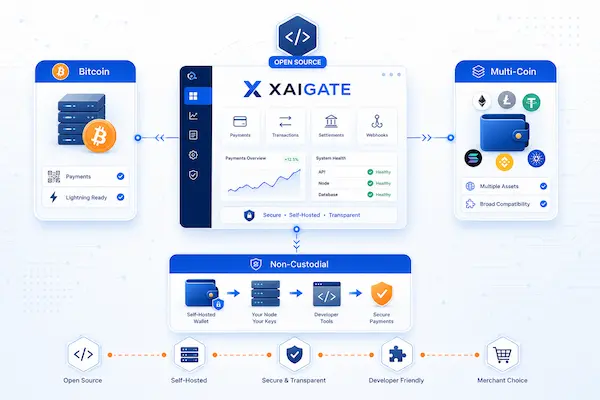
BTCPay Server is one of the most recognized open-source crypto payment gateways, especially for Bitcoin-focused merchants. It is self-hosted, non-custodial, and designed for businesses that want direct control over their payment infrastructure.
Its biggest advantage is independence. Merchants can accept Bitcoin payments without relying on a custodial payment processor. Developers can deploy it on their own server, connect it with wallets, and integrate it with ecommerce platforms or custom systems.
Key strengths include:
- Self-hosted Bitcoin payments: Useful for merchants that want full payment control.
- Non-custodial model: Funds can go directly to merchant-controlled wallets.
- Ecommerce integration: Suitable for stores using common ecommerce platforms.
- Strong developer appeal: Open-source code allows technical review and customization.
The main limitation is technical ownership. BTCPay Server is powerful, but teams must understand server management, wallet setup, backups, updates, security, and payment monitoring. It suits businesses with developer resources better than non-technical merchants.
SHKeeper: Best for multi-coin self-hosted crypto payments
SHKeeper is another open-source crypto payment gateway option, often considered by teams that need broader cryptocurrency support beyond Bitcoin. It can be relevant for businesses that want to accept different coins while keeping more control over payment processing.
For developers, SHKeeper can be attractive because it supports self-hosted payment workflows and can be adapted to custom merchant needs. This makes it suitable for businesses that need crypto payment infrastructure but do not want a fully custodial gateway.
Main advantages include:
- Multi-coin payment support: Useful for merchants that want to accept more than Bitcoin.
- Self-hosted deployment: Gives businesses more ownership of payment infrastructure.
- Custom payment logic: Developers can adapt the flow to specific business models.
- Reduced third-party dependency: The business has more control over payment operations.
The challenge is the same as most open-source systems. A merchant needs technical support to deploy, secure, monitor, and maintain the gateway. Before choosing SHKeeper, businesses should check documentation quality, active development, supported assets, and integration requirements.
CoinPayPortal: Best for flexible non-custodial payment workflows
CoinPayPortal is another open-source crypto payment gateway option for businesses exploring non-custodial payment acceptance. It may suit teams that want flexible payment workflows and more control over how crypto transactions are handled.
This kind of solution is most relevant for developers who need to build payment logic into a custom app, marketplace, or ecommerce workflow. Instead of depending fully on a hosted payment processor, the team can shape the system around its own checkout process.
Key points to evaluate include:
- Non-custodial structure: Helpful for businesses that want direct fund control.
- Flexible integration: Suitable for custom checkout and backend payment workflows.
- Developer-focused setup: Better for teams with technical payment knowledge.
- Open-source adaptability: Allows internal review and customization.
However, merchants should not choose an open-source payment gateway only because it appears cheaper. The total cost includes developer time, infrastructure, audits, monitoring, and long-term maintenance.
See more: What’s the Best Crypto Payment Gateway? A Practical 2026 Guide for Businesses
Comparison Table: Open Source Crypto Payment Gateway Options
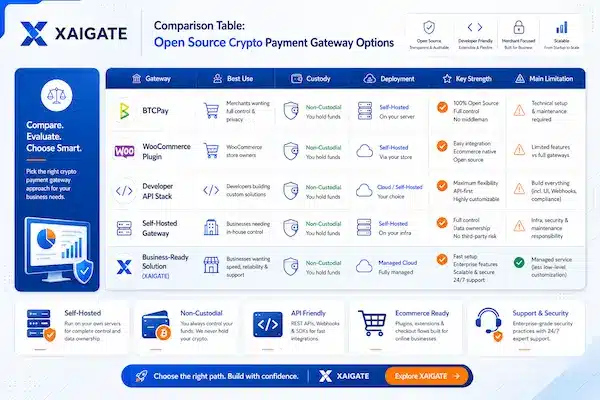
A comparison table helps merchants evaluate tools based on real implementation needs, not only marketing claims or surface-level features.
| Gateway | Best For | Custody Model | Deployment | Key Strength | Main Limitation |
| BTCPay Server | Bitcoin-focused merchants and developers | Non-custodial | Self-hosted | Strong Bitcoin payment control | Requires technical setup and maintenance |
| SHKeeper | Multi-coin self-hosted payment flows | Usually self-managed | Self-hosted | Broader crypto support | Needs technical review before deployment |
| CoinPayPortal | Custom non-custodial payment workflows | Non-custodial focus | Self-hosted | Flexible payment logic | Requires developer resources |
| Hosted gateway | Merchants needing fast launch | Provider-dependent | Managed platform | Easier operations and support | Less code-level control |
| XAIGATE | Businesses needing practical crypto payment infrastructure | Depends on service model | Business-ready gateway | Merchant workflow, support, scalability | Not positioned as purely open-source unless verified |
This comparison shows the core decision clearly. Open source crypto payment gateway options are strong for technical control, while business-ready gateways are stronger for operational speed, merchant support, and scalable payment management.
Key Factors to Evaluate Before Choosing a Crypto Payment Gateway
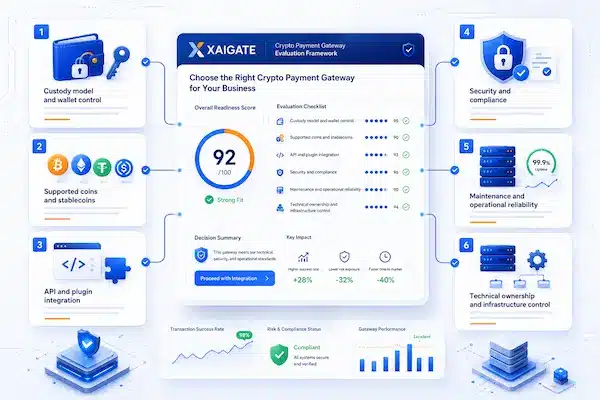
A crypto payment gateway should be evaluated as business infrastructure, not just software. The wrong setup can create security, reporting, and customer experience problems.
Custody model and wallet control
The custody model defines who controls the funds. In a non-custodial setup, the merchant controls wallet keys or receives funds directly into merchant-controlled wallets. In a custodial or managed setup, a provider may hold funds before settlement.
This decision affects security, liability, and operations:
- Non-custodial control: Better for businesses that want direct ownership of funds.
- Custodial convenience: Better for businesses that need simplified settlement and support.
- Hybrid workflows: Useful when businesses need operational convenience and fund-control flexibility.
Developers should also review wallet backup, address generation, key management, and recovery procedures. A payment gateway is only safe if the wallet architecture is safe.
Supported cryptocurrencies and stablecoins
Supported assets matter because customers may not want to pay only with Bitcoin. Many merchants now consider stablecoins because they reduce volatility risk and are easier to price against fiat currencies.
Before choosing a gateway, review these points:
- Bitcoin support: Important for broad crypto payment recognition.
- Stablecoin support: Useful for ecommerce, SaaS, B2B, and cross-border payments.
- Network options: Different chains can affect speed, fees, and user adoption.
- Asset management: Merchants need clear rules for accepted coins and settlement preferences.
A broad list of coins is not always better. The right gateway should support the assets your customers actually use and your finance team can manage.
API, plugin, and ecommerce integration
A strong crypto payment gateway must connect smoothly with the merchant’s existing system. For developers, API quality can be more important than the number of supported coins.
Look at the integration layer carefully:
- API documentation: Clear documentation reduces developer time and integration errors.
- Webhook reliability: Payment status updates must be accurate and timely.
- Ecommerce plugins: Shopify, WooCommerce, Magento, or custom plugin support can reduce launch time.
- Checkout customization: Businesses may need branded checkout pages and flexible payment states.
For SaaS platforms, marketplaces, and Web3 apps, custom API integration is often essential. For traditional merchants, ready-made plugins can be more valuable than deep customization.
Security, maintenance, and technical ownership
Open source does not automatically mean secure. It only means the code can be reviewed. Real security depends on deployment quality, server hardening, update discipline, wallet protection, and monitoring.
Businesses should evaluate:
- Update frequency: Active development reduces long-term technical risk.
- Server security: Self-hosted gateways need proper firewall, SSL, access control, and backups.
- Payment monitoring: Teams must detect failed payments, underpayments, overpayments, and delayed confirmations.
- Internal expertise: Someone must own the system after deployment.
This is where many merchants underestimate open source. The software may be free, but safe operation requires a clear technical owner.
See more: List of Crypto Payment Gateway: 10 Best Options for Online Businesses in 2026
When an Open Source Crypto Payment Gateway May Not Be Enough
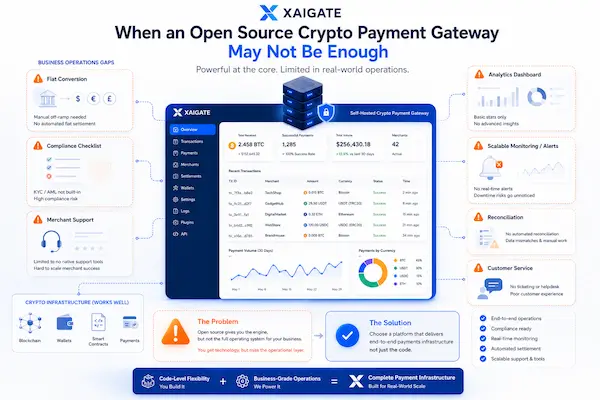
Open-source payment infrastructure is powerful, but it does not solve every business payment problem. Merchants often need more than payment confirmation.
Open source may not be enough when the business requires:
- Fiat settlement support: Some merchants need conversion from crypto to fiat for accounting and cash flow.
- Compliance workflows: Businesses may need KYC, AML screening, reporting, or jurisdiction-specific controls.
- Merchant dashboard: Non-technical teams need simple views for invoices, payments, refunds, and reports.
- Customer support: Payment issues can affect revenue if nobody resolves them quickly.
- Scalable monitoring: Growing merchants need transaction alerts, reconciliation, and operational visibility.
For developers, open source offers flexibility. For businesses, flexibility must be balanced with reliability. A company processing meaningful payment volume should consider support, reporting, risk control, and long-term operating cost.
Why XAIGATE Is a Practical Alternative for Business Crypto Payments
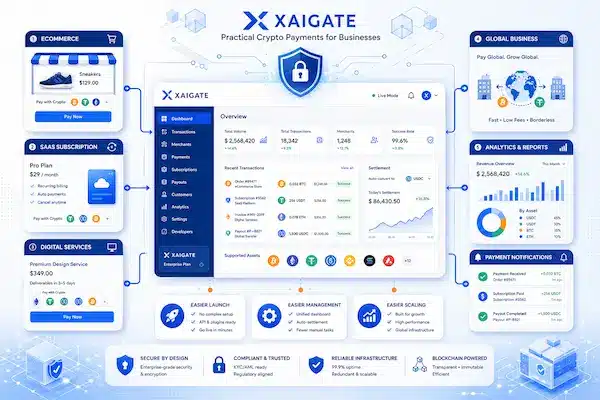
XAIGATE can be positioned as a practical crypto payment gateway for businesses that want crypto payment capability without carrying the full operational burden of open-source infrastructure.
For merchants, the main value is not only accepting crypto. The value is creating a payment flow that is easier to launch, easier to manage, and easier to scale across real business operations.
XAIGATE is relevant for businesses that need:
- Merchant-friendly crypto payment acceptance: Businesses can focus on sales instead of building payment infrastructure from zero.
- Operational simplicity: A business-ready gateway can reduce the need for server management and manual monitoring.
- Scalable payment workflows: Growing merchants need payment visibility, reporting, and reliable transaction handling.
- Support for real business use cases: Ecommerce, SaaS, digital services, and cross-border merchants need stable payment operations.
- Reduced technical burden: Teams can avoid spending excessive engineering time on gateway hosting, wallet monitoring, and maintenance.
FAQs – Open Source Payment Gateway Crypto
1. What is an open source crypto payment gateway?
It is payment software with code that can be reviewed and customized.
2. Why use an open source crypto gateway?
It gives developers more control over payment infrastructure.
3. What is BTCPay Server best for?
It is best for self-hosted Bitcoin payments.
4. What is SHKeeper best for?
It is useful for multi-coin self-hosted payments.
5. What is CoinPayPortal best for?
It fits flexible non-custodial payment workflows.
6. Are open source gateways free?
The software may be free, but hosting and maintenance cost time.
7. Are open source gateways secure?
Only if deployment, updates, wallets, and servers are secured.
8. Do merchants need developers?
Yes, most open-source gateways need technical setup and monitoring.
9. When is open source not enough?
When merchants need fiat settlement, support, dashboards, or compliance tools.
10. Is XAIGATE an alternative?
Yes, XAIGATE is a practical business-ready crypto payment option.
Conclusion
An open source payment gateway crypto solution is a strong choice for developers and merchants who want transparency, customization, and direct payment control. BTCPay Server works well for Bitcoin-focused self-hosted payments. SHKeeper and CoinPayPortal may suit teams that need broader or more flexible crypto payment workflows.
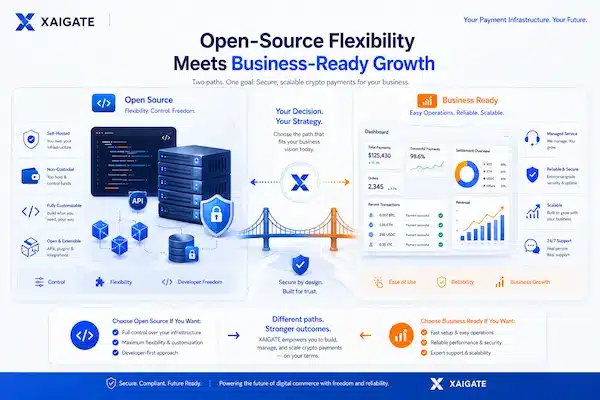
XAIGATE gives businesses a practical path to crypto payment acceptance without forcing them to build every part of the payment stack alone.
For daily updates, subscribe to XAIGATE’s blog!
We may also be found on GitHub, and X (@mxaigate)!