
Integrating crypto payments should not feel like building a bank from scratch. A white label crypto payment gateway gives your business a branded checkout while the provider handles wallets, confirmations, and settlements behind the scenes. Instead of sending users to a third-party-looking page, you keep the payment experience under your own brand. In this guide, you will learn how to integrate a white label crypto payment gateway, what features matter most, and why XAIGATE is a practical option for businesses that want low fees, fast setup, and simple crypto payment infrastructure.
Contents
- 1 What Is a White Label Crypto Payment Gateway and Why It Matters
- 2 Step-by-Step Guide to Integrate a White Label Crypto Payment Gateway
- 3 Key Features to Look for in a White Label Crypto Payment Gateway
- 4 Common Integration Challenges and How to Avoid Them
- 5 Why Businesses Choose XAIGATE for White Label Crypto Integration
- 6 FAQs – White Label Crypto Payment Gateway
- 7 Conclusion: Start Accepting Crypto Payments Under Your Own Brand
What Is a White Label Crypto Payment Gateway and Why It Matters
A white label crypto payment gateway allows businesses to accept crypto payments through a branded checkout experience. Customers see your logo, colors, and payment flow, while the gateway processes the transaction in the background.
For e-commerce stores, SaaS platforms, marketplaces, and global service businesses, this model solves three important problems:
- Brand control: The payment page feels like part of your own platform, not an external crypto tool.
- Faster global payments: Customers can pay with BTC, USDT, USDC, ETH, and other digital assets across borders.
- Lower payment costs: Crypto transactions can reduce dependence on card networks, chargebacks, and high intermediary fees.
In simple terms, a white label crypto payment gateway works like Stripe or PayPal for crypto, but with more control over branding and settlement.

Step-by-Step Guide to Integrate a White Label Crypto Payment Gateway
To integrate a white label crypto payment gateway, you need a clear technical flow. The process usually starts with provider selection, then moves through API access, payment creation, webhook handling, UI customization, and testing.
Step 1 – Choose the Right White Label Crypto Payment Gateway Provider
The first step is selecting a provider that fits your business model, compliance needs, and technical resources. Some businesses need a fully branded checkout. Others need a simple API, plugin, or non-custodial payment flow.
When comparing providers, focus on these key points:
- Transaction fees: Lower fees improve margins, especially for high-volume merchants.
- Coin and network support: Check whether the gateway supports BTC, ETH, USDT, USDC, and preferred networks.
- KYC requirements: Some businesses need flexible onboarding without excessive verification steps.
- API and plugin quality: A clean API reduces developer workload and speeds up launch.
- Settlement model: Decide whether you want crypto settlement, stablecoin settlement, or fiat conversion.
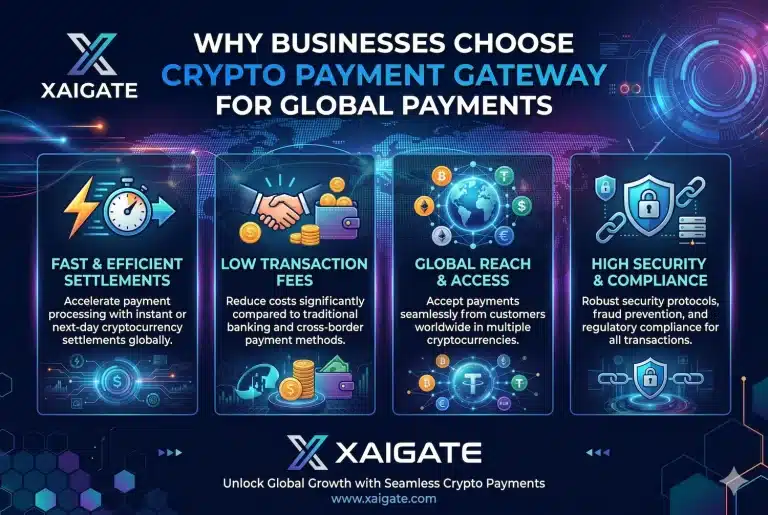
XAIGATE is positioned as a practical crypto payment gateway built for simplicity, low cost, and fast integration. It offers low fees around 0.2%, API and plugin support, non-custodial payments, and broad crypto support.
See more: Best Open Source Payment Gateway Crypto Options for Developers and Merchants
Step 2 – Get API Credentials and Access Documentation
After creating your merchant account, generate your API credentials from the provider dashboard. These credentials usually include a merchant API key and a webhook secret.
Your development team should review the API documentation before writing code. Most white label crypto payment gateways provide endpoints for:
- creating a payment invoice;
- checking payment status;
- receiving webhook callbacks;
- setting accepted coins and networks;
- managing order references and checkout URLs.
The API key authenticates requests from your backend. The webhook secret helps verify that payment notifications really come from the gateway, not from a fake source.

Step 3 – Build the Payment Creation Flow
The payment creation flow starts when a customer clicks Pay with crypto on your website, app, or checkout page. Your backend then sends a payment request to the gateway API.
A typical create payment request includes:
- Amount and fiat currency: For example, 100 USD converted into crypto at checkout.
- Order ID or track ID: This connects the crypto payment to your internal order.
- Accepted coins: You may allow BTC, ETH, USDT, USDC, or selected networks.
- Success and cancel URLs: These redirect users after payment completion or cancellation.
- Expiration time: This protects your business from price changes or unpaid invoices.
The gateway then returns either a branded checkout URL or payment data such as wallet address, crypto amount, and QR code. You can redirect the customer to the white label checkout page or display the invoice directly in your interface.
This step is where white label value becomes visible. Customers complete payment in a familiar branded environment instead of feeling pushed to an unknown third-party payment page.
Step 4 – Handle Payment Status and Webhooks
Crypto payments need reliable status tracking because blockchain transactions require confirmation. A webhook lets the gateway notify your backend when a payment is created, paid, expired, failed, or confirmed.
Your backend should handle webhook events carefully:
- Verify the webhook signature: This prevents spoofed payment updates.
- Match the track ID with your order ID: This keeps order records accurate.
- Update payment status in your database: Mark orders as pending, paid, expired, or failed.
- Trigger fulfillment only after confirmation: This is important for digital goods, subscriptions, and high-value orders.
Some businesses also use polling as a backup. Polling means your backend regularly checks the payment status API. However, webhook integration is usually more efficient and faster for real-time checkout updates.

Step 5 – Customize Branding and User Experience
White label integration is not just technical. The checkout experience must look trustworthy, simple, and consistent with your brand.
Most providers allow you to customize:
- logo;
- checkout colors;
- payment button text;
- invoice layout;
- success and failure messages;
- hosted page or embedded widget style.
A strong branded crypto checkout should reduce friction. Customers should clearly see the crypto amount, wallet address, QR code, network, expiration time, and payment status.
For mobile users, QR code handling and wallet deep links are especially important. A confusing checkout can lead to abandoned payments, even when the gateway works correctly.
Step 6 – Test in Sandbox and Go Live
Before accepting real crypto payments, test the full payment flow in sandbox or test mode. This helps your team catch webhook errors, order mismatches, and checkout UX problems before launch.
Your testing checklist should include:
- create a test crypto payment;
- simulate successful payment;
- simulate expired payment;
- verify webhook signature;
- check order status updates;
- test success and cancel URLs;
- confirm mobile checkout behavior;
- review logs for API errors.
After testing, switch from sandbox keys to production keys. Then monitor your first live transactions closely. Check confirmation time, user behavior, settlement accuracy, and support tickets during the first rollout.

Key Features to Look for in a White Label Crypto Payment Gateway
A strong white label crypto payment gateway should help your business launch quickly while keeping costs and operational risks low.
- Low transaction fees: A fee around 0.2% can be much more efficient than gateways charging 1% to 2%, especially at scale.
- Multi-coin and multi-chain support: Customers should be able to pay with major assets such as BTC, ETH, USDT, and USDC.
- Non-custodial payment model: The gateway should not unnecessarily hold user funds, which can reduce custody risk.
- Fast integration: API, plugins, and clear documentation help your team go live without long development cycles.
- Flexible onboarding: Optional or simplified KYC can help suitable businesses start faster, depending on compliance requirements.
XAIGATE matches these needs by focusing on simple crypto payment acceptance, low-cost transactions, API and plugin integration, and non-custodial payment processing.
Common Integration Challenges and How to Avoid Them
Even a simple crypto payment API can create problems if the integration is not planned correctly.
- API complexity: Choose a provider with clean documentation, sample requests, and plugin support.
- Wrong network selection: Make sure customers know whether they are paying USDT on TRC20, ERC20, or another network.
- Webhook failures: Always verify signatures, log events, and retry failed webhook processing.
- Payment volatility: Use stablecoins such as USDT or USDC when you want predictable settlement value.
- Poor checkout UX: Keep the payment page clear, mobile-friendly, and consistent with your brand identity.
The best approach is to keep the first integration simple. Start with core coins, one clean checkout flow, and reliable webhook handling. Then expand supported networks and advanced features later.

Why Businesses Choose XAIGATE for White Label Crypto Integration
XAIGATE is built for businesses that want crypto payments without unnecessary complexity. Its positioning is practical: make crypto payment acceptance easier, faster, and more cost-effective for global merchants.
XAIGATE gives businesses several important advantages:
- Low fees around 0.2% per transaction: This helps businesses protect profit margins.
- Non-custodial structure: XAIGATE does not position itself as a platform that holds user funds.
- Easy API and plugin integration: Businesses can connect crypto checkout faster.
- Multi-coin support: Merchants can accept popular cryptocurrencies from global customers.
- Simpler onboarding: XAIGATE is designed to avoid the complicated and heavy experience common in many crypto gateways.
For businesses that want a white label crypto payment gateway, XAIGATE offers a practical path: branded payment experience, lower processing costs, and simpler crypto adoption.
See more: What do it work
FAQs – White Label Crypto Payment Gateway
1. What is a white label crypto payment gateway?
It lets businesses accept crypto under their own brand.
2. Why use a white label gateway?
It keeps checkout branded, trusted, and consistent.
3. How does white label integration work?
It connects checkout, APIs, wallets, webhooks, and settlement.
4. What credentials are needed?
Merchants need API keys and webhook secrets.
5. Can businesses customize checkout?
Yes, they can customize logo, colors, layout, and messages.
6. Why are webhooks important?
They update order status after payment events.
7. Should businesses test before launch?
Yes, sandbox testing helps prevent payment errors.
8. Can white label gateways support stablecoins?
Yes, many support USDT, USDC, and major cryptocurrencies.
9. Is XAIGATE suitable for white label integration?
Yes, it supports low-fee, branded crypto payment integration.
10. What should merchants check first?
Check fees, coins, APIs, branding, webhooks, security, and settlement.
Conclusion: Start Accepting Crypto Payments Under Your Own Brand
Learning how to integrate a white label crypto payment gateway starts with a simple principle: keep the payment experience branded, secure, and easy to complete. Choose the right provider, connect the API, create the payment flow, handle webhooks, customize the checkout, and test everything before going live.
With XAIGATE, businesses can simplify crypto payments through low fees, non-custodial processing, API and plugin support, and global crypto acceptance.
Start integrating your white label crypto payment gateway with XAIGATE today and launch branded crypto payments globally in minutes.
For daily updates, subscribe to XAIGATE’s blog!
We may also be found on GitHub, and X (@mxaigate)! Follow us!