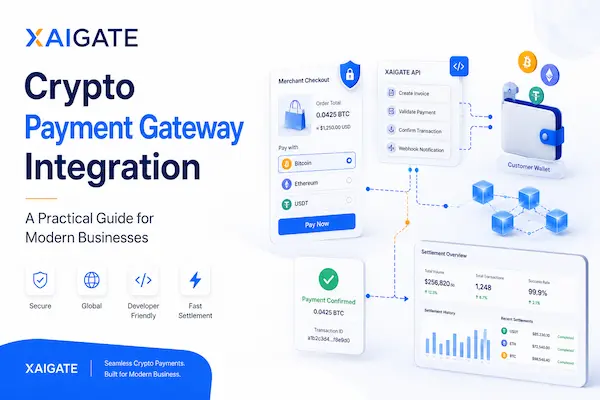
Adding crypto payments to a business can feel like opening a new checkout lane in a crowded store. The opportunity is clear, but the real question is how to make that lane fast, secure, and easy to use. That is why payment gateway integration for crypto matters. It is not only about accepting digital assets. It is about connecting wallets, APIs, settlement flows, and compliance into one working payment system. For modern businesses that want global reach, lower friction, and better flexibility, the right integration approach can turn crypto from an experiment into a reliable revenue channel. Explore the details with XAIGATE in the article below.
Contents
- 1 Key Benefits of Integrating a Crypto Payment Gateway
- 2 Types of Crypto Payment Gateway Integration Methods
- 3 Step-by-Step Process for Crypto Payment Gateway Integration
- 4 Technical Requirements for Crypto Payment Gateway Integration
- 5 Common Challenges in Crypto Payment Gateway Integration
- 6 How to Choose the Right Crypto Payment Gateway for Integration
- 7 FAQs – Payment Gateway Integration for Crypto
- 8 Conclusion
Key Benefits of Integrating a Crypto Payment Gateway
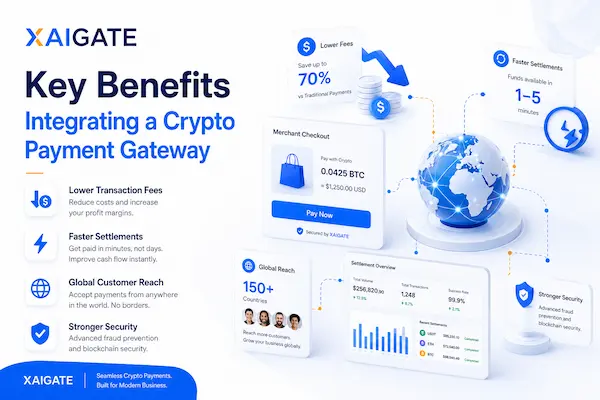
A well-planned integration creates more than a new checkout option. It can improve commercial reach, operational efficiency, and customer experience.
Lower transaction fees and faster settlements
Traditional international payments often involve card processing fees, bank intermediaries, and settlement delays. Crypto payment gateways can reduce these layers. This makes them attractive for businesses with global customers, high transaction volume, or digital service models.
Key benefits often include:
- Lower processing costs: Fewer intermediaries can help reduce payment overhead, especially for cross-border sales.
- Faster fund movement: Settlement can be much quicker than conventional bank-based methods.
- Improved cash flow visibility: Real-time transaction tracking gives finance teams better operational control.
Access to global customers without borders
Crypto payments help businesses serve customers in regions where card access is limited, international transfers are slow, or currency conversion adds friction. This creates a wider payment footprint without forcing the merchant to open multiple local banking relationships.
For e-commerce, SaaS, gaming, digital subscriptions, and online services, this can translate into stronger conversion from international audiences who already hold crypto and want to spend it directly.
Enhanced security and fraud prevention
Blockchain payments are fundamentally different from card-not-present transactions. Once confirmed, they are generally not exposed to the same chargeback patterns that affect card payments. This can reduce certain fraud risks and improve payment confidence for merchants selling online.
That said, security still depends on the quality of the gateway integration. Secure API design, webhook validation, wallet controls, and transaction monitoring remain critical.
Types of Crypto Payment Gateway Integration Methods
Not every business needs the same integration model. The right approach depends on technical resources, platform complexity, and launch speed requirements.
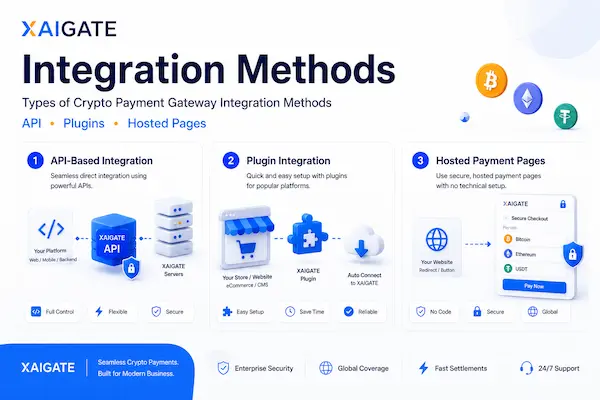
API-based integration for custom platforms
API integration is best for businesses that want full control over checkout logic, user experience, and backend workflows. It allows product and engineering teams to connect payment requests, transaction status, notifications, and settlement data directly into their systems.
This model is ideal for:
- Custom e-commerce platforms
- SaaS billing systems
- Marketplaces
- Mobile apps
- Enterprise payment environments
API integration offers flexibility, but it also requires stronger technical planning and testing.
See more: Pros and Cons of Crypto Payment Gateway in modern electronic payments
Plugin integration for e-commerce platforms
For merchants using platforms such as WooCommerce, Magento, or Shopify-compatible environments, plugins can simplify deployment. Instead of custom coding each payment flow, a plugin handles the connection between store checkout and the crypto gateway.
This method works well when speed matters more than deep customization. It is often the right choice for small to mid-sized businesses that want to test demand before investing in a larger payment architecture.
Hosted payment pages for quick deployment
Hosted checkout pages are the fastest route to market. The gateway manages the payment interface, while the merchant redirects the customer to a secure payment environment. This reduces development time and shifts much of the infrastructure responsibility to the provider.
The trade-off is lower control over branding and user flow. For some merchants, that is acceptable. For others, especially those focused on conversion optimization, native API integration is more effective.
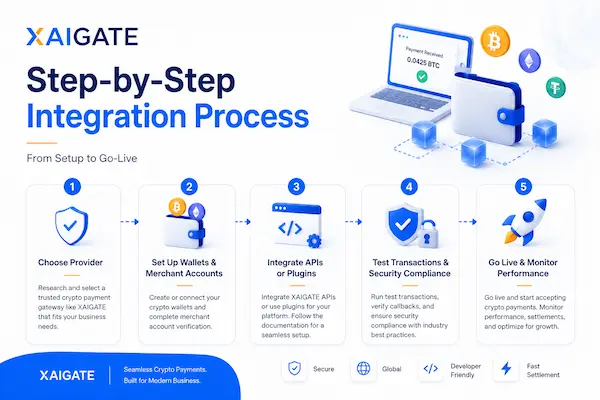
Step-by-Step Process for Crypto Payment Gateway Integration
A strong implementation follows a clear sequence. Skipping these steps often leads to rework, friction, or security gaps.
Step 1: Choose the right crypto payment gateway provider
Start by evaluating the provider against your business model, transaction volume, supported regions, and technical needs. Look beyond marketing claims and review API quality, documentation depth, support responsiveness, and settlement flexibility.
Focus on:
- Supported coins and blockchain networks
- Fiat settlement or crypto settlement options
- Compliance support
- Fee structure
- Scalability for future growth
Step 2: Set up wallets and merchant accounts
Once you choose a provider, configure your merchant environment. This may include wallet settings, business verification, webhook endpoints, callback URLs, and internal user permissions. The goal is to make sure transactions flow into a controlled and auditable structure.
At this stage, finance and compliance teams should also align on how crypto transactions will be recorded, converted, and reported.
Step 3: Integrate APIs or plugins into your platform
Your development team then connects the payment gateway to your checkout or billing process. This includes payment initiation, order mapping, confirmation logic, error handling, and status synchronization. If you use plugins, setup may be lighter, but testing remains essential.
A clean integration should ensure that payment events connect directly to business actions such as order approval, account activation, or service delivery.
Step 4: Test transactions and ensure security compliance
Before going live, run test payments across different scenarios. Confirm success flows, failed payments, underpayments, overpayments, timeouts, and webhook delivery. Review logging, alerts, and reconciliation outputs to ensure operational visibility.
Security checks should include:
- Webhook authentication: Verify that incoming payment events are genuine and untampered.
- API key protection: Store credentials securely and restrict access by role.
- Transaction monitoring: Track anomalies, confirmation delays, and suspicious behavior.
Step 5: Go live and monitor payment performance
After launch, integration work is not finished. Monitor conversion rates, payment completion time, failed transaction patterns, and settlement consistency. This helps your team identify technical bottlenecks and customer friction early.
The best crypto payment setups improve over time through data, UX refinement, and infrastructure tuning.
Technical Requirements for Crypto Payment Gateway Integration
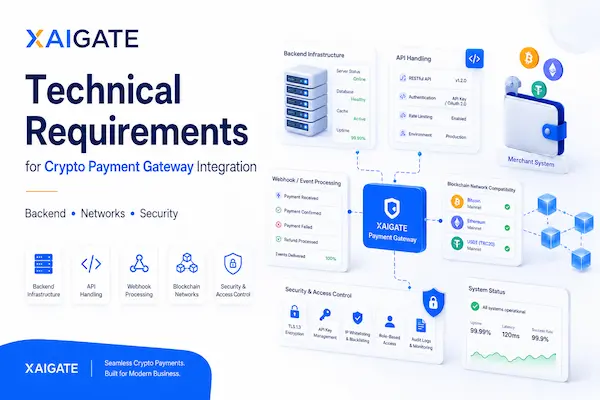
Successful payment gateway integration for crypto depends on more than adding a button at checkout. It requires a stable backend and clear payment logic.
Backend infrastructure and API handling
Your system needs to create payment requests, store transaction references, receive status changes, and trigger post-payment actions. This means your backend must handle API communication reliably and securely. It should also support retry logic, timeout management, and event logging.
Without this layer, payment visibility becomes weak and reconciliation becomes harder.
Blockchain network compatibility
Different cryptocurrencies run on different chains, and users may choose between multiple network options. Your gateway should support the chains your audience actually uses. If network support is narrow or unclear, payment friction increases and support tickets follow.
Choosing the right network mix helps reduce failed payments and customer confusion.
Security layers and encryption standards
Security should be built into the integration from day one. API authentication, encrypted data transfer, role-based access control, and secure webhook processing are basic requirements. Businesses should also define internal approval flows for wallet changes, settlement rules, and access to financial dashboards.
A crypto gateway should simplify payments, not expand your attack surface.
See more: Insight on Crypto Payment Gateway: A Detailed Analysis of Today’s Crypto Payment Systems
Common Challenges in Crypto Payment Gateway Integration
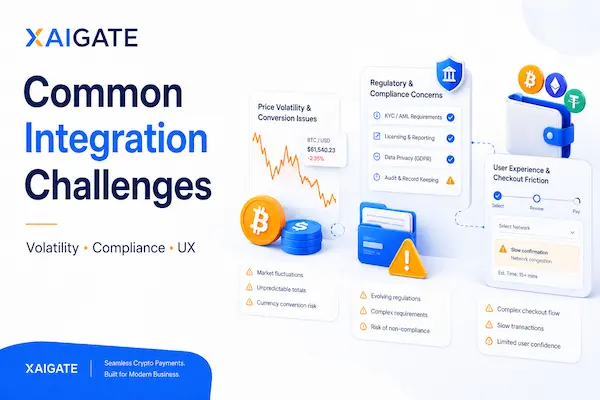
Crypto payments offer clear advantages, but implementation still comes with operational challenges.
Volatility and currency conversion issues
Crypto values can change quickly. If your pricing, invoicing, and settlement logic are not aligned, your business may face accounting complexity or margin pressure. Many merchants solve this by using gateways that support instant conversion or stablecoin settlement.
Regulatory and compliance concerns
Rules vary by region and by industry. Some businesses need stronger KYC, AML screening, or transaction reporting than others. That is why compliance support should be part of gateway evaluation from the beginning, not added later as a patch.
User experience and checkout optimization
Even when the technical integration works, checkout can still fail from a user perspective. Confusing wallet instructions, unsupported networks, and slow confirmation messaging can hurt conversions. Crypto payment UX must be simple, guided, and transparent.
How to Choose the Right Crypto Payment Gateway for Integration
Choosing the right provider shapes the long-term success of your crypto payment stack. Do not focus only on fees. Evaluate the full operational fit.
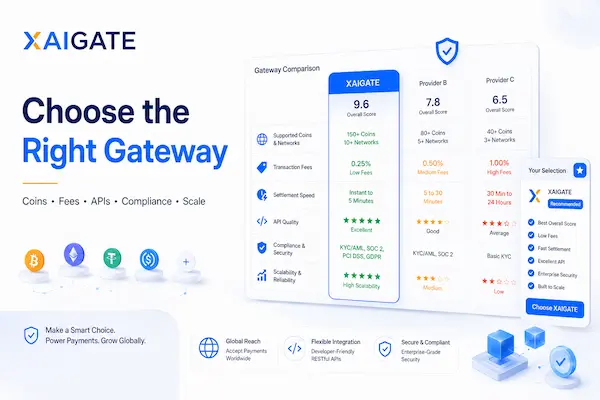
Consider these criteria:
- Supported cryptocurrencies and networks: Match coverage to real customer demand, not just headline numbers.
- Transaction fees and settlement speed: Review total payment cost and how quickly funds become usable.
- API quality and documentation: Good documentation reduces implementation risk and developer workload.
- Compliance and security support: Strong controls protect both the merchant and the end user.
- Scalability: The gateway should support growth across regions, channels, and transaction volume.
FAQs – Payment Gateway Integration for Crypto
1. What is payment gateway integration for crypto?
It connects crypto payments to checkout, wallets, orders, and settlement.
2. Why should businesses integrate crypto payments?
It can lower fees, speed settlement, and reach global customers.
3. What integration methods are available?
API integration, ecommerce plugins, and hosted payment pages.
4. When should businesses use API integration?
Use APIs for custom platforms, SaaS, marketplaces, and mobile apps.
5. When are plugins better?
Plugins are faster for WooCommerce, Magento, and similar stores.
6. What are hosted payment pages?
They are secure checkout pages managed by the gateway provider.
7. Why are webhooks important?
They send real-time payment status updates to your system.
8. What should businesses test first?
Test paid, failed, underpaid, overpaid, timeout, and webhook events.
9. What security checks matter most?
API key protection, webhook validation, encryption, and access control.
10. What should merchants compare first?
Compare coins, fees, settlement, API quality, compliance, and scalability.
Conclusion
Payment gateway integration for crypto is no longer a niche technical project. It is becoming a strategic payment decision for businesses that want broader reach, better flexibility, and stronger digital payment capability. The key is to approach integration as a business system, not just a feature.
Ready to simplify your crypto payment journey with XAIGATE? Contact our team today to explore an integration approach built for your business model, your platform, and your growth goals.
For daily updates, subscribe to XAIGATE’s blog!
We may also be found on GitHub, and X (@mxaigate)!