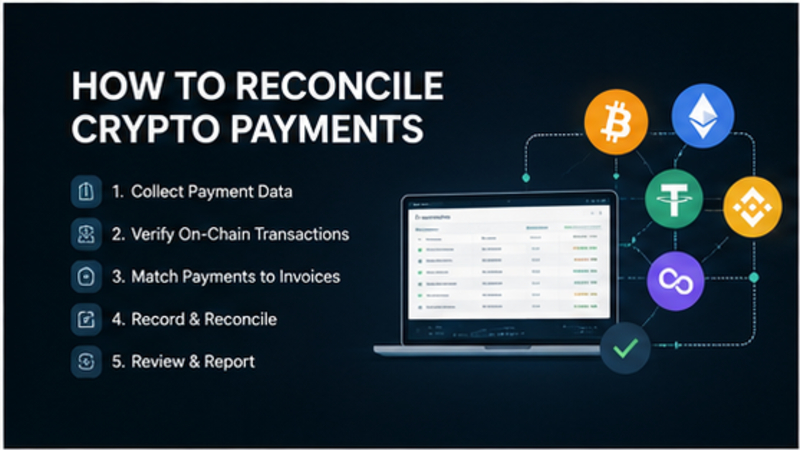
How to reconcile crypto payments is the process of matching cryptocurrency transactions with blockchain records, payment gateway data, and accounting systems to ensure financial accuracy. As businesses process more digital asset transactions, fast and transparent reconciliation becomes essential for reducing errors, improving financial management, maintaining regulatory compliance, and generating reliable reports. In this guide, XAIGATE explains the crypto payment reconciliation process and shares best practices to help businesses operate securely.
Why Do Businesses Need to Reconcile Crypto Payments?
As businesses accept cryptocurrency payments across multiple blockchains, wallets, exchanges, and payment gateways, tracking and verifying transactions becomes more complex. A structured how to reconcile crypto payments workflow helps maintain accurate financial records and simplify payment management.
The main reasons businesses need crypto payment reconciliation include:
- Ensure financial data accuracy: Match blockchain transactions with invoices, payment platforms, and accounting records to reduce missing transactions, duplicate entries, and accounting errors.
- Detect abnormal transactions: Identify unconfirmed or failed payments, incorrect amounts, network fee differences, exchange rate fluctuations, and refunds that have not yet been recorded.
- Support accounting and auditing: Maintain clear transaction records for financial reporting, tax preparation, audits, and compliance requirements.
- Save operational time: Automated or standardized reconciliation reduces manual checking, improves processing efficiency, and minimizes human error when handling large transaction volumes.
Overall, crypto payment reconciliation helps businesses improve financial accuracy, detect transaction discrepancies earlier, and manage cryptocurrency payments more efficiently.

How to Reconcile Crypto Payments: Step-by-Step Process
To maintain accurate financial records, businesses should establish a standardized crypto payment reconciliation workflow from the moment a payment is received until it is recorded in the accounting system. A clear process helps reduce discrepancies, improve transparency, and simplify financial reporting.
Step 1: Collect Data from All Payment Sources
The first step is to gather transaction information from every platform involved in the payment process. Complete data collection provides the foundation for accurate reconciliation.
Key data sources may include:
- Blockchain explorers.
- Crypto payment gateways.
- Business wallets.
- Cryptocurrency exchanges, if applicable.
- ERP systems.
- Accounting software.
Collecting complete transaction data from the beginning helps reduce missing records and reconciliation discrepancies later.
Step 2: Verify Transaction Status on the Blockchain
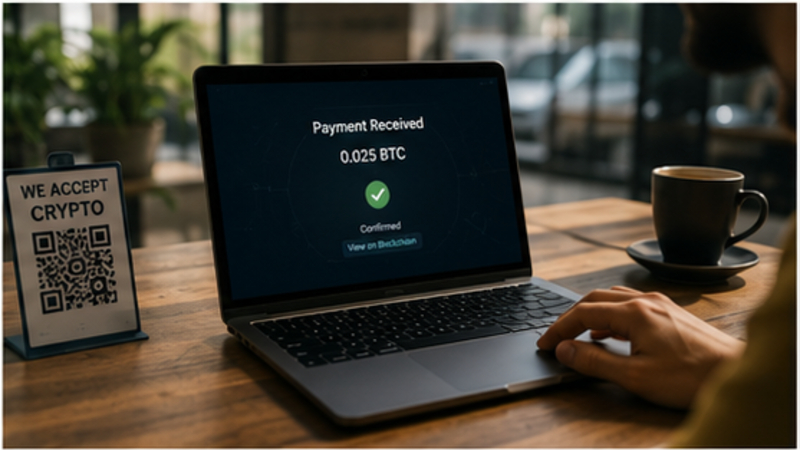
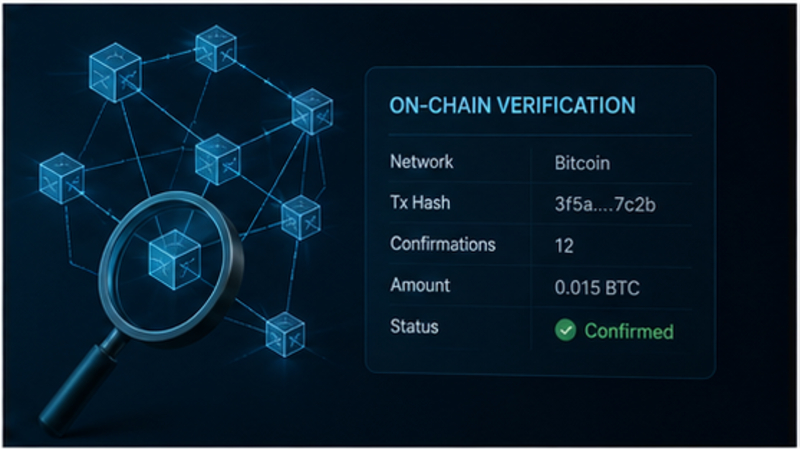
Once transaction data has been collected, businesses should verify that the payment was successfully recorded and confirmed on the blockchain.
Important information to check includes:
- Transaction Hash or TxID.
- Sender wallet address.
- Recipient wallet address.
- Cryptocurrency or token type.
- Transaction amount.
- Transaction timestamp.
- Number of blockchain confirmations.
This verification confirms that the payment exists on the blockchain and has reached the required confirmation status.
Step 3: Compare with Payment System Records
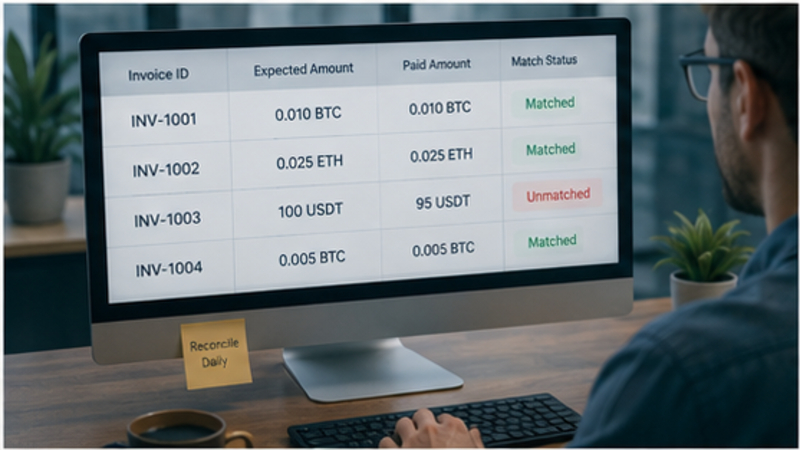
After verifying the blockchain transaction, the next step is to compare it with internal payment, order, or invoice records.
Businesses should check:
- Whether the order has been marked as paid.
- Whether the received amount matches the expected amount.
- Whether duplicate transactions exist.
- Whether completed blockchain payments are still shown as pending internally.
- Whether the payment is linked to the correct invoice or order.
Any discrepancy should be investigated before the transaction is finalized in the financial records.
See more: Crypto Payment Reconciliation Becomes a New Trend in Business Payment Management
Step 4: Convert Crypto Value into Fiat Currency
Because cryptocurrency prices can fluctuate, businesses should determine the fiat value of each payment using a consistent valuation method.
The reconciliation record should include:
- Cryptocurrency amount received.
- Fiat reporting currency, such as USD or EUR.
- Exchange rate used.
- Exchange rate source.
- Transaction or valuation timestamp.
Recording these details provides greater financial transparency and makes future accounting reviews easier.

Step 5: Synchronize with the Accounting System
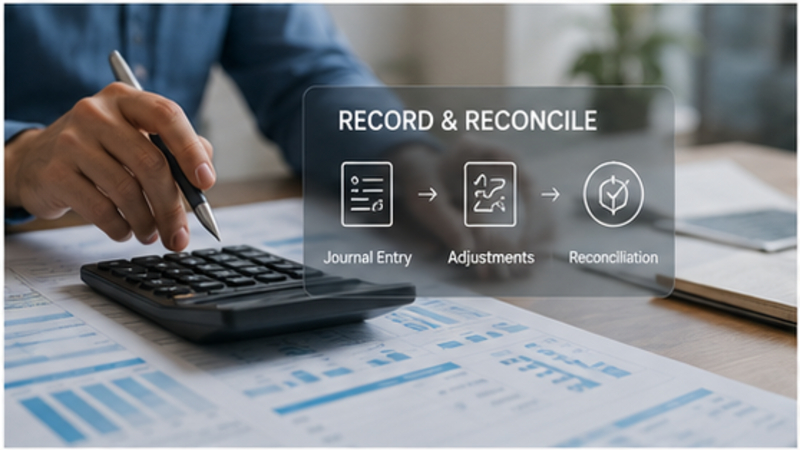
Once the transaction has been verified and valued, the reconciled information should be transferred to the company’s accounting or ERP system.
Relevant data may include:
- Transaction value.
- Blockchain network fees.
- Payment gateway fees.
- Exchange rate differences, where applicable.
- Transaction status.
- Related invoice or order information.
Synchronizing this information helps maintain consistent financial data across blockchain payment platforms and internal accounting systems.
Step 6: Generate Reports and Archive Records
The final step is to generate reconciliation reports and securely retain supporting transaction records for future reference.
Businesses should consider storing:
- Blockchain transaction logs.
- Reconciliation reports.
- Discrepancy resolution records.
- Exchange rate information.
- Payment gateway records.
- Accounting documents.
Proper record retention makes historical transactions easier to retrieve while supporting financial reporting, internal reviews, and future audits.
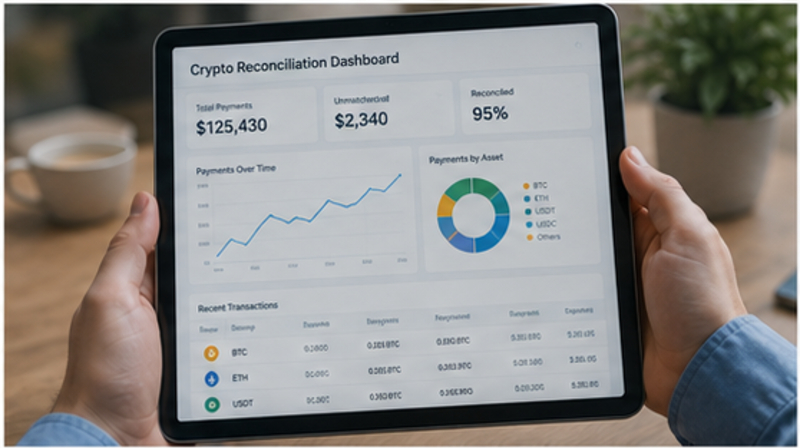
Challenges of Crypto Payment Reconciliation
Although blockchain technology provides greater transaction transparency, crypto payment reconciliation still involves several operational and accounting challenges.
The main challenges include:
- Multiple data sources: Crypto payments may involve blockchain records, wallets, exchanges, payment gateways, and accounting systems. Combining data from multiple platforms manually can increase the risk of errors.
- Constant price volatility: The value of Bitcoin, Ethereum, and other cryptocurrencies can change quickly, making transaction valuation and revenue recognition more complex.
- Different transaction fees: Network fees, gas fees, and payment gateway charges can cause the final amount received to differ from the amount originally sent.
- High transaction volume: Businesses handling large numbers of crypto payments may find manual reconciliation too slow and inefficient.
- Evolving accounting regulations: Rules and accounting guidance for digital assets continue to develop, requiring businesses to regularly review their reconciliation and reporting processes.
Overall, these challenges make automated and standardized reconciliation increasingly important for maintaining accurate records, improving efficiency, and supporting compliance.
Best Practices for Accurate and Efficient Crypto Payment Reconciliation
An effective crypto payment reconciliation process depends not only on technology but also on consistent operational procedures. By standardizing data, reconciling transactions regularly, maintaining complete records, and applying automation, businesses can improve accuracy while reducing manual workload.
Standardize Transaction Data
Using a consistent data structure makes it easier to compare information across blockchain networks, payment gateways, wallets, and accounting systems.
Key transaction information should be standardized, including:
- Transaction ID or TxID.
- Wallet address.
- Cryptocurrency or token type.
- Transaction timestamp.
- Exchange rate.
- Network fee.
- Payment amount.
Standardized data helps reduce mismatches and simplifies integration between different financial systems.
See more: How to Build a USDT Checkout With an API: A Guide to Building a USDT Payment Gateway
Reconcile on a Regular Schedule
Businesses should establish a reconciliation schedule based on transaction volume, payment value, and operational requirements.
Common reconciliation frequencies include:
- Real-time reconciliation: Suitable for high-value or time-sensitive transactions.
- Daily reconciliation: Appropriate for routine crypto payment operations.
- Monthly reconciliation: Useful for financial reporting, accounting reviews, and audit preparation.
A consistent reconciliation schedule helps businesses detect discrepancies earlier and maintain more accurate financial records.
Maintain Complete Transaction Records
Complete documentation is essential for reviewing historical transactions and resolving payment discrepancies.
Businesses should retain records such as:
- Transaction hashes.
- Customer invoices.
- Payment confirmations.
- Reconciliation reports.
- Exchange rate records.
- System and transaction logs.
Maintaining complete records makes future audits, investigations, and financial reviews more efficient.
Automate the Reconciliation Process
Automation can significantly improve reconciliation speed and reduce repetitive manual work, particularly for businesses processing large transaction volumes.
Modern reconciliation platforms can help:
- Synchronize blockchain transaction data.
- Match payments with invoices or orders.
- Detect transaction discrepancies.
- Apply exchange rates automatically.
- Calculate transaction and network fees.
- Generate reconciliation reports.
- Integrate with accounting software.
Automating these tasks helps finance teams save time while reducing the risk of manual data entry errors.
Implement Strong Internal Controls
Clear internal controls help ensure that crypto payment activities are properly monitored and responsibilities are clearly assigned.
Businesses should consider:
- Defining responsibilities for payment and finance teams.
- Establishing approval procedures for unusual transactions.
- Restricting access based on employee roles.
- Regularly reviewing reconciliation results.
- Maintaining clear audit trails for transaction adjustments.
Strong internal controls improve transparency, accountability, and risk management throughout the crypto payment reconciliation process.
Conclusion
Understanding how to reconcile crypto payments is essential for businesses that want to manage cryptocurrency transactions accurately, transparently, and efficiently. A well-designed reconciliation process reduces errors, saves operational time, improves financial reporting, and strengthens compliance as digital asset adoption continues to grow.
If your business is looking for a crypto payment gateway that supports real-time transaction tracking, automated reconciliation, and seamless accounting integration, choosing the right platform can help optimize payment operations and prepare your organization for long-term growth in the digital economy.