KYC vs KYB are two essential verification processes that help ensure regulatory compliance and mitigate risks in the financial and cryptocurrency payment sectors. Although both aim to enhance transparency, KYC vs KYB apply to different entities and involve distinct procedures and requirements. In this article, XAIGATE explores the key differences between KYC vs KYB, the role of each process, and when businesses should implement them to build a secure and reliable payment system.
What Are KYC and KYB?
As regulations surrounding digital payments and cryptocurrencies continue to evolve, businesses must implement effective identity verification procedures to maintain compliance, protect their platforms, and reduce financial risks. Two of the most widely used verification processes are Know Your Customer (KYC) and Know Your Business (KYB).
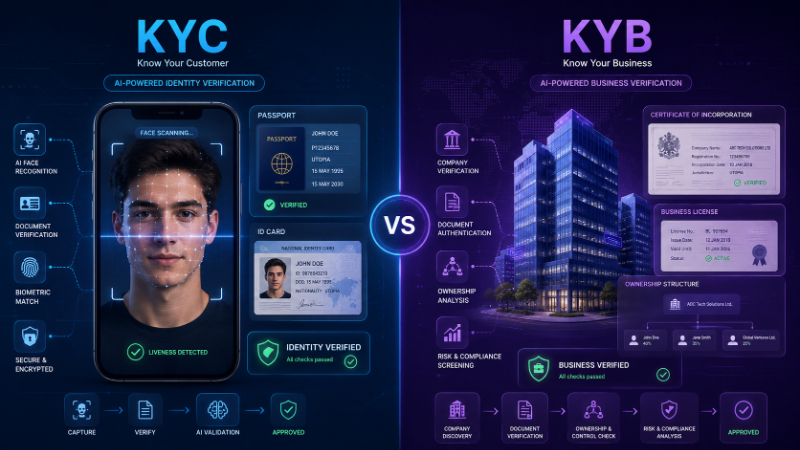
Although KYC vs KYB share the common goal of improving transparency and preventing financial crime, they apply to different types of entities. KYC focuses on verifying individual customers, while KYB is designed to confirm the legitimacy, ownership, and legal status of businesses.

What Is KYC?
KYC, or Know Your Customer, is the process of verifying an individual’s identity before allowing them to access financial services, open an account, or complete transactions. The process helps service providers confirm that customers are genuine and that the information they submit is accurate.
A standard KYC verification process typically requires:
- Full legal name
- Date of birth
- Government-issued identification card or passport
- Proof of residential address
- Selfie or biometric verification
- Contact information, such as an email address or phone number
By verifying these details, financial institutions, cryptocurrency exchanges, fintech platforms, and payment providers can reduce the risks of identity theft, fraud, money laundering, and other illegal financial activities.
What Is KYB?
KYB, or Know Your Business, focuses on verifying companies and other legal entities rather than individual customers. Its purpose is to confirm that a business is legally registered, operates legitimately, and maintains a transparent ownership and management structure.
A typical KYB verification process may involve reviewing:
- Business registration documents
- Certificate of incorporation
- Registered company address
- Tax identification number
- Information about directors and shareholders
- Ultimate Beneficial Owners (UBOs)
- Business licenses or operating permits, where applicable
- The company’s ownership and control structure
KYB is commonly used by banks, payment gateways, fintech companies, cryptocurrency payment providers, and other financial service businesses before onboarding merchants, vendors, or corporate clients. It helps organizations identify potentially fraudulent companies and establish safer, more compliant business relationships.

KYC vs. KYB: A Detailed Comparison
KYC vs KYB are both essential verification processes used to support regulatory compliance, improve transparency, and reduce the risk of financial crime. However, they differ significantly in terms of verification targets, objectives, required documentation, complexity, and practical applications.
The following table highlights the key differences between KYC and KYB:
| Comparison Criteria | KYC — Know Your Customer | KYB — Know Your Business |
| Verification Target | Verifies individual customers. | Verifies companies and other legal business entities. |
| Primary Purpose | Confirms an individual’s identity and helps prevent identity theft, fraud, money laundering, and other illegal activities. | Confirms that a company is legally registered, operates legitimately, and is not being used for financial crime or illicit activities. |
| Required Documentation | Typically requires a passport or national ID, proof of address, and facial or biometric verification. | Typically requires a certificate of incorporation, business licenses, tax documents, shareholder information, UBO declarations, and details of the corporate ownership structure. |
| Verification Complexity | Usually faster and less complex because the process primarily focuses on one individual. | Often more complex and time-consuming because it may involve reviewing ownership chains, corporate structures, beneficial owners, and regulatory records across multiple jurisdictions. |
| Typical Use Cases | Opening personal financial accounts, registering cryptocurrency exchange accounts, and accessing payment or financial services. | Onboarding merchants, establishing corporate payment accounts, integrating cryptocurrency payment gateways, and forming partnerships with financial institutions. |
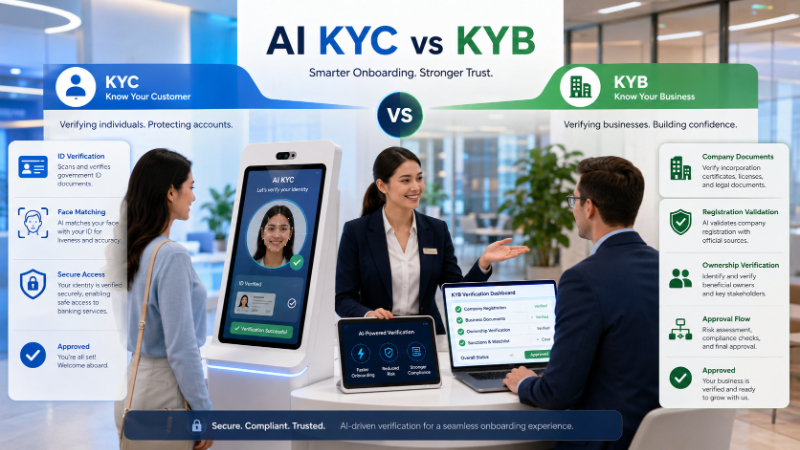
In summary, KYC is designed to verify the identity of individual customers, whereas KYB evaluates the legitimacy, ownership, and compliance status of businesses. Organizations may need to implement one or both processes depending on the type of users, merchants, or corporate partners they serve.

See more: What Is Crypto Payment KYB? Benefits and the KYB Process in Crypto Payments
When Does a Business Need KYC and When Does It Need KYB?
Businesses may need to implement KYC, KYB, or both depending on the type of customers, merchants, and partners they serve. KYC is generally required for individual users, while KYB applies to companies and other legal entities.
Choosing the appropriate verification process helps businesses meet regulatory requirements, reduce fraud, and build a safer financial or cryptocurrency payment ecosystem.
When Is KYC Required?
KYC is required whenever a business provides financial, payment, or cryptocurrency-related services directly to individual users. Before customers can access certain services or complete regulated transactions, they must verify their identity.
KYC is commonly required by:
- Cryptocurrency exchanges
- Digital wallets
- Investment platforms
- Mobile banking applications
- Consumer payment platforms
- Online lending services
- Money transfer providers
In these cases, each customer may need to submit identification documents, proof of address, and biometric information. This process helps the service provider confirm the customer’s identity and detect potentially fraudulent or suspicious activity.
When Is KYB Required?
KYB is necessary when a business works with merchants, corporate clients, vendors, or other legal entities. The process verifies that the organization is legally registered, operates legitimately, and has a transparent ownership structure.
KYB is commonly used for:
- Merchant onboarding
- Business payment processing
- B2B cryptocurrency payment solutions
- Corporate financial services
- Marketplace seller verification
- Business account registration
- Partnerships with financial institutions
Payment providers and financial platforms use KYB before allowing merchants to accept payments or access business services. This helps prevent shell companies, fraudulent organizations, and high-risk entities from entering the payment ecosystem.

When Are Both KYC and KYB Required?
Many fintech companies, banks, and cryptocurrency payment platforms must use both KYC and KYB when onboarding business customers. KYB verifies the legal entity, while KYC verifies the individuals who own, manage, or control that entity.
A combined verification process may include:
- Verifying the company through KYB
- Confirming its registration and business address
- Reviewing its ownership and management structure
- Verifying company directors through KYC
- Identifying and verifying Ultimate Beneficial Owners through KYC
- Screening both the business and related individuals against sanctions or risk databases
For example, when onboarding a merchant, a payment platform may first verify the company’s legal status through KYB and then conduct KYC checks on its directors and Ultimate Beneficial Owners. This combined approach provides stronger compliance controls and more effective risk management.
Why Are Both KYC and KYB Important in Crypto Payments?
Cryptocurrency transactions can be processed quickly and move across borders with fewer geographical restrictions than traditional payment methods. This makes effective identity and business verification essential for maintaining compliance, preventing financial crime, and protecting the integrity of the payment ecosystem.
Implementing both KYC vs KYB helps crypto payment providers achieve several important objectives:
- Support regulatory compliance: Many jurisdictions require cryptocurrency businesses and payment providers to follow Anti-Money Laundering (AML) and Counter-Terrorist Financing (CTF) regulations. KYC verifies individual users, while KYB confirms the legitimacy of merchants and corporate clients, helping businesses meet legal obligations and reduce the risk of regulatory penalties.
- Prevent fraud and financial crime: Verification processes help payment providers detect and reduce risks associated with fake identities, shell companies, account takeovers, money laundering, financial fraud, and other suspicious activities.
- Identify high-risk users and businesses: By reviewing personal identities, corporate records, ownership structures, and Ultimate Beneficial Owners, businesses can identify potentially high-risk customers or merchants before enabling transactions.
- Protect customers and payment providers: Strong verification controls reduce the likelihood of unauthorized transactions, identity theft, fraudulent merchant activity, and misuse of cryptocurrency payment services.
- Build trust across the payment ecosystem: Verified customers and merchants create a safer environment for all participants. Effective KYC and KYB processes can increase confidence among customers, business partners, financial institutions, and regulatory authorities.
- Strengthen business reputation: Crypto payment providers that maintain transparent and reliable compliance procedures are more likely to establish long-term relationships with merchants, banks, and other financial service providers.
Overall, combining KYC vs KYB allows crypto payment businesses to verify both the individuals and legal entities participating in their platforms. This creates a more secure, transparent, and trustworthy payment environment while minimizing legal, financial, and operational risks.
Conclusion
Understanding the differences between KYC vs KYB is essential for any company operating in digital finance or crypto payments. KYC focuses on verifying individuals, while KYB verifies businesses and their ownership structures. Together, they create a comprehensive compliance framework that reduces fraud, supports AML requirements, and builds trust across payment ecosystems.
If your business is planning to integrate a crypto payment solution, implementing both KYC and KYB processes can help ensure secure onboarding, regulatory compliance, and long-term business growth.